Which label withstands the SMT reflow oven at +300 °C?+
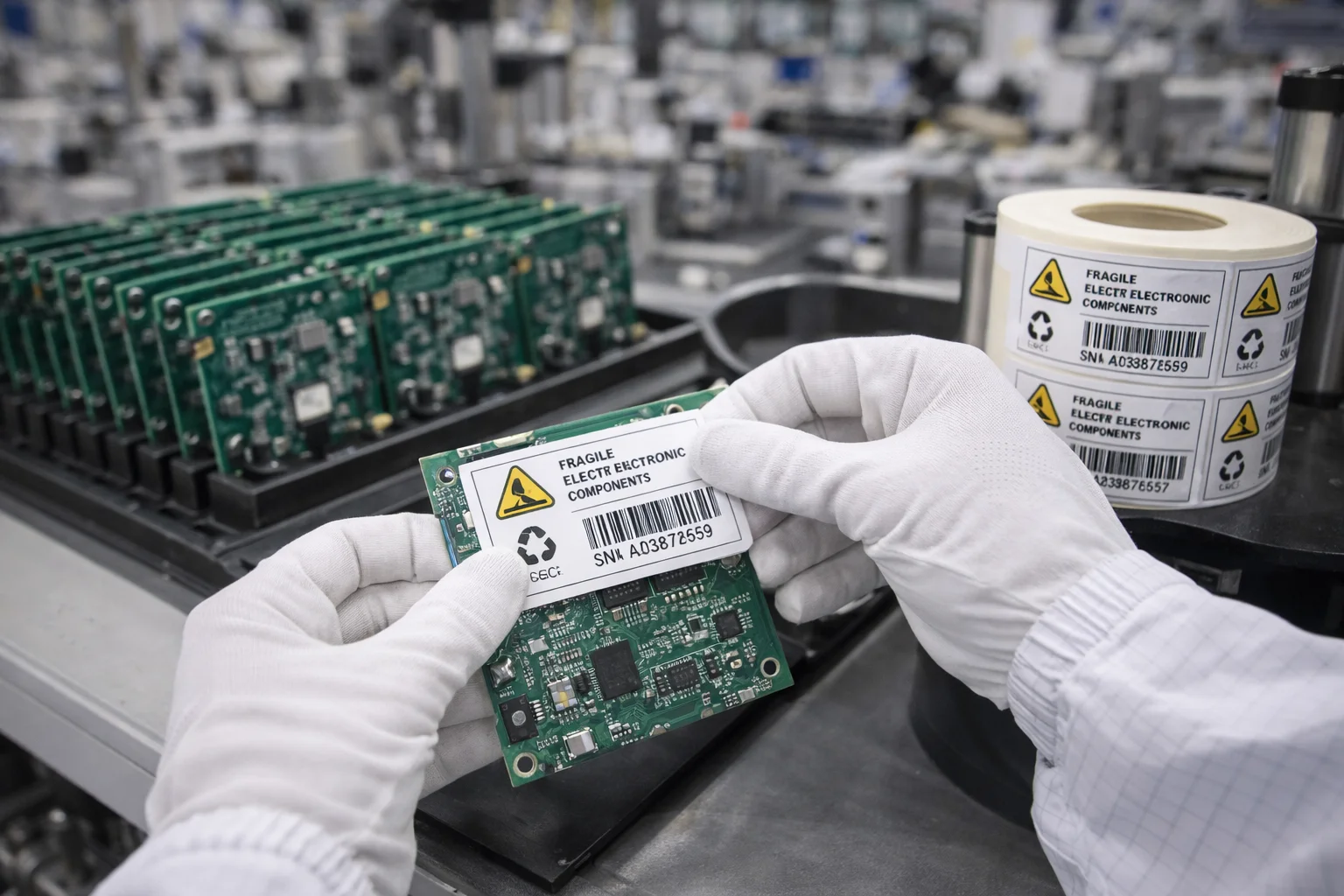
For the reflow soldering process in an SMT oven, high-temperature labels based on polymer materials are used that withstand peaks of up to +300 °C without melting, warping or releasing adhesive. Self-adhesive polyimide Ref. RD-514C is the one for the board itself: it withstands 300 °C for 15 minutes and direct contact with molten solder. The ARGIPRINT° range, which carries no adhesive and is fixed mechanically, covers the racks and carriers that pass through the same oven. It is necessary to validate the customer's oven thermal profile to confirm compatibility.
What is an ESD label and when is it needed?+
An ESD label is a label with dissipative or conductive properties that does not generate or accumulate electrostatic charge when handled. It is needed in electronics manufacturing environments where ESD-sensitive components (MOSFETs, CMOS, microchips) can be irreversibly damaged by an electrostatic discharge. Surface resistance requirements are defined by the ANSI/ESD S20.20 standard.
Do PCB labels withstand cleaning with IPA and solvents?+
Yes, with the right material and ribbon. Ultrasonic cleaning with isopropanol (IPA) or acetone is a common process in electronics manufacturing. Polyester labels with resin ribbon are the most resistant to these solvents: the material does not dissolve or deform, and the print does not smear. Tell us the specific solvent so we can validate the compatibility of the material-and-ink combination.
Can you supply labels in very small formats for microcomponents?+
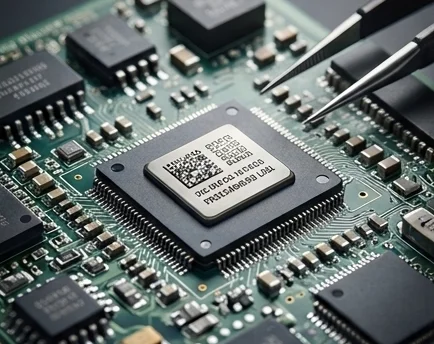
Yes. We supply labels from 6×6 mm with a DataMatrix or QR code readable by machine vision. At these sizes, code density, print contrast and dimensional tolerance are critical. The printing process must be calibrated to ensure the DataMatrix is readable on the customer's reading equipment.
What RoHS regulation applies to electronics labels?+
The RoHS Directive restricts the use of certain hazardous substances in electrical and electronic equipment. Applied to labels, this means the material, adhesive and ink must not contain lead, mercury, cadmium, hexavalent chromium, PBDE or PBB above the established thresholds. We have a RoHS declaration of conformity available for the materials most commonly used in electronics.
What label is used for warranty and tamper control on electronic equipment?+
To provide evidence that a unit has been opened or tampered with without authorisation, tamper-evident (VOID) labels are used with destructible adhesive or a security layer that leaves a visible message when removed. They are common on warranted equipment, high-value assets, batteries and control modules. The choice of material and adhesive depends on the surface type and the level of security required.
Can you send a sample before production?+
Yes. In electronics, where process conditions are very specific — oven thermal profile, cleaning solvent, ESD environment, code format — validating the solution with a sample before production is necessary. Tell us the process, the component or board, the label dimensions and the regulatory requirements so we can prepare the right sample.