Application: identification outdoors
Labels for outdoor use
Outdoor labels: resist UV, rain and hot-and-cold cycles for years
We supply resistant self-adhesive outdoor labels in polyester and polypropylene: they withstand UV radiation, rain and thermal cycling from −40 °C to +150 °C without losing adhesion or readability, lasting 3 to 10 years depending on the environment. For marine salinity or extreme UV, we validate the construction with a sample beforehand. We have supplied outdoor identification to industrial customers across Spain and the whole of Europe since 1994.
Durability
3–10 years depending on environment
UV
High resistance
Temperature (PET)
−40 °C to +150 °C
Adhesive
High-tack acrylic
Where these labels are used
- Identification of equipment, machinery and industrial assets outdoors.
- Inventory labels for outdoor installations and solar panels.
- Signage for pipework, cables and equipment bases outdoors.
- Asset marking in agriculture, civil works and infrastructure.
- Barcodes that stay readable after years of direct sunlight.
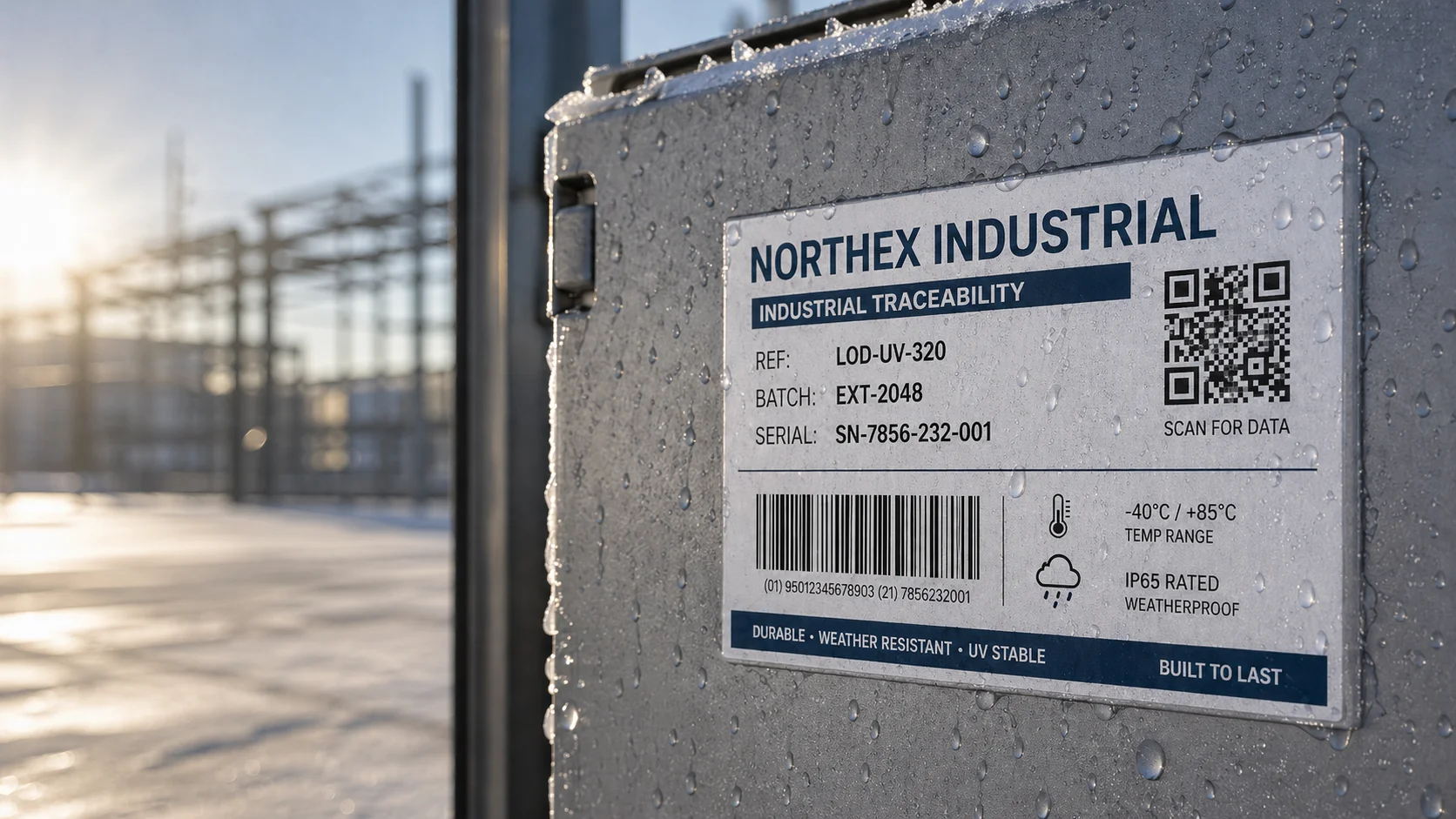
What determines outdoor durability
- Face material: UV-treated polyester or polypropylene, not paper; paper degrades within weeks in moisture and direct sunlight.
- Adhesive: high-performance acrylic formulated for rough surfaces, heat and temperature variations.
- Printing: resin ribbon for weather resistance; wax ink rubs off with moisture and friction.
Face material
Polyester or PP
Printing
Resin ribbon
Water resistance
Total
Min. application
From −20 °C (PP) / −40 °C (PET)
The problem
Why standard labels fail outdoors
Sunlight contains ultraviolet radiation that destroys inks and degrades polymers. A paper label fades within weeks. A standard polypropylene one lasts longer, but the ink can also deteriorate if the ribbon is not right for outdoor use.
Adhesive is the other critical point. General-purpose acrylic adhesives perform well indoors, but outdoors they are subjected to cycles of heat (expansion) and cold (contraction) that eventually crack the material or lift the edges. Rough surfaces such as wood, painted metal or textured plastic need adhesives with high initial tack.
Rain and condensation are not the main problem — plastics are waterproof — but they are a problem if the adhesive is not properly formulated: moisture can seep in at the edges and degrade adhesion over the long term.
Polyester, with the right adhesive and ribbon, is the reference material when outdoor durability is critical.
Technical requirements
What an outdoor label must meet
- Plastic face material: polyester or polypropylene. No paper withstands continuous outdoor exposure.
- UV-resistant ink or ribbon: in thermal transfer, resin ribbon is necessary so the print does not degrade.
- Outdoor acrylic adhesive: formulated to withstand wide thermal cycling and maintain adhesion on painted, galvanised or plastic surfaces.
- Quality release liner: a low-quality liner can absorb moisture and make it harder to release cleanly on automated application lines.
Recommended materials
Face materials validated for outdoor use
Maximum UV, thermal and mechanical resistance. The reference material when durability is critical. Range -40 °C to +150 °C.
Suitable for moderate outdoor use (without intense direct sunlight). More economical. Range -20 °C to +80 °C.
The choice between polyester and polypropylene depends on the intensity and duration of sun exposure, the application surface and the budget. We will advise you with no obligation.
Common sectors
Wood, metalworking, logistics and automotive are the sectors where these labels are most commonly used.
See sector details ↓What commonly goes wrong
Common mistakes when choosing outdoor labels
Mistake 01
Using laminated paper as an outdoor solution
Surface lamination delays paper degradation under rain, but does not prevent it. Within 6-12 months outdoors, the paper under the laminate degrades, the ink loses adhesion and the adhesive fails. For permanent outdoor use, the face material must be plastic (PP or polyester), not coated paper.
Mistake 02
Printing with wax ribbon on weatherproof labels
Wax ribbon is not formulated for outdoor exposure: rain, heat and UV radiation degrade the print in a short time. For outdoor use, resin ribbon is the standard: the print anchors firmly to the face material and resists continuous exposure. A high-quality wax-resin ribbon can also work in moderate conditions; tell us the conditions if you are unsure which applies to your case.
Mistake 03
Not considering the application temperature in the field
Applying a label to outdoor assets in winter, with the surface at 0 °C or below, using a standard acrylic adhesive that needs at least +10 °C to activate. The result is a label that looks stuck down but falls off as soon as it rains or frosts. Adhesive rated for a low minimum application temperature is needed, or applying the label in the workshop before the asset is installed outdoors.
Mistake 04
Not specifying the required working life
A polypropylene label may be enough for 1-2 years in a moderate outdoor environment, but insufficient for 5+ years in a marine or heavy industrial environment. Polyester with UV adhesive and resin ribbon is the long-duration option. Specifying the expected working life allows the material to be sized correctly without incurring unnecessary costs.
How to choose
Recommended material by durability and outdoor environment
| Scenario | Required life | Face material | Adhesive | |
|---|---|---|---|---|
| Moderate outdoor, temperate climate | 1–2 years | Polypropylene | Permanent acrylic | |
| Aggressive outdoor, thermal cycling | 3–5 years | Polyester | Permanent UV acrylic | |
| Industrial or marine environment | 5+ years | Reinforced polyester | High-resistance acrylic | |
| Outdoor asset identification | Indefinite | Aluminium / Polyester | Structural acrylic |
In all cases, resin ribbon is recommended to guarantee the UV resistance of the print.
By industry
Sectors where these labels are most used
Sector
Wood industry
Labelling of boards, profiles and sawn timber stored outdoors before processing.
See sector →Sector
Metals and steel
Identification of coils, profiles and metal structures stored outdoors.
See sector →Sector
Logistics and warehousing
Pallets and containers travelling outdoors during transport or waiting outdoors in a storage yard.
See sector →Sector
Automotive
Identification of vehicles, chassis and components exposed outdoors in vehicle storage yards.
See sector →Frequently asked questions
Common questions about outdoor labels
How long does a polyester label last outdoors?+
With the right combination of face material, adhesive and ribbon, a polyester label can last more than 5 years outdoors in temperate climate conditions and moderate UV exposure. For environments with high UV radiation, marine salinity or extreme thermal cycling, working life depends on the specific construction and requires validation.
Does rain affect adhesion once the label has been applied?+
A label correctly applied to a clean, dry surface withstands rain without any problem. Permanent acrylic adhesive does not dissolve in water. The risk lies in the initial application: if the surface is wet or dirty when the label is applied, the adhesive does not wet the surface properly and subsequent rain ends up lifting it off.
Is hot-melt adhesive suitable for outdoor labels?+
Hot-melt adhesive is common in indoor industrial labelling, but has limitations outdoors: it softens with heat, yellows with UV radiation and loses adhesion in humid environments over the long term. For short-duration applications — less than 6-12 months — or without intense direct sunlight, it can be a viable option. For longer durations or aggressive conditions, permanent acrylic adhesive is the right choice.
Is polypropylene enough, or is polyester better for outdoor use?+
For short-duration outdoor use (up to 2 years, temperate climate), PP can be enough. For long durations, intense UV exposure or aggressive conditions, polyester is clearly superior: more mechanically resistant, more dimensionally stable and better performing against UV and temperature. If in doubt, polyester is the safer choice.
Can outdoor labels be printed with an office printer?+
Office printing (laser or inkjet) on outdoor labels is not suitable for real outdoor use: the ink or toner degrades quickly in rain and UV. For outdoor use, the recommended technology is thermal transfer with a resin ribbon, which produces a print integrated into the plastic face material and resistant to the weather.
Do these labels work for outdoor barcodes?+
Yes. Polyester labels with resin ribbon are compatible with standard thermal transfer printers (Zebra, Honeywell, SATO, Cab, TSC, Toshiba TEC, among others) and produce high-density barcodes that scanners can read even after prolonged outdoor exposure. Unlike paper, the plastic face material does not warp or ripple with moisture, which keeps the code's geometry intact.
Do outdoor labels resist extreme cold or heat?+
Outdoor polyester resists from −40 °C to +150 °C in continuous service; polypropylene, from −20 °C to +80 °C. The key is the adhesive: for high temperature, a high-performance acrylic is used; for extreme cold, one formulated for good flow at low temperatures. For severe thermal cycling or borderline conditions, the safest approach is to validate with a sample before ordering.
Can you send a sample before production?+
Yes. Before any production run, we can send a sample of the selected material so you can validate how it behaves in your real application. This is the standard step when there are special conditions — temperature, moisture, chemicals, a difficult surface — that are worth confirming before committing to an order.
For technical profiles
Properties of polyester (PET) material
Data sheets, UV durability ranges and adhesive specifications
Contact
Need labels for outdoor use?
Tell us about the surface, sun exposure and typical weather conditions. We will advise you on the most suitable material and adhesive.
- Free, no-obligation technical advice.
- Response within 24 hours.
- Material testing available.