Lit-Off Desarrollo

Industrial sector

Labels for the automotive industry

Labels for automotive: withstand oil, solvents and extreme temperatures

We supply resistant self-adhesive labels for automotive: they withstand oil, grease, cleaning solvents, brake fluid and thermal processes up to +200 °C while staying legible, with VDA 4902 and AIAG formats for Tier-1 suppliers and UL-certified references. Identification for components, work-in-progress parts and shipping across the automotive supply chain. We have supplied the automotive industry across Spain and Europe since 1994.

Temperature

−40 °C to +200 °C

Standard

VDA 4902 · AIAG

Resistance

Oils · Solvents

Reading

1D and 2D codes

Main applications

  • Component traceability on assembly lines.
  • Identification of parts in the engine bay and high-temperature areas.
  • VDA 4902 shipping labels for Tier 1 and Tier 2 suppliers.
  • Identification plates on the body and vehicle documentation.
  • Safety and tamper-evident labels on critical parts.
Industrial labels for the automotive sector

Common materials in automotive

  • Polyester: the standard material for component traceability and shipping.
  • High temperature (ARGIPRINT°): for engine areas and thermal treatments.
  • Tamper-evident (Void): for critical parts with a safety requirement.

Need technical guidance?

Tell us the surface, the environment of use and whether specific customer regulations (CSR) apply. We will guide you in choosing the material from the first contact.

Ask about materials for automotive →

Environment and technical requirements

Conditions of use in automotive

In automotive, labels face conditions that don't occur in office settings or standard warehouses. Choosing the wrong material or adhesive has direct consequences for traceability and for meeting customer requirements.

Common conditions of use

  • Service temperatures from −40 °C to +150 °C, with peaks of +200 °C in engine areas or heat treatment.
  • Exposure to hydraulic fluids, fuel, solvents and brake fluid, often combined with pressure washing cycles.
  • Oily, galvanised, anti-rust treated surfaces or vulcanised rubber that make conventional adhesion difficult.
  • Traceability labels that must last the component's entire service life, from the assembly line to the vehicle's end of life.

Technical requirements and regulations

  • VDA 4902 (European) and AIAG (American) formats for shipping labels in Tier 1 and Tier 2 supply chains.
  • High-reliability reading of 1D and 2D barcodes (DataMatrix, QR) after exposure to temperature, chemicals or abrasion.
  • Adhesives that keep their adhesion after wash cycles with solvent and pressure water, with no lifting or loss of legibility.
  • Complete component traceability: assembly, service, maintenance and end-of-life. The label cannot fail at any of these stages.
In automotive there's no single solution. The right material and adhesive depend on the area of the vehicle, the customer's manufacturing process and their regulatory requirements. We review each case before recommending.
Labelling applications in the automotive sector

Where our labels are used

From identifying the component at the point of manufacture to reading the code at the end of the supply chain, the label is the thread that runs through traceability in automotive.

Specific applications

Where our labels are used

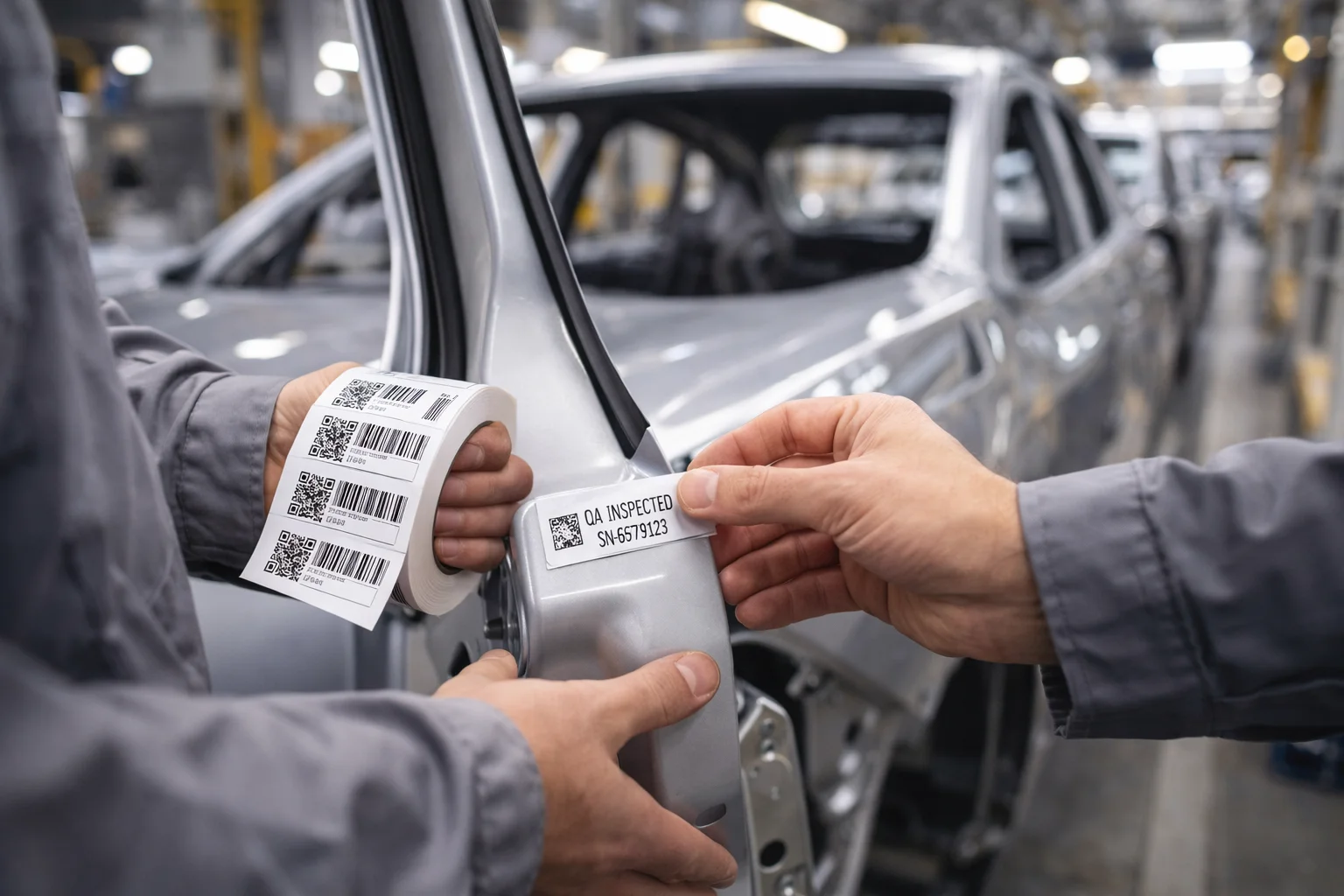
Component traceability on the assembly line

Permanent identification of parts from the start of production. The label must stay intact during transport, storage and the assembly process, with the code readable by scanner at every stage.

Polyester · Permanent acrylic adhesive

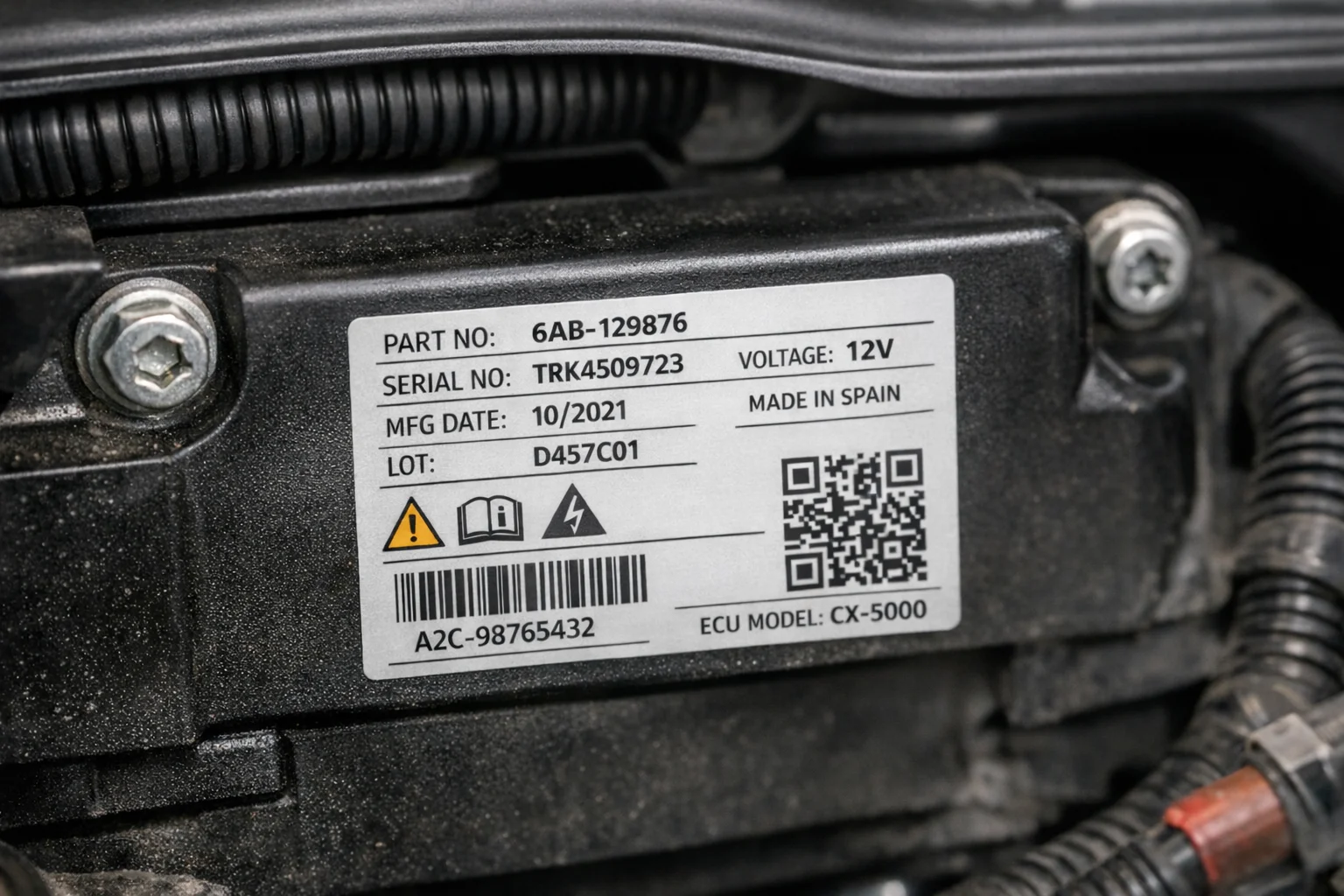
Identification in engine areas and under the bonnet

Service temperatures in the engine area regularly exceed +150 °C. For these applications we use labels from the ARGIPRINT° range, adhesive-free, with adapted mechanical fixing systems.

High temperature (ARGIPRINT°) · Adhesive-free

VDA 4902 / AIAG shipping labels

Major car manufacturers require standardised labelling formats from their suppliers. We supply labels in VDA 4902 format for the European market and in AIAG format for supply chains with a presence in the American market.

Polyester · Custom VDA / AIAG format

Safety and tamper-evidence on critical parts

Void labels that reveal any attempt at removal or substitution on safety components. Used in critical assemblies where the part's integrity must be documented.

Void tamper-evident · Evidence of opening

Recommended materials

Three materials to cover every area

In automotive there's no single material valid for the whole vehicle. The choice depends on the service temperature, the aggressiveness of the chemical environment, and whether the part requires an integrity guarantee.

01

Main material

Polyester

The standard material for component traceability, shipping and part marking. Resists oils, solvents, temperature up to +150 °C and wash cycles without losing adhesion or code legibility.

  • Range: −40 °C to +150 °C.
  • High chemical and abrasion resistance.
  • Thermal transfer printing (resin ribbon).
  • Matt white, gloss, silver or clear.
02

Identification plate · Adhesive-free

High temperature ARGIPRINT° range

For areas where polyester doesn't meet the demands: continuous service temperatures above +150 °C, oven paint treatments, galvanising or casting. The ARGIPRINT° range carries no adhesive; fixing is mechanical.

  • Up to +500 °C depending on construction.
  • Adhesive-free — mechanical fixing systems.
  • Resistant to oils, fluids and aggressive chemicals.
  • Permanent marking by laser or engraving.
03

Critical parts

Tamper-evident Void / Safety

Labels that reveal any attempt at removal: when peeled off they leave a visible “VOID” text pattern on the substrate or on the label itself. Used in critical assemblies where the component's integrity is made evident.

  • Evidence of opening or tampering.
  • Cannot be transferred without visible destruction.
  • Compatible with barcode printing.
  • Applies to metal, plastic and glass.

Sector needs and processes

Common applications in automotive

In automotive, the label lives alongside fluids, extreme heat and long life cycles. The choice depends on the area of the vehicle, the manufacturing process and the customer's regulations. These are the most common needs.

Application

Fluid- and chemical-resistant labels

Solutions for components exposed to engine oils, hydraulic fluids, fuel, solvents and cleaning agents. Chemical resistance must be maintained throughout the component's service life.

  • Tested resistance to common oils, fuels and solvents.
  • Adhesion on oily or galvanised surfaces.

Application

Labels for high temperatures

Applications in engine, exhaust, brake and transmission areas where thermal cycles demand a material that doesn't degrade or release adhesive. The peak temperature and exposure time determine the solution.

  • Up to +200 °C at process peaks; in continuous service, up to +150 °C.
  • Validation against the component's real thermal profile.

Application

Traceability and barcodes (VDA)

Identification of components and subassemblies during manufacturing, logistics and warranty. Includes labels in VDA 4902, GS1-128 and DataMatrix format for exchange with OEMs and Tier 1.

  • VDA 4902 and GS1-128 formats compatible with EDI systems.
  • Reliable legibility after assembly, painting and transport.

Regulations and standard formats

Sector technical requirements

The automotive sector is governed by labelling standards that determine the format, content and printing method. Failing to meet customer requirements can mean whole shipments being returned.

VDA 4902

European standard

A shipping label format developed by the VDA association for European automotive supply chains. Mandatory for most Tier 1 and Tier 2 suppliers to German, French and Italian manufacturers.

  • Standardised data fields (part number, quantity, supplier, batch).
  • Code 128 or 2D barcode in a defined position.
  • Standardised label sizes by packaging type.

AIAG

American standard

The Automotive Industry Action Group standard, mandatory for suppliers to North American automotive manufacturers (GM, Ford, Stellantis) and for global supply chains with a presence in the US market.

  • B-10 format and AIAG container label.
  • Common use of PDF-417 and DataMatrix codes.
  • OEM-specific fields: part number, revision, UPN.

Post-process legibility

Critical requirement

The label must keep the code legible after going through the customer's manufacturing processes: washing, phosphating, painting, curing, assembly or prolonged storage. Prior verification with a sample is mandatory on new projects.

  • Legibility testing with an industrial scanner (grade A/B).
  • Process simulation before launching production.
  • Resin ribbon for maximum durability of the printed code.

Difficult surfaces

Adhesive selection

The most common surfaces in automotive — galvanised metal, untreated PP plastic, rubber, oily surfaces — require specific adhesives with high initial tack and anchoring ability without prior treatment.

  • High-performance adhesive for low surface energy.
  • Special formulations for oily surfaces.
  • Validation with a sample on the customer's real surface.

Frequently asked questions

Common questions about labels for automotive

Answers to the most frequently asked questions before requesting a sample or quote for an automotive project.

Which material is best suited for labels in engine areas?+

For engine areas with continuous temperatures above +150 °C, the solution is the ARGIPRINT° range. For all other applications — component traceability, shipping and marking parts in less exposed areas — polyester with a high-performance adhesive is the standard material.

Do self-adhesive labels withstand solvent washing?+

Yes, with the right material and adhesive. Polyester with a permanent acrylic or high-performance adhesive keeps its adhesion and code legibility after washing cycles with aliphatic solvents, isopropanol and pressure water. To validate resistance in the customer's specific process, it's standard practice to run a sample trial before production.

Can you prepare labels in VDA 4902 format?+

Yes. We supply shipping labels in VDA 4902 format for European automotive supply chains, as well as in AIAG format for suppliers with relationships with North American manufacturers. Tell us the specific format, the size and whether the end customer has a template, and we will guide you correctly.

Which adhesive is used on oily or galvanised surfaces?+

Oily surfaces require a high-performance adhesive with high initial tack, able to penetrate the oil film and create a stable anchor. Galvanised surfaces are usually compatible with standard permanent acrylic adhesive, although contamination or special coatings can also call for high-performance adhesives. In all cases involving non-standard surfaces, we validate with a sample before production.

Can self-adhesive labels be used on outdoor-exposed body plastics?+

Yes. For outdoor body plastics we use polyester labels with a permanent acrylic adhesive resistant to UV, rain and temperature changes. For low-surface-energy substrates such as untreated PP or PE, a high-performance adhesive is recommended. In some cases prior surface treatment with a primer or flame treatment may be needed.

Can you send a sample before production?+

Yes. In automotive, where conditions of use are especially demanding and surfaces highly varied, it's standard and recommended practice to validate the material and adhesive with a sample before launching production. Tell us the surface, the environment and whether specific customer regulations (CSR) apply, and we will prepare a sample suited to your application.

How long does the adhesive take to cure on painted or galvanised surfaces?+

Permanent acrylic adhesive on painted or galvanised surfaces reaches its maximum strength between 24 and 72 hours at room temperature. During that period peel resistance builds up progressively. On galvanised zinc we recommend cleaning the area before applying and confirming with a prior sample.
Contact

Need a solution?

Tell us the surface, the area of the vehicle, the process the label will go through and whether the end customer has specific regulations. We will guide you in choosing the right material from the first contact.

  • No-obligation technical advice.
  • Reply within 24 hours.
  • Material samples for prior validation.
  • Supply in VDA 4902 and AIAG formats.
Please enter your company name.
Please enter your name.
Enter a valid email address.
Please write your message.
You must accept the privacy policy to continue.