Application: cold chain and identification in wet conditions
Labels for cold and moisture
Cold chain, frozen and moisture labels: applied wet without lifting from condensation
We supply self-adhesive labels resistant to moisture and the cold chain: adhesives that apply from 0 °C — and down to −10 °C in specific references — onto cold or wet surfaces, work down to −40 °C in service — and down to −196 °C with cryogenic adhesive — and keep their adhesion when the product moves from the cold room to room temperature and condensation forms. We have supplied cold labelling to the food and logistics industry across Spain and Europe since 1994.
Temperature
−40 °C to +80 °C
Adhesive
Cryogenic
Face material
PP · PET
Application
On wet or condensed surfaces
Where these labels are used
- Identification of trays, boxes and pallets in cold rooms.
- Labels for products that generate condensation when leaving the cold.
- Marking of packaging on lines with washing and wet disinfection.
- Traceability in frozen goods: face material and adhesive validated for continuous contact.
- Application on condensed or wet surfaces on the production line.
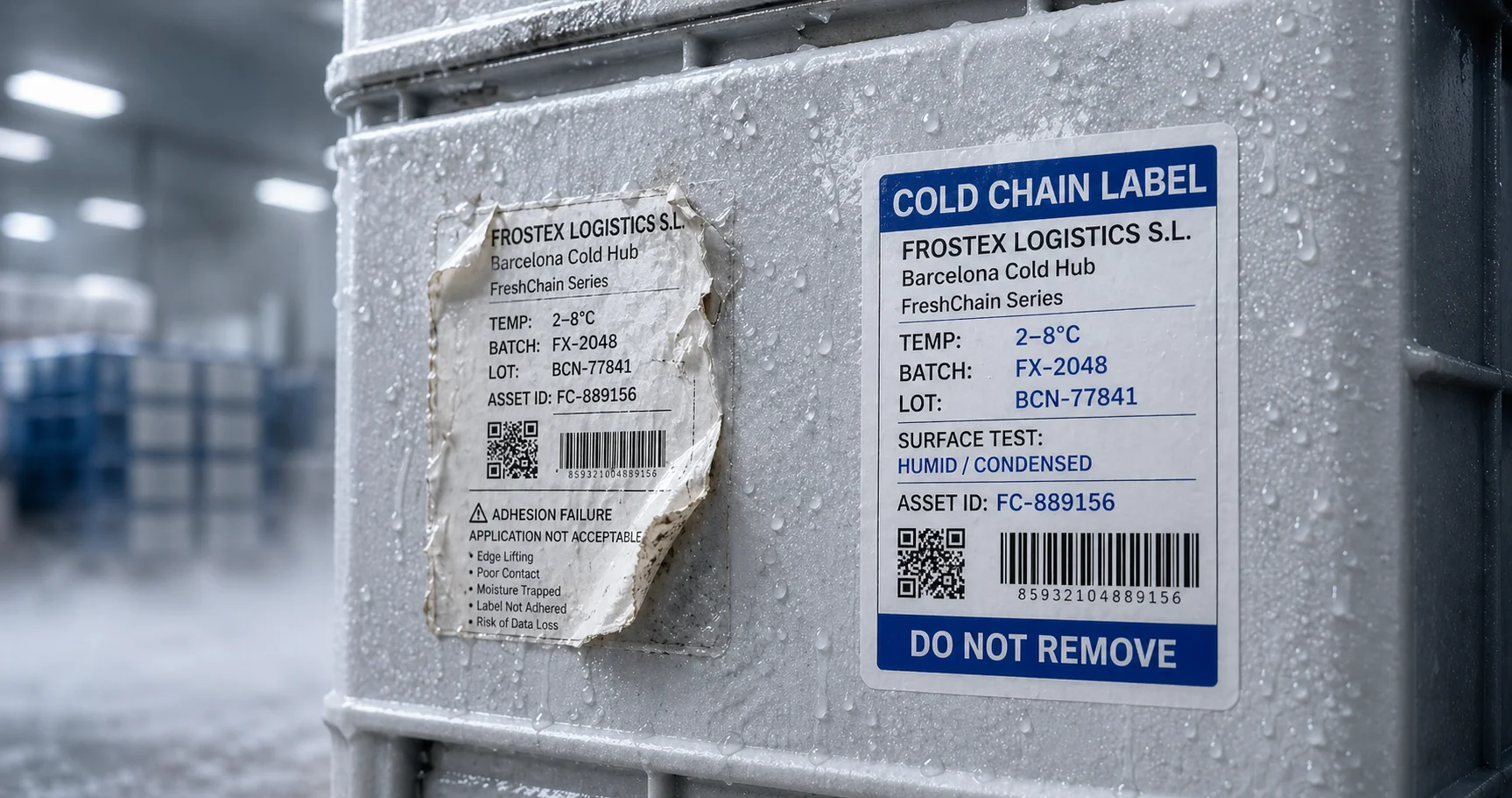
What determines performance in cold and moisture
- Cryogenic adhesive: formulated to keep bond strength at sub-zero temperature and on wet or condensed surfaces.
- Plastic face material: polypropylene or polyester do not absorb water, unlike paper, which soaks through and loses mechanical strength.
- Application temperature: some adhesives require a minimum of −5 °C or −10 °C; below that, only ultra-low-temperature adhesives.
Hot-cold cycles
Supported
Cold application
Down to -10 °C
Water resistance
Total
Printing
Resin ribbon
The problem
Why standard labels fail in cold and moisture
Conventional adhesives (hot-melt or general-purpose acrylics) are formulated to be applied at room temperature on dry surfaces. Below 5 °C, the adhesive's viscosity increases and the initial tack is not enough. In a cold room, the label can lift off during storage.
Condensation is the other classic problem. When a product leaves the cold room and enters a warmer environment, the surface becomes covered in droplets of water. If the label is applied at that moment — or if the product already had condensation in the cold room — the adhesive cannot make real contact with the substrate.
The face material matters too: paper absorbs moisture, warps and loses stiffness. The barcode can stop being readable before it even reaches the in-line reader. A plastic face material (polypropylene or polyester) is waterproof and keeps its dimensions at any level of humidity.
How low-temperature adhesive works
The key is the adhesive, not just the face material
- Adhesives formulated for low temperature: the water-based acrylic of Ref. A10 keeps its flow and initial tack when applied from −10 °C; the hot-melt of Ref. RH9, applicable from 0 °C, then resists storage down to −40 °C continuously.
- Resistance to temperature cycling: the adhesive withstands hot-cold cycles without losing adhesion. A label applied in the cold room withstands the transition to room temperature without lifting off.
- Waterproof face material: white or clear polypropylene, or polyester for higher demands. Neither absorbs moisture nor warps with water.
- Print stable in moisture: with resin ribbon, the ink does not rub off on contact with water or with an operator's wet hands.
Recommended materials
For every level of demand
Waterproof, flexible and economical. Ideal for cold logistics, chilled packaging and cold rooms at 0–8 °C. With cryogenic adhesive, also for deep freeze.
When there are also additional chemical or mechanical resistance requirements. Range up to +150 °C on the hot side.
Common sectors
Food, cold-chain logistics and pharmaceuticals are the sectors with the highest demand for cold and moisture labelling.
See sector details ↓Real-world scenarios
Recommended material and adhesive by level of low temperature and moisture
The low-temperature range and the type of surface completely shape the choice. Labelling in a cold room at +4 °C is not the same as in a freezing tunnel at -30 °C, and applying to dry plastic is not the same as applying to wet metal.
| Scenario | Application temp. | Service temp. | Face material | Adhesive |
|---|---|---|---|---|
| Chilled cold room | +2 to +8 °C | 0 to +8 °C | PP | Cold-rated acrylic |
| Deep freeze / tunnel | 0 to -10 °C | -18 to -25 °C | PPCryogenic | Cryogenic adhesive |
| Ultra-freeze / laboratory | Room temperature | -80 °C or lower | PolyesterCryogenic | Extreme cryogenic adhesive |
| Damp or wet surfaces | Variable | Variable | PPPolyester | Adhesive for wet surfaces |
| Hot-cold cycles (thawing) | Room temperature | -20 to +30 °C | PPFlexible | Thermal-cycle adhesive |
What commonly goes wrong
Common mistakes in cold chain labelling
Mistake 01
Applying the label once the surface is already cold
The adhesive needs a minimum activation temperature to flow and bond properly to the surface. If it is applied with the product already at -5 °C, the adhesive does not flow and the label lifts off within minutes or on the first condensation cycle. The label should always be applied before the product enters the cold room, or with adhesives specifically formulated for cold application.
Mistake 02
Using direct thermal paper in a cold room
Direct thermal paper is sensitive to temperature and moisture. In a cold room, the combination of cold and condensation damages the heat-sensitive coating and the print becomes illegible within hours. For cold environments, plastic materials (PP or polyester) are used with thermal transfer printing and resin ribbon.
Mistake 03
Not accounting for thawing cycles
A product that goes from deep freeze to room temperature and back to the cold generates thermal cycles that stress the adhesive. Not all cold adhesives handle those cycles well. A thermal-cycle adhesive keeps its adhesion through both phases without the label lifting off or bubbling.
Mistake 04
Confusing "water resistant" with "cold-rated adhesive"
Standard polypropylene resists water, but its adhesive can fail at -5 °C. The face material and the cryogenic adhesive are two different things: the face material stops moisture from degrading the material, but the adhesive is what determines whether the label stays stuck at low temperatures.
By industry
Sectors where these labels are most used
Sector
Food
Cold rooms, cold packaging lines and frozen products.
See sector →Sector
Logistics and warehousing
Labelling of pallets and boxes moving through cold-storage warehouses and distribution cold rooms.
See sector →Sector
Pharmaceuticals and laboratory
Biological samples, reagents and vials stored at -80 °C or in liquid nitrogen.
See sector →Sector
Electronics
Components stored in controlled humidity and temperature environments to prevent degradation.
See sector →Frequently asked questions
Common questions about cold and moisture labels
Down to what temperature does a cryogenic adhesive work?+
It depends on the formulation. Standard cryogenic adhesives work down to -40 °C or -60 °C. For laboratory applications with liquid nitrogen or ultra-freezing (-80 °C to -196 °C), specific formulations exist. When ordering, you need to state the minimum operating temperature so the right construction can be selected.
Is it possible to apply the label once the product is already frozen?+
Not with a standard adhesive. The adhesive needs a minimum temperature to activate and bond properly to the surface. With adhesives formulated for cold application it is possible to apply down to -10 °C or even lower, but there is always a limit. It is standard practice to apply the label before the product enters the freezing tunnel. Tell us the conditions if you need to label a product that is already frozen.
Is a standard plastic face material enough for the cold chain, or is something more needed?+
PP face material does withstand cold room temperatures. The critical point is the adhesive: standard PP adhesive can fail below -5 °C. For sub-zero cold chain, PP with cryogenic adhesive is needed. For positive cold (0 to +8 °C), PP with standard cold-rated adhesive is usually enough.
Does condensation affect adhesion?+
Yes. When a cold product leaves the cold room for a warmer environment, condensation forms on the surface. If the label is not already well adhered before that point, the film of water stops the adhesive from bonding. Cold labels are ideally applied to a dry, cold surface, not one that has already condensed.
What happens to printing in humid environments?+
The plastic face material (PP or polyester) protects against moisture, but the print also needs to be resistant. With wax ribbon, the ink can smudge when it gets wet. With resin ribbon, the print anchors to the face material and stands up well to moisture. For labels in cold rooms or at risk of contact with water, resin ribbon is always recommended.
Can the label be applied directly onto ice or frost?+
Not directly onto frost. The surface can be cold and wet, but should not have a layer of ice or loose frost, which acts as a barrier between the adhesive and the substrate. Cryogenic adhesives are formulated to bond to wet surfaces at sub-zero temperature, but if there is frost, it needs to be cleaned off before application.
Can you send a sample before production?+
Yes. Before any production run, we can send a sample of the selected material so you can validate how it behaves in your real application. This is the standard step when there are special conditions — temperature, moisture, chemicals, a difficult surface — that are worth confirming before committing to an order.
For technical profiles
Properties of polypropylene (PP)
Substrate specifications, available variants and adhesive comparison
Related resources
Requirements for cold chain labels
What the regulations require, what fails from condensation and how to choose material and adhesive for chilled and frozen goods.
GuideAdhesives guide for labels
Types of adhesive, application temperature ranges and selection criteria by substrate and environment.
Technical helpFrequently asked questions about moisture and the cold chain
Questions about application temperature, condensation, adhesives and face materials.
Data sheetData sheet: PP WHITE RH9
Specifications of a top-coated white PP with hot-melt adhesive for humid environments.
Contact
Need labels for cold or moisture?
Tell us the application temperature, the storage temperature and whether there are hot-cold cycles. We will advise you on the right adhesive and face material.
- Free, no-obligation technical advice.
- Response within 24 hours.
- Adhesive testing under your conditions.