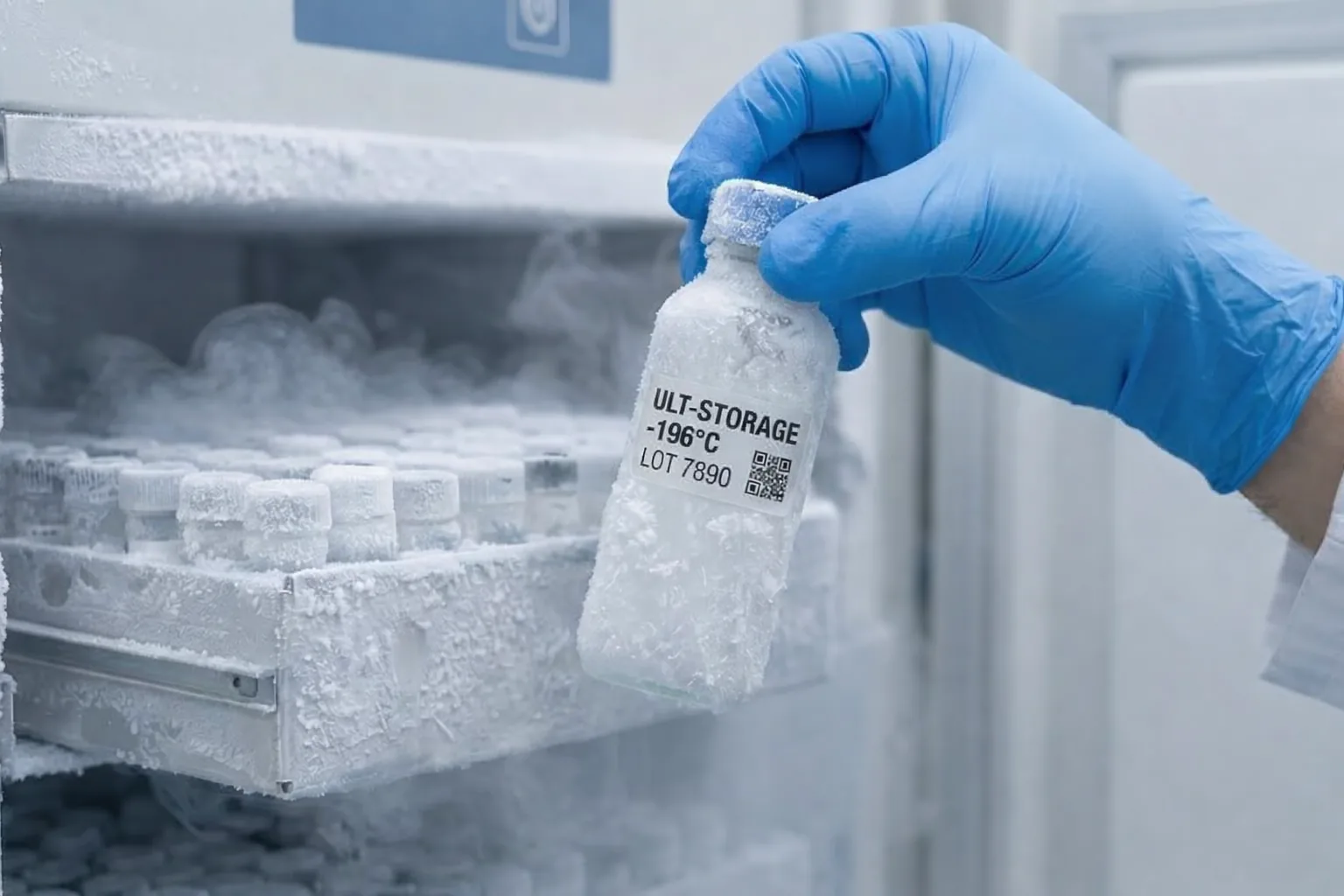
A label that works perfectly in a warehouse at room temperature can fail within hours inside a cold store. Not because it's lower quality: it's that the environment poses requirements a standard material isn't designed to meet.
Why the cold chain is a particularly demanding environment
The first is application temperature. Most conventional adhesives need a minimum temperature of between +10 °C and +15 °C to form a proper bond with the surface. If the label is applied to a container coming straight out of the cold, or on a packaging line at low temperature, the adhesive doesn't flow, doesn't wet the surface, and the anchor is superficial from the very start.
The second is condensation. When a cold product comes into contact with warm outside air, moisture settles on the surface. If the label is already applied, that film of water acts as a barrier between the adhesive and the substrate. If it's applied right afterwards, the surface moisture prevents contact. In both cases the result is the same: lifting.
The third is thermal cycling. A product that passes several times between cold and room temperature subjects the label-adhesive assembly to repeated expansion and contraction. Rigid materials or adhesives with little elasticity end up delaminating at the edges.
The environment defines the material, not the other way round. There's no generic "cold" label: the right combination depends on whether the cold is constant or cyclical, whether there's condensation, whether the surface is smooth or rough, and whether it's applied to a cold product or at room temperature before entering the cold store.
The four most common failures and their real cause
Failure 1 — The adhesive doesn't bond or the label lifts in the cold store
Most common cause: a standard acrylic-based adhesive with a minimum application temperature of +10 °C has been used on surfaces at 2 °C or with condensation. The adhesive doesn't flow, doesn't wet the surface, and real contact is minimal.
✓ Solution
Low-temperature adhesive (application down to -10 °C) or freezer adhesive (down to -18 °C or -25 °C depending on the product).
Failure 2 — The material wrinkles, deforms or becomes brittle
Paper absorbs moisture and loses rigidity. In humid environments or with condensation cycles, the paper face material wrinkles, the edges lift, and the printed image can run.
✓ Solution
Synthetic materials —polypropylene or polyester— that don't absorb moisture. Polypropylene is the usual choice for food; polyester gives greater rigidity for pharma or chemicals.
Failure 3 — The barcode or QR code stops scanning
Condensation on the label or moisture reflecting off the surface can interfere with optical reading. In addition, a ribbon incompatible with the working temperature can lift or lose optical density.
✓ Solution
Resin or wax-resin ribbons with good low-temperature adhesion, and validation of code readability under the actual conditions of use.
Failure 4 — Edges that lift
Even when the adhesive bonds correctly, repeated thermal cycling contracts and expands the material differentially. If the face material is rigid or the adhesive lacks enough elasticity, the label's edges progressively separate from the substrate.
✓ Solution
High-cohesion elastic adhesive and flexible synthetic face material (polypropylene). Avoid large-format labels without extra perimeter anchoring in applications with frequent thermal cycling.
⚠ Common validation mistake
Validating the label only at room temperature before it enters the cold store. The correct test is to apply the label under the actual conditions of use and check adhesion and legibility after the thermal cycles it will be subjected to.
| Failure | Typical cause | Material solution |
|---|---|---|
| Adhesive doesn't bond | Application temp. below the minimum | Low-temp. or freezer adhesive |
| Material deforms | Paper absorbing moisture | Synthetic face material (PP or PET) |
| Code unreadable | Ribbon incompatible with low temp. | Resin ribbon + validation in real conditions |
| Edges lift | Differential contraction in cycles | Elastic adhesive + flexible material |
How to choose: the questions to answer first
Without answering these four questions, any material recommendation is a guess. With them, the specification is straightforward.
- At what temperature is the label applied? If it's applied to a cold or frozen product, you need a low-temperature adhesive with a minimum application temperature of -10 °C or lower.
- Is there condensation at the application point or during the cycle? If the product moves from a cold store to a warm area and back, condensation is practically unavoidable. The face material must be synthetic.
- How many thermal cycles will it undergo? Each cycle is a contraction and an expansion. Permanent adhesives with high initial tack withstand these cycles better.
- What information does it carry and how is it read? If it carries a barcode that must be scanned in the cold store, you need to validate reading under those conditions.
“The correct specification of a cold-chain label doesn't start with the material: it starts with understanding where, how and at what temperature it's applied.”
Common combinations by type of application
| Application | Face material | Adhesive | Ribbon |
|---|---|---|---|
| Chilled food (+2 °C to +8 °C) | White matt PP | Low-temp. permanent | Wax-resin |
| Frozen (-18 °C, cold application) | White PP or PET | Freezer (-25 °C) | Pure resin |
| Pharma cold chain | Clear or white PET | Low-temp. permanent + chem. resistance | Pure resin |
| Last-mile logistics (thermal cycling) | White gloss PP | Elastic permanent | Wax-resin or resin |
Need to specify labels for your cold chain? Tell us about your process and we'll recommend the right combination.
Ask with no obligationSummary
The cold chain tests labels at three critical points: application temperature, condensation and thermal cycling. The four most common failures have a known cause and an available material solution.
Choosing well isn't about looking for the "most cold-resistant" label: it's about precisely answering what the real application temperature is, whether there's condensation, how many cycles the product will see and what type of marking must survive. With those four answers, the correct specification is straightforward.
Frequently asked questions
Why does a label that works in the warehouse fail in a cold room?
For three reasons the warehouse does not present: application temperature, condensation and thermal cycling. It is not a matter of quality, but of a standard material not being designed to cover those requirements.
What is the minimum temperature for applying a label?
Most conventional adhesives need between +10 °C and +15 °C to form a proper bond. If the label is applied to packaging coming straight out of the cold, the adhesive does not flow, does not wet the surface, and the anchorage is superficial from the outset.
Why does condensation make the label come off?
Because the film of water acts as a barrier between the adhesive and the substrate. It makes no difference whether the label was already applied or is applied just afterwards: in both cases the result is the same.
Is there a generic “cold” label?
No. The right combination depends on whether the cold is constant or cyclic, whether there is condensation, whether the surface is smooth or rough, and whether the label is applied to a cold product or at room temperature before entering the cold room.