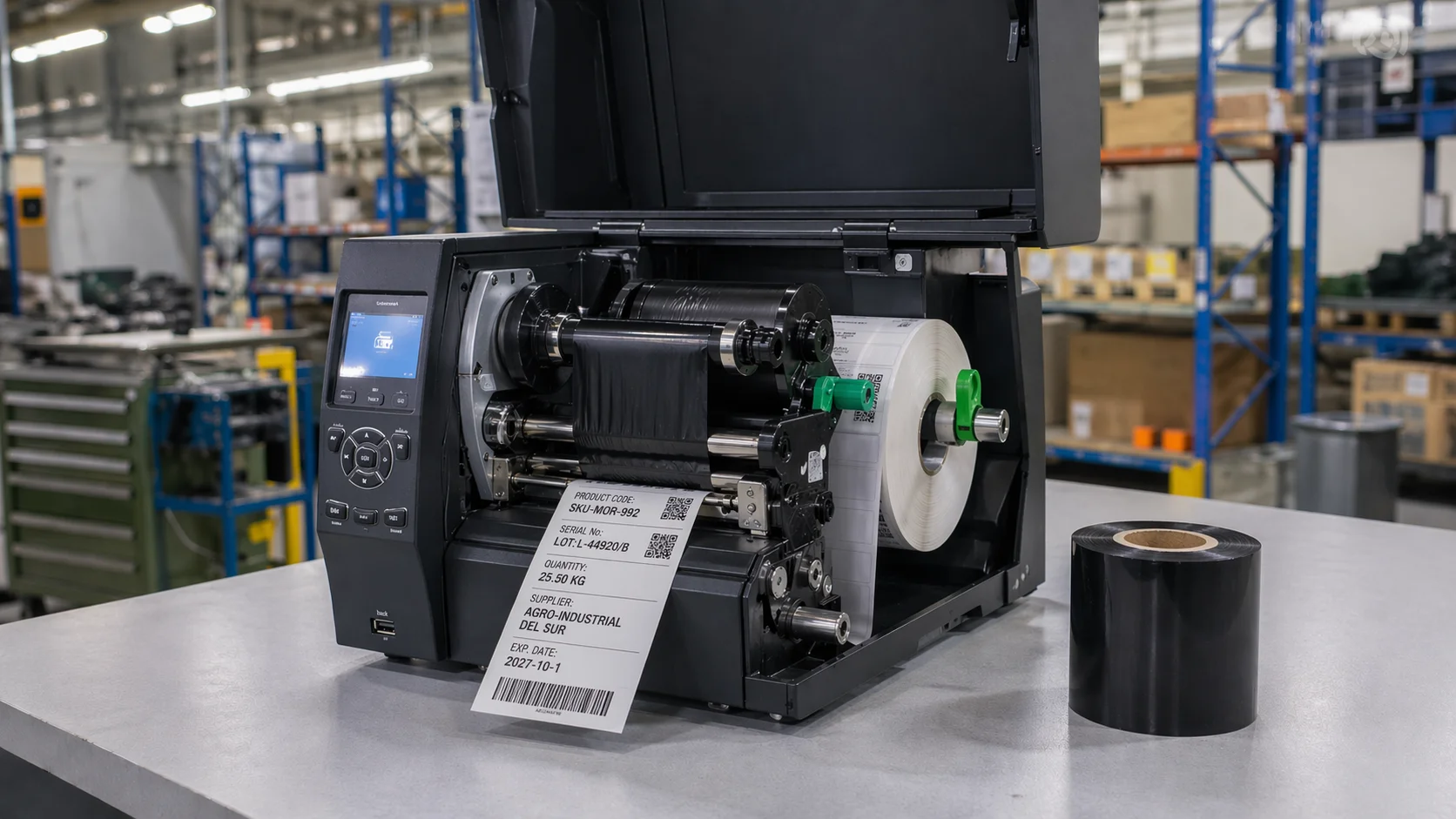
Many people choose the label material well —polyester, polypropylene, paper— and forget about the ribbon. But if the ink isn't up to the environment of use, the print disappears even when the face material is right. The ribbon is half the equation.
What a ribbon is and why not all of them are the same
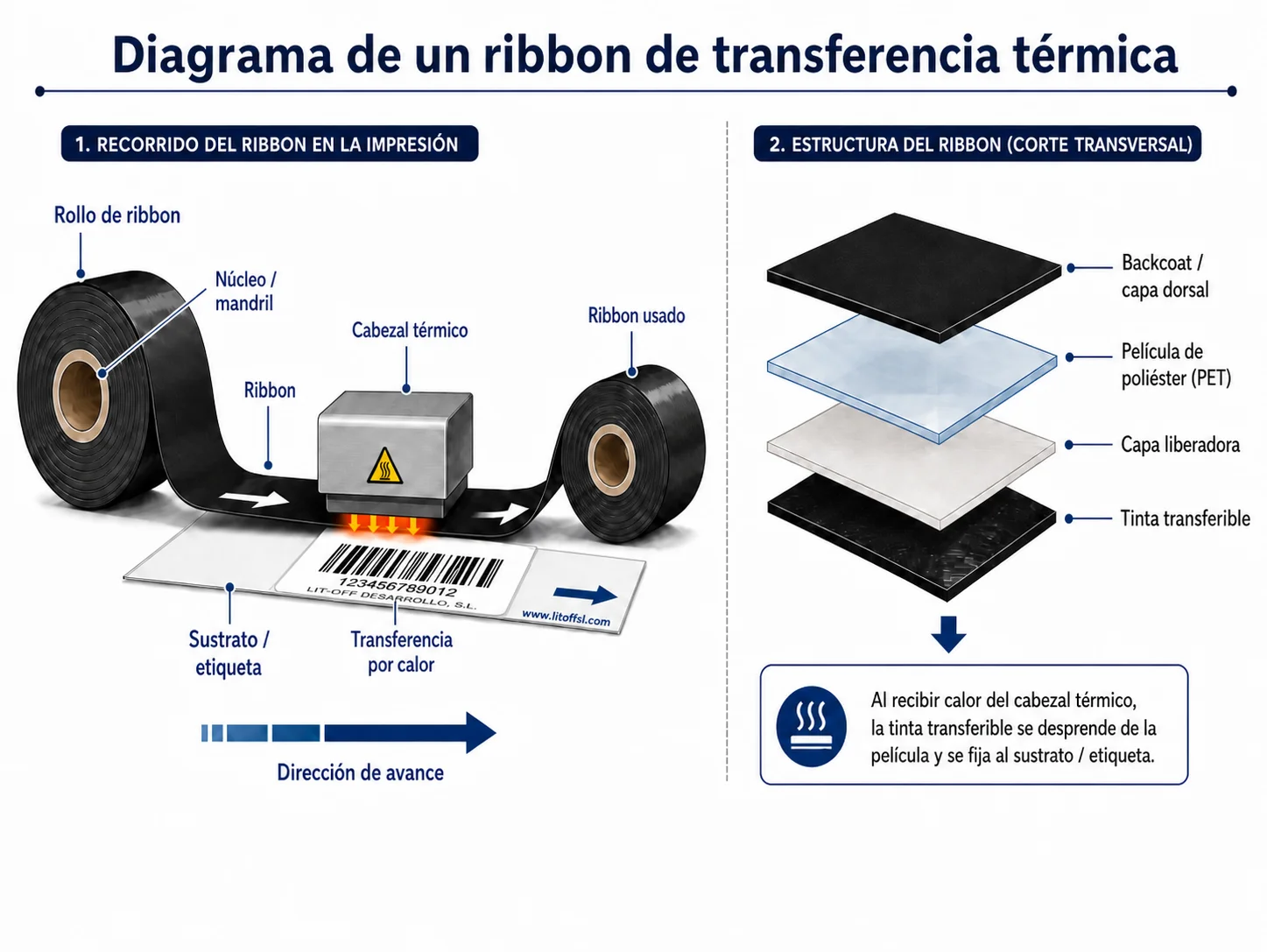
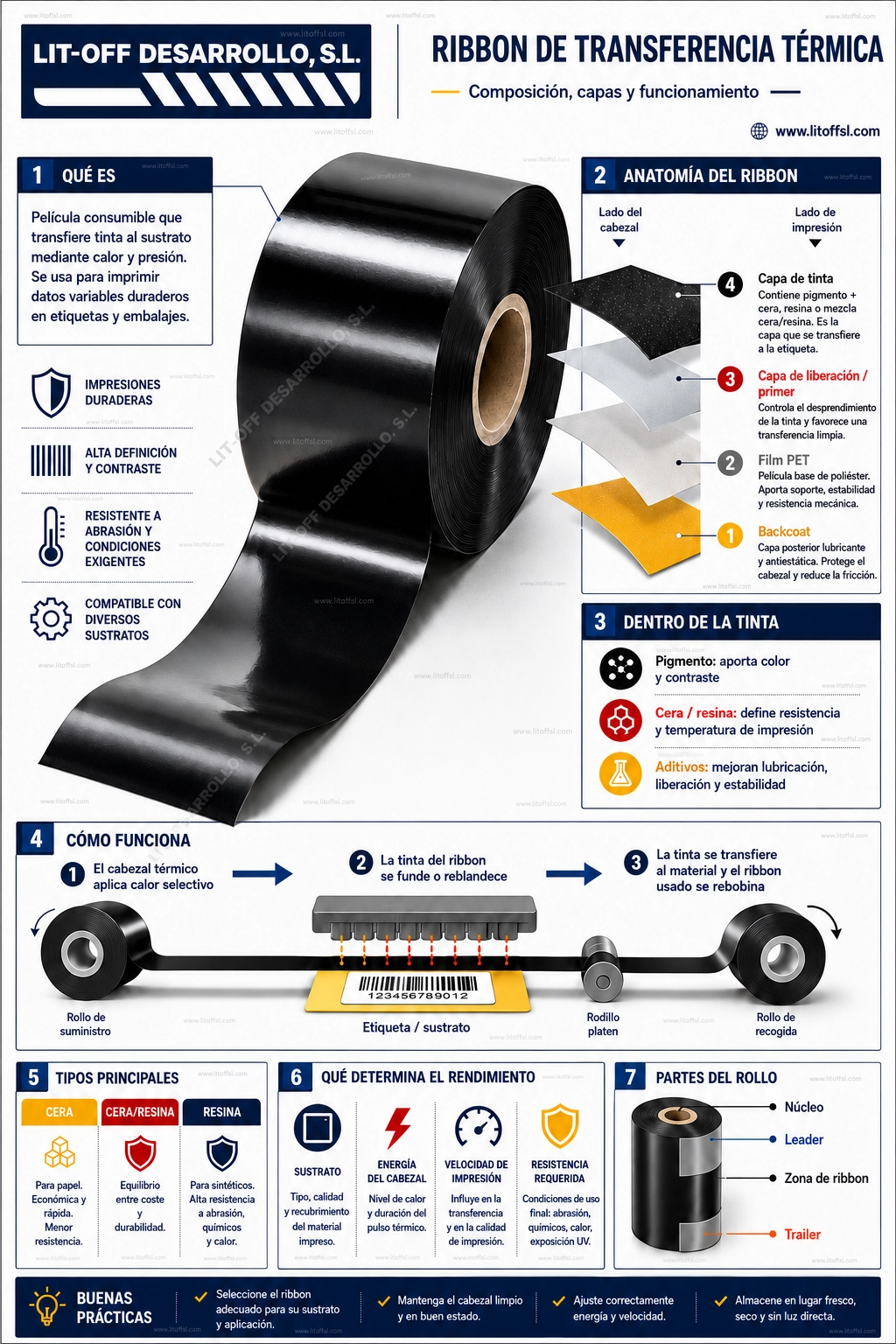
A ribbon is simply a tape coated with ink. The printer presses it against the label while applying heat, and the ink transfers from the tape to the face material. Up to that point, all three types work the same way. What changes is what that ink is made of: the more resin, the more the print resists water, chemicals, abrasion and sunlight.
A wax ribbon on a polyester label produces a print that doesn't bond: the ink lifts off at the first touch or handling. The material can be right; the ink isn't.
Wax ribbon: the economical option for indoor use
Wax ribbon is the cheapest and most common. It prints well on coated paper and works fine in warehouses, logistics or any application where the label won't face anything aggressive. The problem comes when it's asked to do more than it can deliver.
When it's enough
- Logistics and dispatch labels with a service life of days or weeks.
- Warehouse labelling under normal temperature and humidity conditions.
- Low-cost applications where the label won't come into contact with liquids, solvents or intense friction.
- Printing on coated paper. On polypropylene only for basic indoor applications with no moisture or abrasion.
Its limitations
- Limited moisture resistance: water, sweat or condensation can degrade the print, depending on the wax formulation and the face material.
- Lower abrasion resistance: repeated friction against surfaces or packaging degrades a wax print sooner than a wax-resin or resin one.
- Limited chemical resistance: for contact with cleaning products or solvents, move up to wax-resin or resin and validate a sample with the actual agent and exposure time.
- Not valid for polyester: the ink doesn't bond properly and lifts off. On polypropylene it can work in basic indoor applications, but for any real demand —moisture, repeated handling or medium durability— wax-resin ribbon is the right choice.
Wax-resin ribbon: the balance between price and resistance
Wax-resin ribbon combines wax and resin in its formulation. It resists more than pure wax but costs less than full resin. It's the middle-ground option in the good sense: it covers most industrial situations without blowing the budget.
When it's the right choice
- Labels on polypropylene in industrial indoor settings with moderate humidity.
- Product identification with medium durability: weeks or a few months.
- Applications with some abrasion or occasional contact with non-aggressive liquids.
- Retail or finished-product labels that will be handled repeatedly.
⚠ Important note
Wax-resin ribbon isn't valid for applications exposed to solvents, acids, alkalis or prolonged outdoor exposure. In those environments, the result can look acceptable at first and deteriorate quickly within a few weeks of real use.
Resin ribbon: the option for aggressive environments
Resin does not simply sit on top the way wax does: as it melts it anchors to the surface of the face material and forms a high-durability print layer. That is why it withstands the rubbing, moisture and solvents that remove a wax print. It's the only valid option when the label will be in an aggressive environment.
What resin withstands that wax and wax-resin can't
- Solvents and chemical products: acids, alkalis, oils, fuels, industrial cleaning products.
- Prolonged UV exposure: the ink doesn't discolour or fade under sunlight.
- Extreme moisture and condensation: including cold stores and pressure-washing environments.
- Intense abrasion: dragging, friction against metal surfaces, repeated handling.
- Temperature: certain resin ribbons withstand up to 150–200 °C depending on the formulation.
Resin ribbon only works correctly on synthetic materials: polyester and polypropylene. On paper, the ink and face material don't integrate, and the result is inferior to wax.
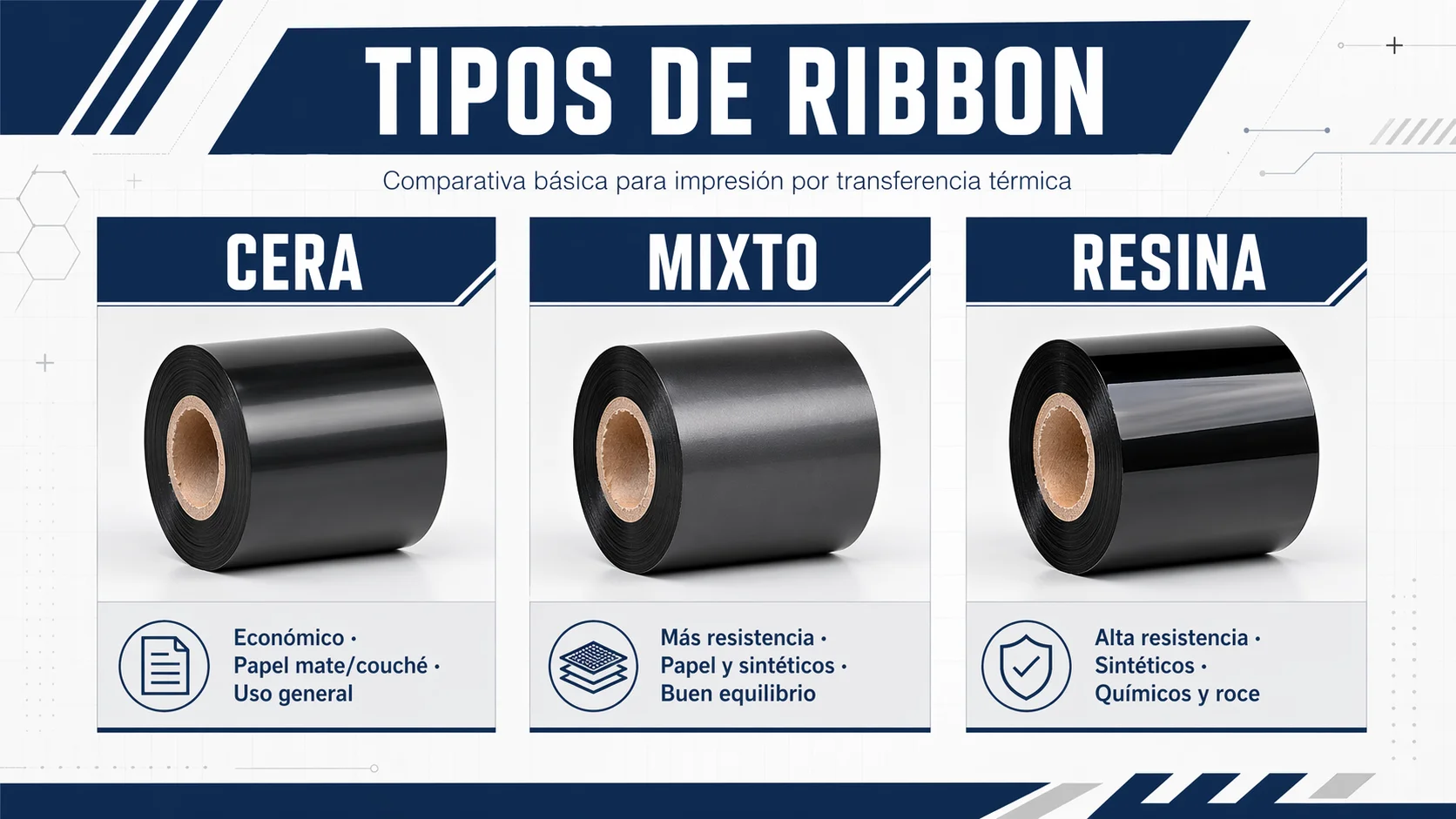
Comparison table of the three types
| Ribbon type | Compatible face material | Resistance | Relative cost | |||
|---|---|---|---|---|---|---|
| Moisture | Chemicals | Abrasion | UV / outdoor | |||
| Wax | Coated paper | None | None | Low | None | Low |
| Wax-resin | Paper, PP, PET | Medium | Low | Medium | Low | Medium |
| Resin | Polyester, PP | Very high | High | High | High | High |
The most common mistake: good label, wrong ribbon
The situation that generates the most complaints: polyester, correct adhesive, process in order — and wax ribbon. The label withstands the environment, but the print lifts off within the first few days. The material isn't the problem; the ink is.
The opposite mistake also happens: using resin where wax would be enough. In indoor logistics on paper, resin adds nothing and even prints worse than wax on that face material. Every ribbon has its place.
“The right ribbon isn't the most expensive one: it's the one formulated for the specific face material and environment of each application.”
How to choose the right ribbon
The selection comes down to three questions, in order:
- What's the label's face material? If it's paper, the option is wax or wax-resin. If it's polyester or polypropylene, the starting point is wax-resin or resin.
- What will the label encounter during its service life? Moisture, chemical products, UV, intense abrasion or temperature push the requirement towards resin. Dry indoor conditions with no aggressive agents allow you to stay with wax or wax-resin.
- How long does the print need to last? Days or weeks: wax. Months with moderate demands: wax-resin. Years in tough conditions: resin.
Not sure which ribbon your application needs? Tell us the face material, the environment and the durability required.
Ask with no obligationSummary
Wax is the economical option for coated paper indoors with a short service life. Wax-resin offers a reasonable balance for synthetic materials in environments with moderate demands. Resin is the only valid option when the label will be exposed to chemical agents, extreme moisture, UV or intense abrasion — always on a synthetic face material.
Choosing the ribbon without considering the face material and the environment always ends up costing more than getting it right from the start. The investment in the right ribbon is always less than the cost of relabelling or a traceability failure in production.
If you're looking for wax, wax-resin or resin ribbons for your process, you can see our range of thermal transfer ribbons at ribbonsimpresoras.com.
Frequently asked questions
Which ribbon goes with which label material?
The basic rule is wax for paper, wax-resin for polypropylene, and resin for polyester and chemical environments. On synthetic film, wax does not anchor.
What are the limitations of wax ribbon?
It offers lower resistance to moisture, abrasion and chemical products than a wax-resin or a resin ribbon. The final result depends on the wax formulation, the face material and the exposure time, so it is worth validating a sample in the real application.
When is resin necessary?
When the label will be in an aggressive environment: solvents, extreme moisture, intense abrasion or high temperature.
How do you choose a ribbon in three questions?
What the face material is, what the label will encounter during its service life, and how long the print has to last. Days or weeks allow wax; months with moderate demands, wax-resin; years in difficult conditions, resin.