Application: resistance to industrial chemical agents
Chemical-resistant labels
Chemical-resistant labels: withstand acids, solvents and industrial cleaning
We supply chemical-resistant self-adhesive labels: polyester face material, resin ribbon and an adhesive formulated for contact with acids, alkalis, solvents, cutting oils and industrial cleaning, without losing readability or adhesion. A standard label degrades within hours in those environments; the right construction lasts the full working life of the container or the part. We have supplied chemical, laboratory and automotive customers across Spain and Europe since 1994.
Face material
Polyester PET
Ribbon
Resin
Resistance
Acids · Solvents · Oils
Adhesive
Resistant acrylic
Where these labels are used
- Identification of containers and drums for chemicals and lubricants.
- Safety labels resistant to cleaning with industrial solvents.
- Marking of parts in contact with cutting oils and coolants.
- Laboratory labelling exposed to acids, bases and organic solvents.
- Traceability on production lines with corrosive or abrasive agents.
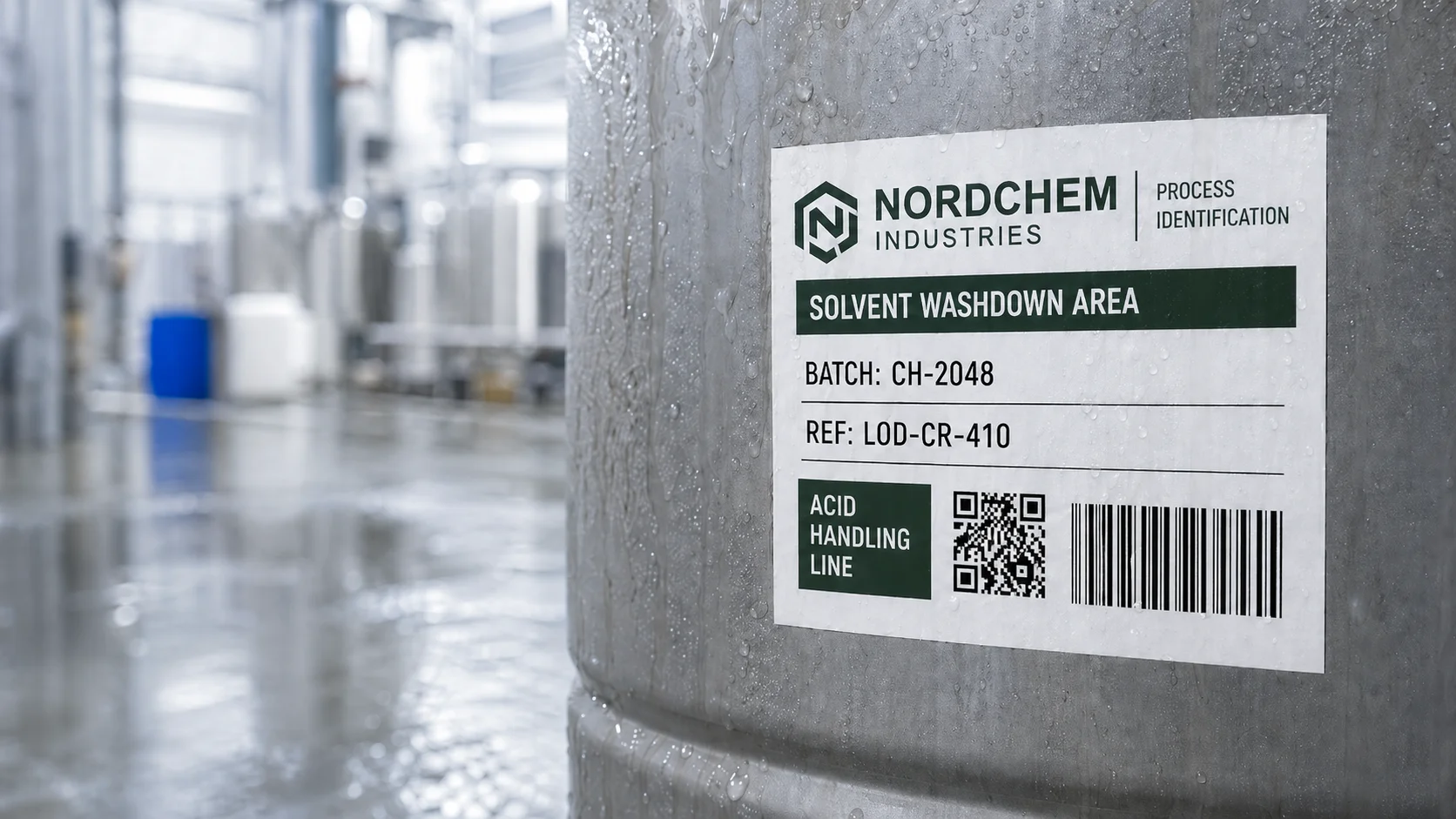
What determines a label's chemical resistance
- Face material: polyester is the most resistant to acids, solvents and oils; paper and polypropylene are vulnerable to many agents.
- Resin ribbon: resin ink is formulated to resist chemical agents; wax or wax-resin dissolves with common solvents.
- Adhesive: not every adhesive withstands immersion even if the face material does; in aggressive environments, adhesive and face material need to be validated together.
Service temperature
-40 °C to +150 °C
Water resistance
Total
Surfaces
PE, PP, metal, glass
Printing
Thermal transfer
The problem
What destroys a label in contact with chemicals
Organic solvents such as acetone, toluene or isopropyl alcohol (IPA) directly attack solvent-based inks and dissolve non-resistant adhesives. The result is a label that is illegible or lifts off on first contact.
Diluted acids and bases, common in industrial cleaning processes, degrade paper within minutes and can attack the adhesive even on plastic labels if the adhesive is not specifically formulated for that pH.
Cutting oils and industrial lubricants are especially problematic because they seep in under the edges of the label and progressively reduce adhesion, even though they do not destroy the face material immediately.
Resistance table by agent
Polyester + resin ribbon against common agents
| Agent | Face material | Ink (resin) | Acrylic adhesive |
|---|---|---|---|
| IPA / alcohols | High | High | High |
| Mineral oils | High | High | Medium |
| Cleaning agents (neutral) | High | High | High |
| Diluted acids (pH 4–6) | High | Medium-high | Medium |
| Acetone / ketones | High | High | Medium |
| Concentrated acids | Medium | Medium | Low |
Indicative values. Real resistance depends on the concentration, temperature of the agent and exposure time. For concentrated acids or aggressive mixtures, consult us for a specific recommendation.
Recommended material
Polyester as the primary option
Polyester is inert to most solvents and diluted acids. With 100% resin ribbon and resistant acrylic adhesive, it is the standard solution for industrial chemical environments.
The right combination
- Face material: matt or gloss polyester, minimum thickness 50 µm
- Ribbon: 100% resin (not wax or wax-resin)
- Adhesive: high-performance acrylic, not hot-melt
Common sectors
Chemicals and pharmaceuticals, metalworking and automotive are the sectors where a label's chemical resistance is critical.
See sector details ↓What commonly goes wrong
Common mistakes when choosing chemical-resistant labels
Mistake 01
Using varnished or laminated paper as chemical protection
UV varnish or surface lamination protects against occasional splashes, but not against immersion or prolonged exposure. The paper degrades under the coating and the label ends up lifting off or the print is compromised from the substrate up.
Mistake 02
Choosing wax ribbon to print on polyester
Polyester resists chemicals, but if printed with wax ribbon, the ink loses readability quickly when exposed to solvents or alcohol. The right ribbon for chemical environments is resin. Wax-resin ribbon is only suitable for occasional or surface-level chemical contact.
Mistake 03
Validating only the face material, not the adhesive
The face material can be high-resistance polyester, but if the adhesive is standard acrylic and the surface is impregnated with oil or solvent, the label will not stick. The adhesive and surface preparation are just as critical as the face material.
Mistake 04
Asking for generic chemical resistance without specifying the agent
A polyester that resists acetone may not resist nitric acid. Chemical resistance is not an absolute value: it depends on the agent, the concentration and the contact time. Always tell us exactly which chemical will be in contact with the label.
How to choose
Recommended material by chemical agent
There is no single material for every chemical environment. The choice depends on the specific agent, the frequency of contact and whether the exposure is by splashing or immersion.
| Agent / Environment | Face material | Ribbon | Adhesive |
|---|---|---|---|
| Oils and lubricants | Polyester | Resin | High bond strength acrylic |
| Solvents (acetone, isopropyl alcohol — IPA) | Polyester | Resin | Resistant acrylic * |
| Diluted acids and bases | Polyester | Resin | Permanent acrylic |
| Detergents and cleaners | PPPolyester | Wax-resinResin | Permanent acrylic |
| Water immersion / industrial washing | Polyester | Resin | High water-resistance acrylic |
* Resistant acrylic: formulated not to degrade when exposed to organic solvents, unlike standard permanent acrylic.
By industry
Sectors where these labels are most used
Sector
Chemicals and pharmaceuticals
Labelling of drums, containers and reagents with constant exposure to solvents and acids.
See sector →Sector
Automotive
Identification of parts exposed to oils, greases and workshop fluids during manufacturing.
See sector →Sector
Metals
Labels on parts that go through surface treatments, pickling or galvanising baths.
See sector →Sector
Industrial food processing
Production lines with CIP/SIP cleaning cycles using alkaline and acid detergents.
See sector →Frequently asked questions
Common questions about chemical-resistant labels
Does polyester resist all chemicals?+
No. Polyester is the material with the highest chemical resistance in the standard label catalogue, but it is not universal. It resists common solvents, oils and diluted acids well. Against concentrated acids or strong bases, resistance depends on the specific type of polyester and the exposure time. We always recommend testing with the real agent before validating the material.
What is the difference between a wax, wax-resin and resin ribbon?+
Wax ribbon produces a less durable print: it rubs off easily with solvents and alcohol. Wax-resin ribbon improves chemical resistance for light exposure and semi-synthetic surfaces. Resin ribbon produces the most resistant print: it resists solvents, acids and high temperatures. For environments with real chemical exposure, only resin ribbon offers lasting readability.
Is a special adhesive needed for chemical environments?+
It depends on the environment. Standard permanent acrylic adhesive resists most industrial chemical agents well under normal use conditions. If the surface is contaminated with oil, grease or solvent before the label is applied, an adhesive with high bond strength is needed. For immersion or continuous exposure, a specific adhesive is assessed depending on the agent.
Can polyester labels be laminated for extra protection?+
Yes. An over-laminate or additional polyester film applied over the printed face adds an extra barrier against abrasion and chemical agents on top of the print. It is a valid option when resin ribbon alone is not enough, or when the label will be in direct, prolonged contact with very aggressive agents.
How is it validated that a label resists a specific chemical?+
The validation process involves applying the proposed label to the real surface and exposing it to the agent for the usual time and concentration. Adhesion, print readability and the condition of the face material are assessed when it is removed. We always recommend this before placing a production order, especially for uncommon agents or high concentrations.
What happens if the label is submerged rather than splashed?+
The difference is significant. A polyester label with resin ribbon tolerates accidental contact or splashes from many agents without losing readability. Continuous immersion in aggressive solvents or concentrated acids is a much more demanding environment: in that case, additional lamination or prior validation with the specific agent is recommended. Not every adhesive withstands immersion even if the face material does.
Can you send a sample before production?+
Yes. Before any production run, we can send a sample of the selected material so you can validate how it behaves in your real application. This is the standard step when there are special conditions — temperature, moisture, chemicals, a difficult surface — that are worth confirming before committing to an order.
For technical profiles
Technical properties of polyester (PET) material
Data sheets, chemical resistance and adhesive specifications
Related resources
Contact
Need labels for chemical environments?
Tell us which chemical agents are present, the approximate concentration and whether there is additional heat. We will advise you on the exact combination of face material, ribbon and adhesive.
- Free, no-obligation technical advice.
- Response within 24 hours.
- Resistance testing available.