Lit-Off Desarrollo

Industrial security

Tamper-evident labels

Tamper-evident and destructible labels: any attempt to open leaves a permanent mark

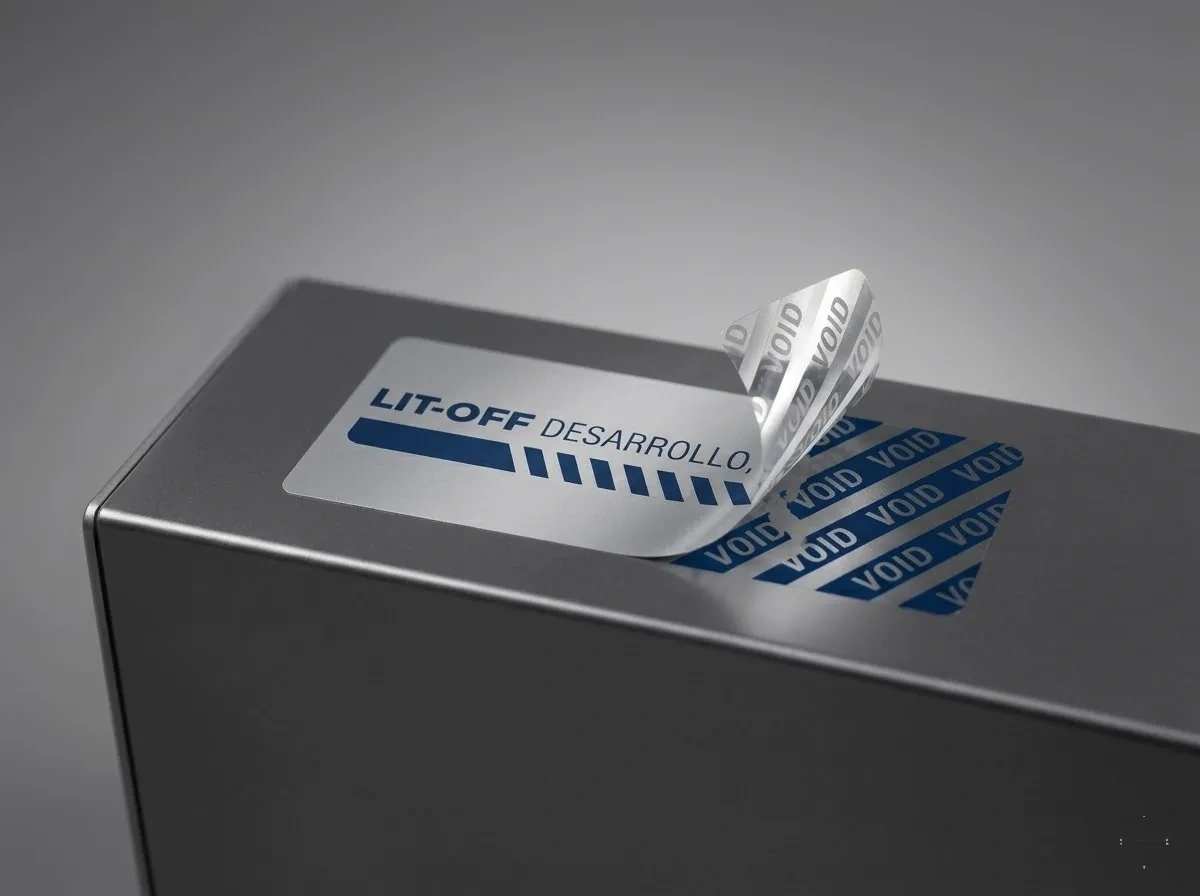
We supply self-adhesive tamper-evident labels — also known as tamper-proof labels: if someone tries to open, remove or move them, they leave a visible sign that cannot be hidden. The VOID film shows a message when peeled off (service range −30/+120 °C), the destructible material breaks into fragments and the holographic type loses its structure and cannot be reused. We have supplied warranty seals and access control to Spanish and European industry since 1994.

Types

VOID · Destructible · Holographic · Serialised

Adhesive

High-tack permanent

Customisation

Logo · Numbering · QR

Surfaces

Metal · Glass · ABS · PC

When they are used

  • Warranty sealing in electronics, machinery and equipment.
  • Sealing of packaging, boxes and official documentation.
  • Asset control with serial numbering and barcodes.
  • Product authentication against counterfeiting and the grey market.
  • Seals for meters, vehicle inspections and calibrated equipment.
Tamper-evident VOID security label on a metal surface

Types of tamper-evident solution

VOIDDestructibleHolographicNumbered
  • VOID: leaves a visible message on the surface when someone tries to remove the label.
  • Destructible: the face material fragments when peeled off, with no possibility of reuse.
  • Holographic: visual authentication that is hard to replicate, can be combined with VOID or numbering.

Not sure which type to choose?

The right type depends on the surface, the level of evidence needed and whether the label must authenticate or just show evidence of opening. We will advise you with no obligation.

Ask about a solution →

Available solutions

Four types of security label

The right choice depends on the level of evidence required, the application surface and whether the goal is to detect tampering, prevent reuse or authenticate the product.

Tamper detection

VOID label

When you need immediate visual evidence that someone has tried to open or remove the label. When peeled off, a message — usually “VOID” or custom text — becomes visible on the surface, leaving permanent evidence of tampering. It is the most common solution when the surface needs to retain a clear sign even after an attempted removal.

Effect

Visible message

Face material

Polyester / Polypropylene

Curing

Min. 24 h

Finish

Matt / Gloss / Silver

  • Warranty sealing in electronics and machinery.
  • Sealing of boxes, packaging and official documentation.
  • Access control for high-value assets and inventory.
  • Seals for meters, vehicle inspections and measuring equipment.

Common surfaces: metal · glass · ABS · polycarbonate

Cannot be removed intact

Destructible label

When the label must not be removable without being destroyed — with no possibility of reuse. The face material fragments into small pieces when someone tries to peel it off, making it impossible to remove it in one piece or move it to another surface. It is the most direct option when the priority is to prevent any reuse and make it clear that any removal means destruction.

Effect

Fragmentation

Face material

Destructible vinyl

Curing

Min. 24 h

Finish

White / Silver

  • Serial number plates on equipment and fixed assets.
  • Seals where removal must be destructive.
  • Certification of inspections and calibrations.
  • Anti-theft labelling in shops and warehouses.

Common surfaces: metal · rigid plastics

Anti-counterfeiting

Holographic label

When you need visual authentication that is hard to replicate, in addition to opening evidence. The holographic effect adds an immediate layer of authentication against counterfeiting or channel diversion. It can be combined with VOID evidence, serial numbering or variable codes to reinforce the individual identification of each unit.

Effect

Holographic

Face material

Metallised film

Curing

Min. 24 h

Combines with

VOID / Numbering

  • Authentication of premium and pharmaceutical products.
  • Authenticity seals on documentation and certificates.
  • Brand protection against counterfeiting and the grey market.

Unique traceability

Numbered / serialised label

When each unit needs a unique identity that can be verified for audits or traceability. Each label incorporates a unique identifier — a sequential number, barcode or QR code — to physically link each unit with a record, a warranty or a movement history.

Identification

Unique per unit

Codes

Barcode / QR

Face material

Polyester / Paper / PP

Combines with

VOID / Destructible / Holo

  • Batch traceability in production and the supply chain.
  • Numbered seals for delivery notes, warranties and contracts.
  • Protection of calibrated equipment and process instrumentation.

Comparison

Tamper-evident solutions

A quick summary to guide your choice according to the type of evidence that must be left, the possibility of reuse and the level of customisation or traceability the project needs.

SolutionWhat happens when tampered withCan it be reused?CustomisationCommon application
VOIDLeaves a visible message on the surface or the labelNot recommendedLogo, text, security message, numbering and codesWarranties, seals, boxes, electronics, equipment and documentation
DestructibleThe label breaks or fragments when peeled offNoFixed text, numbering, codes and custom formatsFixed assets, ID plates, calibrations and internal control
HolographicProvides visual authentication and can be combined with other layersDepends on constructionHolographic effects, numbering, overprint and combination with VOIDProduct authenticity, certificates, brands and originality control
Numbered / SerialisedUnique identification per unit or batchDepends on the face materialSequential numbers, barcodes and QR codesTraceability, inventory, records, warranties and controlled seals

For the technical differences between VOID in polyester, destructible paper and holographic material, see the security materials comparison →

What commonly goes wrong

Common mistakes when choosing tamper-evident labels

Mistake 01

Choosing by price without validating the real surface

A generic VOID label applied to untreated polyethylene or polypropylene can peel off without leaving visible evidence. Low surface energy stops the adhesive from doing what it is asked to do. Validation on the real application surface is necessary before production.

Mistake 02

Removing the label before the adhesive has cured

The VOID effect requires the adhesive to have cured properly, which can take up to 24 hours. If removal is attempted too soon, the effect is weaker or does not appear at all. On cold or porous surfaces, curing time can be longer.

Mistake 03

Confusing opening evidence with total security

A VOID label leaves evidence of opening, but it does not stop someone from substituting the contents and applying a new label. In high-risk applications, physical evidence needs to be combined with unique serialisation per unit so that traceability detects any replacement.

Mistake 04

Using generic holography without customisation

A holographic label with no exclusive elements (logo, unique code, brand-specific text) can easily be replaced by another generic holographic label available on the market. Real authentication requires the holographic design to be exclusive and not replicable with standard materials.

Applications by sector

Common sectors

Security labels turn up wherever there is something to protect: an asset, a warranty, an original product or a chain of custody. The type of solution changes by sector, but the need for evidence is the same.

Sector

Electronics and components

In electronics, security labels protect equipment, batteries and valuable components. Evidence of opening allows tampering to be detected under warranty and discourages unauthorised access. Sealing housings with a VOID label is standard practice in consumer and industrial equipment.

  • Sealing of housings, batteries and electronic modules.
  • Integrity guarantee for equipment shipped or repaired.
  • Identification of components with serial numbering and barcodes.
See electronics sector

Sector

Pharmaceuticals and medical products

In pharmaceuticals and healthcare, packaging integrity is both a regulatory requirement and a patient safety issue. Destructible and holographic labels show whether a product has been tampered with since it left the source and allow its authenticity to be verified at any point in the distribution chain.

  • Tamper-evident seals on medicine and device packaging.
  • Holographic labels for authenticity verification.
  • Traceability with serial numbering on batches and clinical records.
See chemicals and pharmaceuticals sector

Sector

Calibrated equipment and instrumentation

In industry, destructible labels identify fixed assets, instrumentation and calibrated equipment. Their destruction when someone tries to peel them off shows any unauthorised access and protects the validity of the calibration. This is the standard solution in industrial maintenance and equipment audits.

  • Fixed asset plates with unique identification and barcodes.
  • Seals for calibrated instruments and measuring equipment.
  • Access control for machines, electrical cabinets and critical installations.

Sector

Product and brand authenticity

Holographic and numbered labels protect against counterfeiting and the parallel market. They allow the consumer, the distributor or the inspector to verify the product's originality immediately, without needing any extra instruments.

  • Holographic authenticity labels on branded and licensed products.
  • Numbered seals for originality control in distribution.
  • Product guarantee with a unique, verifiable code and full traceability.

Frequently asked questions

Common questions about tamper-evident labels

What is the difference between a VOID label and a destructible label?+

A VOID label leaves a visible message on the surface or on the label itself when someone tries to remove it. A destructible label, on the other hand, uses a destructible face material that breaks or fragments when peeled off. Both are tamper-evident, but the destructible type is designed for when there must be no possibility of removing it intact or reusing it.

Which solution is best for warranties, openings or calibrated equipment?+

For warranties, seals and unauthorised openings, VOID is usually the most common solution. For plates or labels that must not be removed intact or moved to another surface, a destructible label is more suitable. When there is also a risk of counterfeiting or a need for visual authentication, holography and serial numbering can be added.

Can they be customised with a logo, numbering, QR or barcodes?+

Yes. We can supply labels with a logo, fixed text, a security message, sequential numbering, a barcode or QR code. It is also possible to combine different elements on a single label to bring together visual security and operational traceability.

Do they work the same on any surface?+

No. The result depends on the material, surface energy, texture and condition of the substrate. On metals, ABS or polycarbonate they usually perform well. On untreated polyethylene or polypropylene it may be necessary to validate the adhesive and construction with a prior test on the real surface.

What level of protection do I need if the main risk is product substitution?+

If the risk is that the contents could be substituted without being noticed, you need a combination of opening evidence (VOID or destructible) with unique serialisation per unit. That way, even if someone manages to remove and replace the label, individual traceability detects the anomaly.

Can a VOID label be reused once it has been peeled off?+

No. Once a VOID label has been removed, the pattern remains visible on the surface and/or on the label itself. Even if you try to reposition it, the damage is permanent. That irreversibility is precisely its security function.

How far in advance does the label need to be applied for the VOID effect to be reliable?+

The label needs to have been applied for at least 24 hours for the adhesive to cure properly and for the VOID effect to be reliable when peeled off. In low-temperature environments or with porous surfaces, curing time can be longer: it needs to be validated with a sample before production.

Can you send a sample before production?+

Yes. Before any production run, we can send a sample of the selected material so you can validate how it behaves in your real application. This is the standard step when the surface, environment or security requirements raise doubts that are worth confirming before committing to an order.
Contact

Need guidance on the right solution?

Tell us what you want to protect: a warranty, an opening, authenticity, integrity control. We will advise you on the type of label, the adhesive and the most suitable level of customisation.

  • Free, no-obligation technical advice.
  • Response within 24 hours.
  • Material samples when the project requires it.
Please enter your company name.
Please enter your name.
Enter a valid email address.
Please write your message.
You must accept the privacy policy to continue.