Frequently asked questions
Common questions about polyester labels
Answers to the most frequent questions before requesting a sample or a quote.
Why is polyester better than paper or polypropylene in industrial environments?+
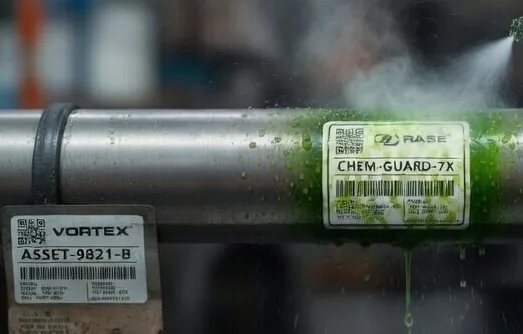
Polyester does not distort with moisture, does not tear through abrasion and keeps its readability after exposure to solvents, oils and chemicals. Paper loses integrity on contact with any liquid, and polypropylene has temperature and chemical-resistance limits that polyester comfortably exceeds.
What ribbon is needed to print polyester labels?+
Polyester requires a high-quality resin or wax-resin ribbon. Standard wax ribbon is not compatible: the print would wear away on contact with chemicals or abrasion. For the most demanding applications, resin ribbon is recommended.
What temperature can a polyester label withstand?+
Polyester withstands up to around 150 °C in continuous exposure, which makes it suitable for moderate-heat environments, low-temperature curing ovens and conventional industrial processes. For processes above that threshold — heat treatment, galvanising, metals or steelworks — the right solution is high-temperature labels from the ARGIPRINT° range.
See labels for temperatures above 150 °C
Does polyester work on metal or painted surfaces?+
Yes. With permanent or high-performance acrylic adhesive, polyester adheres correctly to metal, painted surfaces, polycarbonate, ABS and most technical plastics. For low-surface-energy substrates such as untreated PE or PP, the right adhesive needs to be selected.
Can polyester be used for fixed-asset and inventory labels?+
It is the most common application. Polyester labels with a barcode or QR code for fixed assets last for years in industrial environments without losing readability. They are usually combined with permanent acrylic adhesive.
What is the difference between the various polyester finishes?+
- White mattThe most common. Removes glare and makes barcodes easier to read in environments with variable lighting.
- White glossGreater visual vividness. For when presentation matters, although it is not the first choice for automatic scanning.
- SilverMetallised industrial finish. Common on identification plates for equipment and electronic components.
- TransparentNo visible white background. The label blends with the application surface.
Can you send a sample before production?+
Yes. In projects where the environment or the surface raises questions, it is standard practice to validate a sample first before starting production.
Does it hold up when the machine is cleaned with alcohol or solvent?+
Yes. Polyester printed with resin ribbon withstands cleaning with isopropyl alcohol, diluted acetone and most common industrial solvents. For prolonged immersion in strong acids or bases, check the right adhesive for the surface.
What happens if I choose the wrong material for my application?+
If you choose a material with less resistance than the application needs, the label can lose its print, come off or become unreadable before it has done its job. That is why we offer samples before production: it is the simplest way to confirm the material suits your real process.
Is it suitable for outdoor labels that need to last more than a year?+
Yes, it is one of its most common uses. Polyester with permanent adhesive and resin ribbon keeps its readability outdoors for several years, even with exposure to UV, rain and temperature changes.