Lit-Off Desarrollo

Security technologies for self-adhesive labels

VOID film, destructible paper and holographic: materials that leave a trace when tampered with

There are three security materials with different evidence mechanisms. VOID is a polyester film with a metallised layer that transfers the pattern to the substrate on removal — it cannot be reused. Destructible is paper formulated to break into fragments when removal is attempted. Holographic combines a visual effect with difficulty of reuse without visible evidence. Which to choose depends on the surface, the printing method and the level of evidence you need.

Evidence

High permanence

Base

PET / Paper / Holo.

Ribbon

Resin

Reusable

No

Common applications

  • Warranty seals on electronics and appliances.
  • Anti-counterfeiting labels in pharmaceuticals and cosmetics.
  • Asset identification with tamper detection.
  • Packaging closure with evidence of opening.

Compatible adhesives

High-tack permanent acrylic for definitive adhesion on most substrates; specific formulations for difficult surfaces (lacquers, textured plastics) available on request.

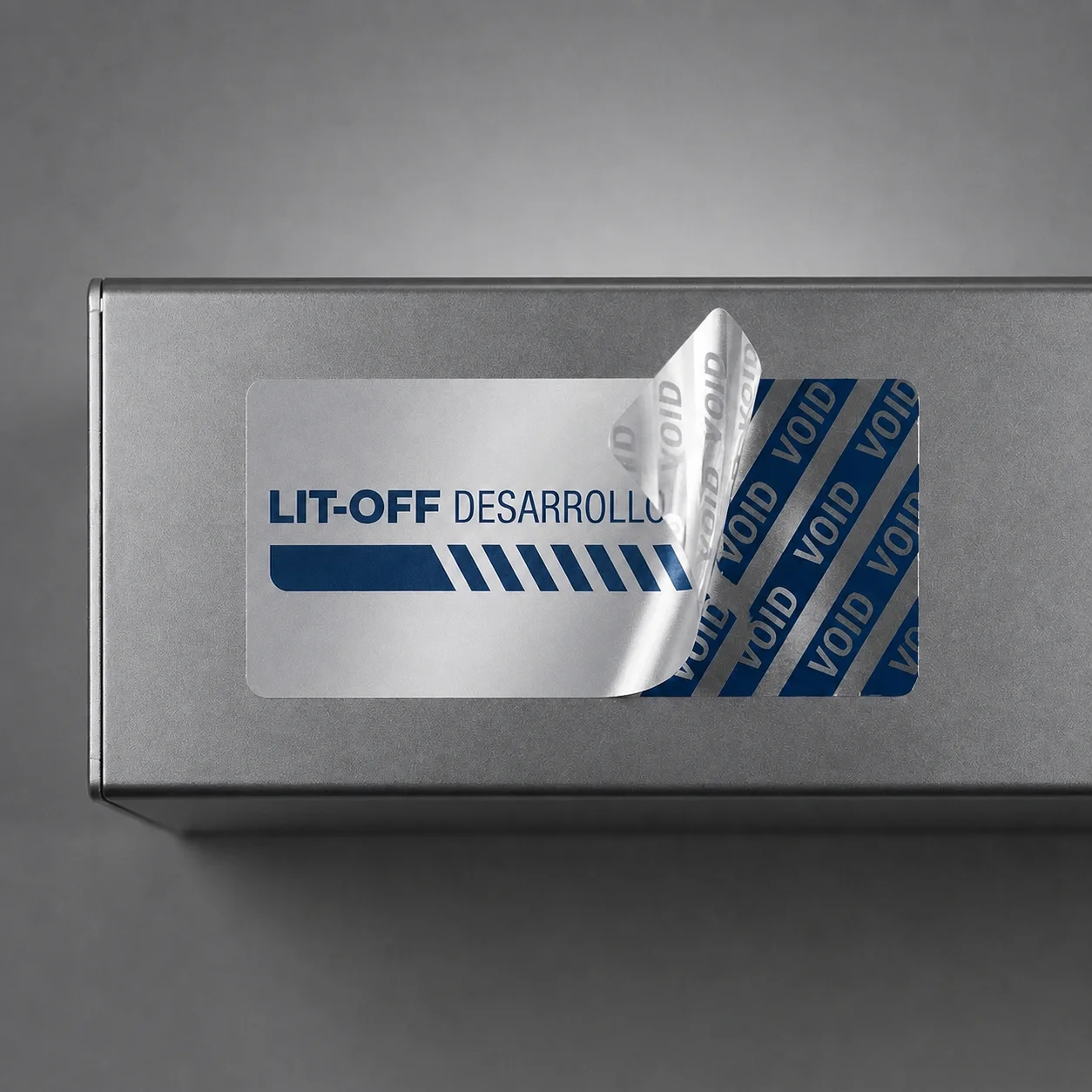
VOID security label for seals and evidence of tampering

Material variants

Metallic VOIDDestructibleHolographicTransparent VOID
  • Metallic VOID: polyester film with a metallised layer; transfers the “VOID” pattern to the substrate on removal.
  • Destructible: paper formulated to fragment when removal is attempted; cannot be removed intact.
  • Holographic: variable optical effect that is difficult to reproduce; combines visual security with deterrence.
  • Transparent VOID: no visible metallisation; subtle evidence on clear surfaces or glass.

Not sure which construction to choose?

Each application requires a different level of evidence. See the available constructions or get in touch for technical guidance.

See available constructions →

Selection criteria

When do you need a security label instead of a standard one?

A standard label identifies and traces. A security label does that and also leaves visible evidence if someone tries to remove or replace it. The decisive question is not the material but the need: does your application require detecting tampering, or does it just need the information to be readable?

When to choose it

  • You need physical, visible evidence of opening or tampering: warranty seals, packaging closure, calibration seals.
  • A customer, audit or regulation requires that the label cannot be removed intact or reused.
  • The product carries a risk of counterfeiting or substitution: pharmaceuticals, consumer electronics, premium brands.
  • You need a visual authentication element the end customer can verify without equipment.

When not to choose it

  • You only need identification or traceability with no access control: a standard PP or polyester label is more economical and enough.
  • The surface is very rough, porous or flexible: high-strength permanent adhesion may not work correctly and could compromise the evidence.
  • The use is temporary or internal and the label must come off cleanly: use standard removable adhesive.
  • The application involves high process temperatures: as a reference, destructible PVC works up to +40 °C and PET VOID up to +120 °C; above that range, ask us.

Once confirmed, VOID, destructible or holographic?

If your application requires tamper evidence, the specific type depends on the surface, the required security level and whether you need visual authentication. The application guide orients the choice by real use case.

See tamper-evident labels guide →

Available constructions

Types of security material

Three families of materials with different security mechanisms. The choice depends on the type of evidence required and the end use of the label.

Irreversible evidence

VOID film

When removal of the label is attempted, it leaves the “VOID” message or a pattern etched onto the surface. The label is destroyed or rendered unusable.

Constructions

  • Transparent VOID (leaves no visible residue)
  • Metallic VOID (leaves “VOID” printed on the surface)

Adhesive

Strong permanent

Surfaces

Metal · Glass · ABS · PC

When to choose it

When the goal is for the surface to retain a visible signal after the removal attempt. Works best on smooth, non-porous, clean surfaces. On rough or porous surfaces the result can be uneven.

Not removable intact

Destructible material

Film or paper with very low tear resistance. When removal of the label is attempted, it breaks into fragments. Impossible to reuse. It is the material base of tamper-evident labels.

Types

  • White destructible paper
  • Silver destructible film

Adhesive

Very strong permanent

Surfaces

Metal · Rigid plastic · Smooth surfaces

When to choose it

When it matters that the label cannot be removed intact. Requires high-permanence adhesive. Suitable for hard, clean, rigid surfaces where adhesion is complete from the start.

Visual authentication

Holographic material

Holographic laminate with a variable optical pattern. Difficult to reproduce, immediate visual evidence of authenticity. Option with integrated VOID available.

Printing

Digital, offset or hot-stamp.

Security

Variable optical

Surfaces

Smooth surfaces · Paper · PVC

When to choose it

When the primary evidence is visual and immediate: the variable optical effect is difficult to reproduce and verifiable without instruments. Can be combined with a VOID layer or sequential numbering to add a second layer of identification.

Technical comparison

Security materials: comparison

TechnologyType of evidenceVisible residueBreaksRepositionableCommon surfacesTechnical note
VOID filmMessage or pattern on substrateYes (metallic) / No (transparent)NoNoSmooth and clean: metal, glass, ABS, PCMost effective on non-porous surfaces
DestructibleFace material breaks apartNot alwaysYesNoMetal, rigid plastic, smooth surfacesThe label is left in fragments on removal
HolographicOptical effect / authenticationDependsDependsDependsSmooth: paper, card, plastic, PVCCombines with VOID or sequential numbering

Technical compatibility

Surface compatibility

Not all security technologies behave the same on every substrate. Surface energy, roughness, porosity and cleanliness affect the material's behaviour and the quality of the evidence.

CompatibleConditional — requires specific adhesive or prior validation

Metal

Steel, aluminium, galvanised surfaces

✓ VOID✓ Destructible✓ Holographic

High-energy surface. VOID film gives clear transfer. Check that the surface is free of dirt or oil before applying.

Rigid plastic

ABS, polycarbonate, PVC

✓ VOID✓ Destructible✓ Holographic

On ABS and PC, VOID film leaves a sharp transfer. PVC may require prior validation due to its plasticiser content.

Glass

Jars, windows, industrial glassware

✓ VOID✓ Destructible✓ Holographic

Very smooth, high-energy surface: transfer of the VOID pattern is especially clear. Always apply to clean, dry glass.

Cardboard and paper

Boxes, envelopes, documentation

⚠ VOID✓ Destructible✓ Holographic

VOID can be uneven on recycled or rough cardboard. Destructible is suitable. On porous surfaces, validate with a sample before production.

Rough or textured

Powder coating, textured surfaces

⚠ VOID✓ Destructible⚠ Holographic

Roughness reduces adhesive contact and can affect VOID transfer. Destructible tends to be more reliable. High-tack adhesive recommended.

Low surface energy

Polyethylene, untreated polypropylene

⚠ VOID⚠ Destructible⚠ Holographic

Require high-adhesion LSE acrylic adhesive. Without it, the label can lift off without activating the evidence mechanism. Always validate under real conditions.

Frequently asked questions

What people ask us about security materials

Answers to the most frequent questions before requesting a sample or a quote.

What is the technical difference between a VOID film and destructible paper?+

VOID film is made of polyester with a metallised layer that transfers to the substrate on removal, leaving the “VOID” pattern visible. Destructible paper is formulated to break into fragments when removal is attempted, with no visual transfer. Each technology responds to a different tamper-evidence mechanism.

Can a VOID label be printed with thermal transfer?+

Yes. The printable face of VOID film is compatible with thermal transfer printing. It is important to check that the ribbon and printing temperature are right for the specific substrate, since excess temperature can prematurely activate the security layer.

Does VOID material work on cardboard and paper surfaces?+

Yes, with high-adhesion permanent adhesive. The pattern-transfer mechanism works best on flat, non-porous surfaces. On recycled cardboard or very rough surfaces, a higher-viscosity adhesive may be required.

What adhesive is suitable for security materials on low-energy surfaces?+

On polyethylene, polypropylene and other low-surface-energy substrates, a high-adhesion acrylic adhesive formulated for LSE is recommended. Standard adhesive may not reach the bond strength needed for the label to function as tamper evidence.

Can sequential numbering, QR or barcode be combined with the security material?+

Yes. VOID, destructible and holographic materials are compatible with variable printing (sequential numbering, QR, DataMatrix, barcode). This combination lets you use the label both as physical evidence of opening and for digital traceability of the product.

Which technology leaves visible residue on the surface after removal?+

VOID film is the technology that leaves visible residue: on removal it transfers a pattern — usually the text “VOID” or a custom design — directly onto the substrate. Destructible material breaks into fragments but does not systematically transfer residue onto the substrate. Holographic depends on its specific construction.

Can a security label be repositioned once removed?+

No, in none of the three technologies. VOID film activates the transfer mechanism on the first removal attempt, making tampering irreversibly visible. Destructible material fragments on removal, making it impossible to take off intact. Holographic material can lose its visual integrity if repositioning is attempted.

What surface factors most affect how the security material performs?+

The main factors are: surface energy of the substrate (high or low), roughness or texture, porosity, the presence of contaminants such as oil or dust, and application temperature. A low-energy or rough surface can prevent the adhesive from generating the bond strength needed for the security mechanism to work correctly when removal is attempted.

Contact

Need technical specifications for these materials?

Tell us the type of evidence required, the application surface and the process of use. We will guide you to the most suitable material and adhesive from the first contact.

  • No-obligation technical advice.
  • Response within 24 hours.
  • Material samples when the project requires it.
Please enter your company name.
Please enter your name.
Enter a valid email address.
Please write your message.
You must accept the privacy policy to continue.