Application: industrial traceability and identification
Labels for barcodes
Barcode labels: reliable reading at every point in the chain
We supply barcode labels with GS1-128, Code 128, QR and DataMatrix with reliable reading at every point in the chain: receiving, warehouse, line and dispatch. Compatible with Zebra, Honeywell and SATO printers; the right face material avoids codes that wrinkle, ink that rubs off and failed reads at exactly the moment they matter most. We have supplied printed traceability to Spanish and European industry since 1994.
Standard
GS1 · SSCC
Symbology
Code 128 · QR · DM
Printers
Zebra · Honeywell · SATO · etc.
Reading
Fixed and handheld scanners
Where these labels are used
- Warehouse labels for picking, dispatch and receiving.
- Pallet marking with SSCC for GS1 logistics exchange.
- Product identification with DataMatrix or 2D codes.
- Batch, expiry and serial number traceability.
- Pre-printed labels or for in-house printing with a variable field.
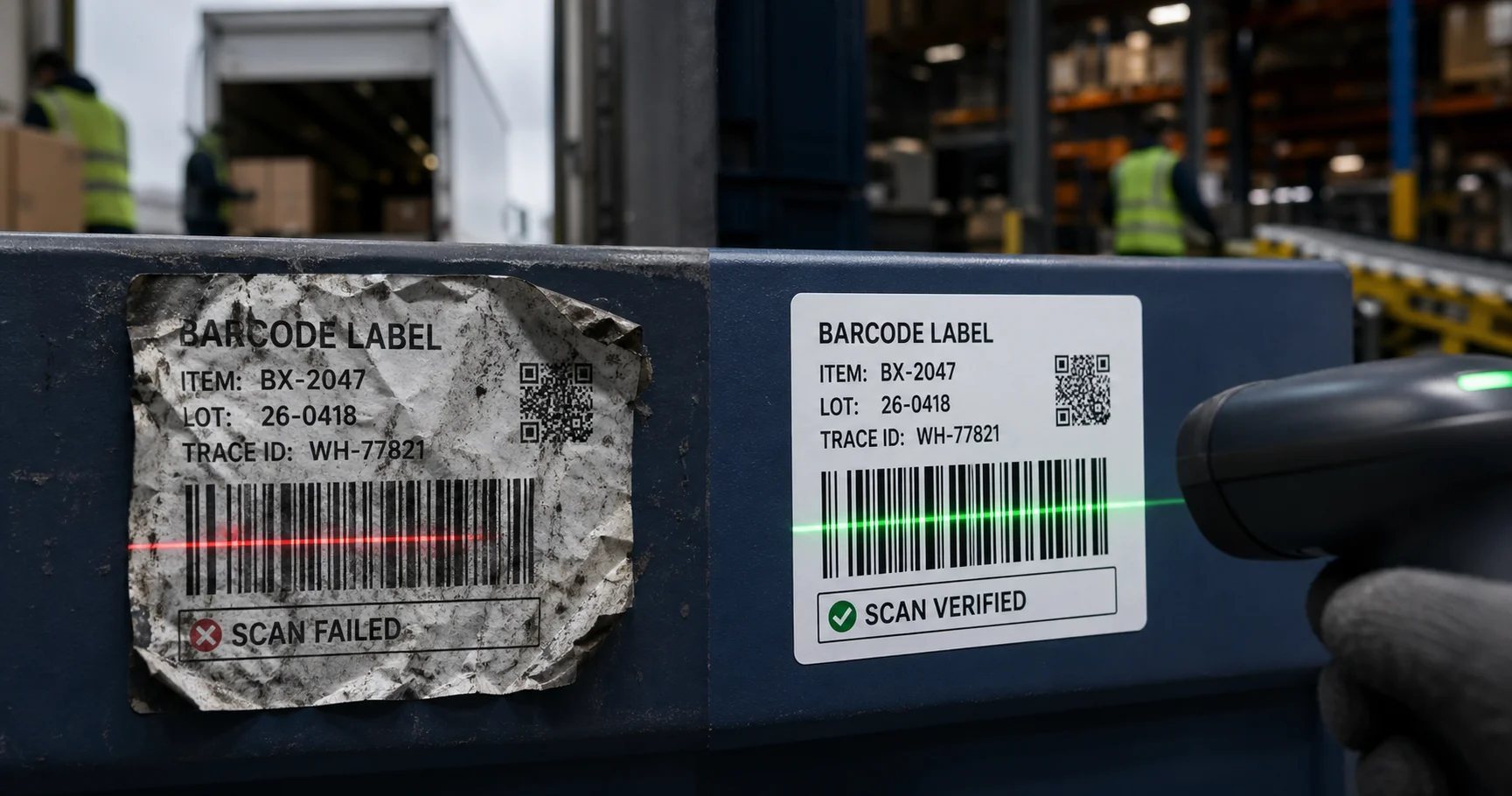
What determines readability throughout the chain
- Face material: direct thermal paper for short-cycle warehouse use; polypropylene or polyester for prolonged exposure or contact.
- Ribbon: wax for smooth surfaces and fast-turnaround stock; wax-resin or resin in environments with rubbing, moisture or temperature.
- Printer: DPI and printhead temperature settings determine the density and contrast of the printed code.
Quality standard
ISO/IEC 15416
Recommended grade
B (minimum acceptable: C)
Minimum resolution
203 DPI
Quiet zone
Required by the standard
What determines readability
Print quality does not depend on the printer alone
The same well-calibrated printer can produce grade A quality under ISO 15416 with the right material, and drop to grade C if the face material or ribbon are not suitable. The face material, coating and ribbon all need to work together for the print to stay stable and legible throughout the label's working life.
Standard thermal paper is the most economical option for short-cycle dispatch labels. But if the label goes through an outdoor warehouse, a cold room or a production line with oil in the air, the paper degrades and the code stops reading before its time.
The minimum code size also matters. A Code 128 on a small label can be right at the density limit of an in-line scanner. We check this before confirming the final label size and the code's module width.
Symbologies and standards
The most widely used formats in industry
Code 128
Standard for dispatch, picking and internal traceability. High data density in a small space.
GS1-128 / SSCC
GS1 logistics label with a pallet code (SSCC). Compatible with customers' EDI and WMS systems.
EAN-13
For finished product and commercial distribution. Requires a company GS1 prefix.
QR / DataMatrix
2D codes for higher data density or direct part marking traceability (DPM).
Material by environment
The right face material for every point in the chain
- Dispatch and dry indoor warehouse: direct thermal paper. Economical, no ribbon, short cycle.
- Outdoor logistics or moisture: polypropylene with resin ribbon. Waterproof and legible in any weather condition.
- Production line with chemicals: polyester with resin ribbon. Resists oils, solvents and aggressive cleaning.
- Cold chain: polypropylene with cold-chain stable adhesive. High readability from -25 °C.
Recommended materials
By type of environment
For dispatch, parcels and short-cycle traceability in dry indoor conditions. No ribbon, high productivity.
For logistics with moisture, cold or outdoor conditions. Waterproof and resistant to handling.
For production lines with chemicals, heat or abrasion. Maximum durability.
Common sectors
Logistics, automotive, food and electronics are the sectors with the highest demand for barcode and traceability labels.
See sector details ↓Need RFID too?
If you need traceability without line of sight or automated inventory, RFID labels complement or replace barcodes in many processes.
See RFID labelsWhat commonly goes wrong
Common mistakes in barcode labels
Mistake 01
Printing at the wrong density for the scanner
A barcode can look correct but still be unreadable if the print density (bar and space width) is not right for the scanner being used. Industrial handheld scanners have a different reading range and resolution to checkout-line scanners. The optimal density depends on the scanner, not just the printer.
Mistake 02
Using the wrong material for the reading environment
A barcode on coated paper works well in a dry warehouse. In a cold room, condensation smudges the print or warps the face material, making the code unreadable. The choice of face material needs to consider the environment where the label will be read, not just where it will be applied.
Mistake 03
Not leaving enough quiet zone
The blank margin on both sides of the code (quiet zone) is part of the symbol's specification. If it is trimmed for design reasons or by the label size, the reader cannot identify the edges of the code and fails to read it. This is a common mistake when the label size is adjusted without checking the symbology specifications.
Mistake 04
Wax ribbon for codes in an industrial environment
Wax ribbon offers lower resistance to abrasion and moisture than wax-resin or resin: in industrial conditions the print comes away sooner than it should. For traceability on the plant floor, in the warehouse or in transport, the standard is wax-resin or resin depending on how demanding the environment is. An unreadable code halfway through the traceability process breaks the record chain.
How to choose
Recommended face material and ribbon by point in the chain
Readability conditions vary depending on where the code is read: on a production line with a fixed scanner, in a warehouse with a handheld scanner, in outdoor transport or at the receiving point. Each point has its own requirements.
| Point in the chain | Face material | Ribbon | Common symbology |
|---|---|---|---|
| Production line / plant | PolyesterPP | Resin | Code 128, GS1-128 |
| Dispatch and indoor warehouse | Direct thermalCoated paper | —Wax | Code 128, SSCC |
| Outdoor transport / logistics | PPPolyester | Wax-resinResin | SSCC, GS1-128, QR |
| Cold room | PPCryogenic | Resin | Code 128, GS1 |
| Permanent asset identification | Polyester | Resin | Code 39, QR, DataMatrix |
By industry
Sectors where these labels are most used
Sector
Logistics and warehousing
Pallet, case and unit labels with SSCC, Code 128 and GS1 for traceability in the distribution chain.
See sector →Sector
Automotive
Component identification with 2D barcodes from raw material receiving through to dispatch.
See sector →Sector
Food
Batch and expiry traceability in packaging lines with printing at the time of production.
See sector →Sector
Chemicals and pharmaceuticals
Batch traceability under strict regulations, serialisation and DataMatrix codes for pharmaceuticals.
See sector →Frequently asked questions
Common questions about barcodes and traceability
What is the difference between Code 128, GS1-128 and SSCC?+
Code 128 is a high-density 1D barcode symbology that can encode alphanumeric text. GS1-128 is a variant of Code 128 that uses standardised GS1 application identifiers (GTIN, batch, expiry, etc.). SSCC is a logistics container serial number encoded in GS1-128, used to identify unique dispatch units. For logistics exchange between companies, GS1-128 with SSCC is the industry standard.
When should QR or DataMatrix be used instead of a 1D barcode?+
2D codes (QR, DataMatrix) encode more information in less space and remain readable even with partial damage (error correction). They are used when label space is very limited, when complex data needs to be encoded, or when reading with an in-line machine-vision camera. DataMatrix is the standard for pharmaceuticals (GS1 DataMatrix standard). QR is more common in solutions read by smartphone.
How do I know if the material is compatible with my printer?+
Compatibility depends on the printer model, the optimal printhead temperature and the print density (DPI). Each material has a recommended printhead temperature range: a resin ribbon needs more heat than a wax one, and a top-coated face material responds differently to an uncoated one. If you tell us the exact printer model, we will confirm the material and ribbon combination validated for that machine before production.
What is the minimum readability grade for a barcode?+
The ISO/IEC 15416 standard sets the quality criteria for 1D codes: the key parameter is the grade (A to F), with A being the highest quality and C the minimum acceptable for use in a logistics chain. For industrial traceability and dispatch, a grade of B or higher is recommended. The parameters that matter most are contrast, decodability and module defect.
Can you supply labels with codes already printed, or blank only?+
Both options. We supply pre-printed labels with either fixed data — logo, reference, product code — or variable data — serial numbering, a unique barcode or QR code per unit. We also supply blank material optimised for printing with the customer's thermal printer. The most common combination is pre-printing the static elements plus a variable field printed at the time of production.
What is "print density" and how does it affect reading?+
Print density (DPI) determines the minimum bar width the printer can reproduce accurately. The higher the density (203, 300 or 600 DPI), the finer the bars can be and the more information fits in less space. For standard warehouse applications, 203 DPI is enough. For pharmaceutical DataMatrix or very small labels, 300 or 600 DPI is recommended.
Can you send a sample before production?+
Yes. Before any production run, we can send a sample of the selected material so you can validate how it behaves in your real application. This is the standard step when there are special conditions — temperature, moisture, chemicals, a difficult surface — that are worth confirming before committing to an order.
Contact
Need labels for traceability?
Tell us the required standard (GS1, SSCC, Code 128…), the environment of use and the printer available. We will advise you on the optimal material and format.
- Free, no-obligation technical advice.
- Response within 24 hours.
- Readability validation included.