Frequently asked questions
Common questions about high temperature labels
The questions that come up most often before choosing a model and requesting a quote.
What matters more: the maximum temperature or the exposure time?+
Both variables are critical, but to different degrees depending on the process. A brief peak of 300 °C for a few seconds — as in a curing oven — is very different from continuous exposure to 200 °C for hours in an industrial oven. A material can withstand a peak without degrading and still fail under continuous exposure at a lower temperature. Before selecting a solution, you need both figures: maximum temperature and exposure duration.
Can a label be applied before the thermal process?+
It depends on the type of solution. For hang tags, applying before the process is standard practice: it is mechanically fixed to the part and stays with it through the whole cycle. For self-adhesive labels in moderate ranges (up to ~180 °C), it is also possible to apply beforehand if the adhesive is validated for that temperature. What matters is that the fixing is settled before heat exposure, since trying to fix a label mid-way through the temperature cycle is not workable.
When does an adhesive solution stop being viable in a thermal process?+
Generally from around 150 °C under continuous exposure, most conventional adhesives break down: they soften, migrate or lose adhesion irreversibly. Above that threshold, the most robust solution is mechanical fixing without adhesive. There are technical adhesives validated for specific ranges above 150 °C, but they always require prior validation with a sample to confirm behaviour in the real process. Tell us the conditions if your case requires an adhesive solution at high temperature.
Which label resists 300 °C?+
For processes around 300 °C, the usual option is KPK 800 (validated up to 320 °C) or KPK 874 (up to 350 °C) hang tags, both with an adhesive-free Kraft/PET/Kraft laminate. The choice between them depends on whether the process combines temperature with exposure to acids or aggressive chemical agents. Conventional adhesive is not viable in this range: fixing is mechanical (wire, strapping, hook or weld stud). See the ARGIPRINT° range.
Which label resists 500 °C?+
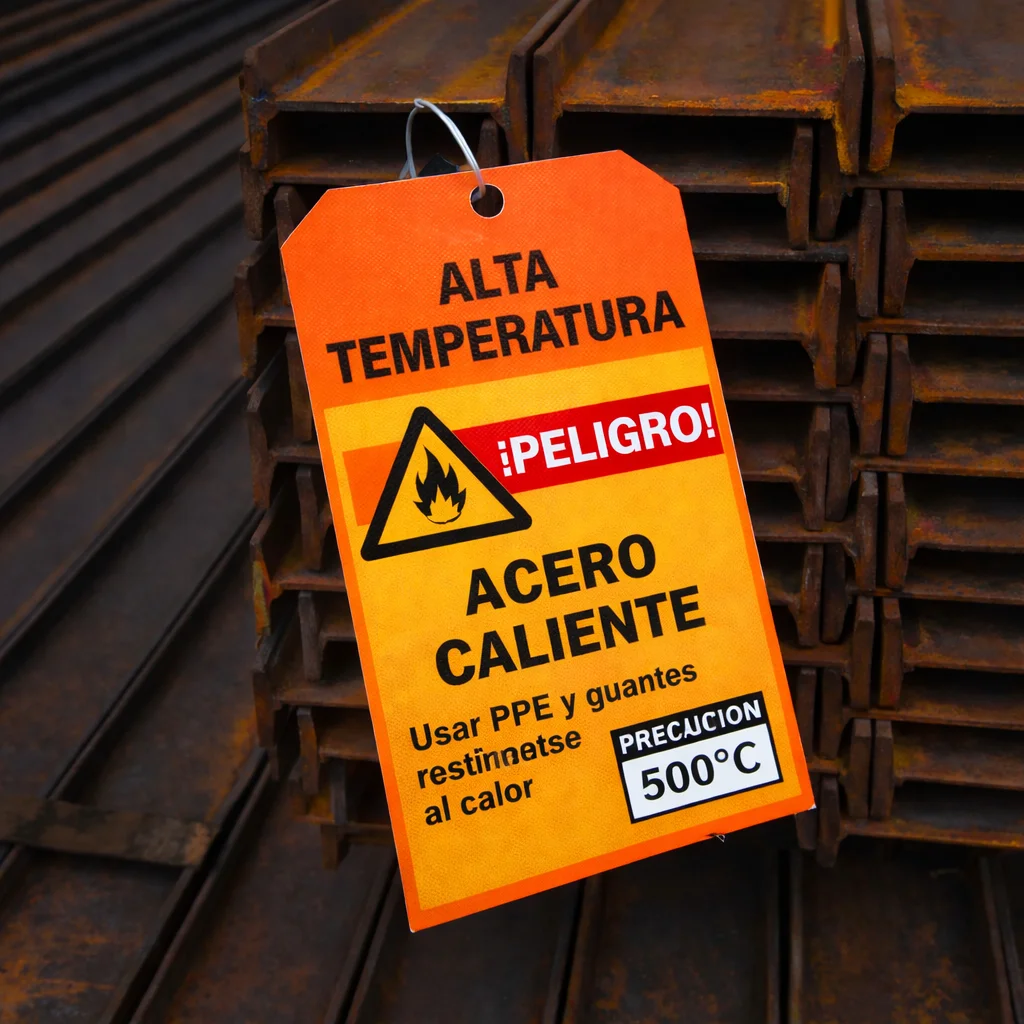
The HOT 151 model resists up to 500 °C in short-duration exposures. It is a white polyimide film printable by thermal transfer (TTR), designed for steelworks, blast furnaces, immersion in concentrated hydrochloric acid and extreme processes where no other material can withstand the full cycle. Mechanical fixing only. See the HOT 151 data sheet.
Which label is right for a powder coating or curing oven?+
Powder coating and curing ovens typically run between 180 °C and 220 °C. For that range, the KPK 842 (up to 200 °C) or KPK 800 (up to 320 °C) model is the usual choice for short cycles: those temperatures correspond to exposures of up to 10 minutes, not continuous service. If your curing cycle is longer, tell us the actual process duration. If the part is labelled before entering the oven, the label must be fixed mechanically or with adhesive validated for that temperature.
What happens if heat exposure is continuous rather than a brief peak?+
Continuous exposure is the most demanding scenario. The material needs a real margin above the process temperature: being within the nominal range is not enough if exposure lasts for hours. For sustained temperature, the right solution is adhesive-free ARGIPRINT° tags with mechanical fixing: KPK laminates go up to 350 °C and the HOT 150/151 polyimide film covers 350 to 500 °C, but only in short-duration exposures.
Do you also supply the fixing elements?+
Yes. In addition to the labels, we supply hooks, clips and weld studs compatible with the ARGIPRINT° range. If you need a complete identification and fixing solution, we can offer it.
Can you send a sample before production?+
Yes. In processes where temperature or chemistry raise doubts about the right model, it is standard practice to run a sample test before starting production.
Do these labels work in areas with combined water and heat (steam, hot washing, pickling)?+
Yes. For processes where heat coexists with moisture, steam or a liquid bath — industrial washers, hot acid pickling, steam ovens or immersion cooling cycles — the base material and adhesive are selected to withstand the combination of both demands. A label resistant to combined water and heat requires a validation specific to the customer's process, since the usual degradation does not come from heat alone or water alone, but from the combined cycle. For environments where moisture is the dominant factor without extreme temperature, see labels for moisture and the cold chain.