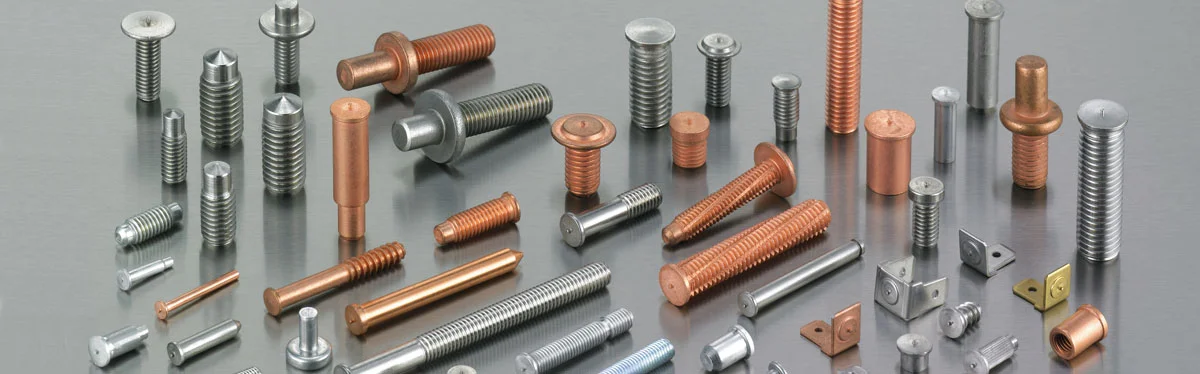
When you decide to use stud welding to anchor an identification system, there are two purchases: the welding machine —which pays for itself over years— and the studs, which are the consumable used up on every operation. The choice of machine determines which process is possible; the choice of stud determines whether the bond withstands service conditions and whether the label's fixing system works correctly. This guide covers the second decision.
What a weld stud is as a consumable
A weld stud is a small metal part —generally between M3 and M25 in diameter— that is metallurgically joined to a metal surface by an electric arc or capacitor discharge process. Unlike a conventional threaded bolt that is screwed in, the weld stud partially melts and becomes integrated into the base material: it cannot be removed without cutting or grinding.
Anatomy of the stud: tip, shank and head
All weld studs share the same basic structure. The tip is the end that contacts the substrate: it has a special geometry —conical, with aluminium flux coating on arc models— that concentrates the energy of the arc or discharge and ensures controlled fusion. The shank is the body of the stud, whose length varies by application. The head is the end opposite the weld, and is the part that determines how the label is fixed: it can be threaded, plain or internally threaded.
Reference standard
Weld studs are standardised under EN ISO 13918, which defines geometries, tolerances and mechanical properties. When specifying a stud, the reference includes the type (PT, UT, IT, PD…), the nominal diameter and the length before welding. After welding, the stud loses between 1 and 3 mm of length as the tip fuses, which is why specifications always state the length before welding.
The weld stud is permanent. Once welded, the anchor is metallurgical and irreversible. If the identification needs to be movable or replaceable, the right system is a hook or a strap, not a stud.
Stud types: head, process and application
The stud type is defined mainly by the shape of its head —which determines how the label or carrier connects— and by the welding process it is designed for, which sets the range of compatible diameters and materials.
Threaded stud (PT / PD): the most common in identification
The threaded stud has an external thread on the head, just like a screw. It is the most common type in identification systems: the stud is welded to the part and a nut or label-carrier bracket is screwed onto the thread. It allows the label to be replaced without touching the anchor. The PT model is designed for the capacitor discharge process (Ø 2–10 mm); the PD model corresponds to the ceramic ferrule arc process (Ø 2–25 mm). For most industrial identification applications, the M4–M8 range covers 90% of cases.
Plain stud (UT / UD): for hooks and pins
The plain stud has no thread: it is a cylindrical shank that is welded to the part and serves as a hooking point. A hook or a ring is fitted onto it, or the wire of a hang tag is passed through it. It is the alternative when a thread is not wanted —because the area is dirty or is expected to fill with rust or weld spatter— or when the label's fixing system is a hook that simply slides onto the stud. The UT model is for capacitor discharge; the UD for ceramic ferrule arc.
Internal-thread stud (IT): a clean anchor on the surface
The internal-thread stud has a female thread in the head: after welding, the surface is left practically flat and the screw or carrier enters from above. It is the right type when space above the surface is limited, when a visually cleaner finish is wanted, or when the label carrier is fixed with a screw from the outside instead of screwing onto a shank. Available for the capacitor discharge process.
Summary table: stud types and process compatibility
| Type | Code | Process | Diameter | Use in identification |
|---|---|---|---|---|
| External thread | PT (CD) / PD (ARC) | CD / ARC | Ø 2–25 mm | Threaded carriers, label brackets, nuts |
| Plain | UT (CD) / UD (ARC) | CD / ARC | Ø 2–25 mm | Hooks, rings, hang tags |
| Internal thread | IT (CD) | CD | Ø 2–10 mm | Carriers fixed with a screw from above |
Stud material: when to use each alloy
The stud material must be compatible with the substrate material. A bond between incompatible materials can be brittle, generate galvanic corrosion in the weld area, or simply fail to fuse correctly. There are four options available depending on the process.
Copper-coated steel (4.8) — the standard option
This is the most common and most economical material. The copper coating makes arc starting easier and improves electrical conductivity in the contact area. It welds onto carbon steel with no complications. Its mechanical properties (Rm ≥ 420 N/mm², yield strength ≥ 340 N/mm²) are sufficient for any industrial identification application. It is not the right choice in prolonged damp environments, acids or wash-down cycles, where unprotected steel can corrode in the weld area.
Stainless steel 1.4301/03 (A2-50) — for corrosive environments
A2-50 stainless (equivalent to AISI 304) is the choice when the environment involves sustained moisture, exposure to dilute acids, marine environments, installations with frequent cleaning or the food industry. Its mechanical properties are superior to standard steel (Rm ≥ 500 N/mm², Rp0.2 ≥ 210 N/mm²). It welds well onto stainless steel; it can also be welded onto carbon steel when corrosion resistance is only needed at the surface.
CuZn37 brass — conductivity and special applications
Brass is available exclusively for the capacitor discharge process and in small diameters (up to around M8). Its main use in industrial identification is in earthing systems or when the identified part needs an electrically conductive anchor. It is also used in environments where the visual appearance of the anchor matters, as brass does not corrode noticeably indoors.
Aluminium (Al99.5 / AlMg3) — only for aluminium substrates
Aluminium studs are necessary when the substrate is aluminium. Welding a steel stud onto aluminium is not viable: the expansion coefficients are incompatible and the metallurgical bond does not form correctly. Al99.5 aluminium (high purity, more ductile) and AlMg3 (magnesium alloy, higher mechanical strength: Rm ≥ 230 N/mm²) cover the two application ranges. They are preferably welded by capacitor discharge; using them on arc equipment requires specific configuration and shielding gas — contact us.
⚠ Material compatibility
Never weld a steel stud onto aluminium or an aluminium stud onto steel. The bond does not form correctly and there is a risk of accelerated galvanic corrosion. Likewise, on galvanised substrates or those with special coatings, check compatibility before selecting the stud material.
Compatibility table: substrate × stud material × process
| Substrate | Stud material | Recommended process | Note |
|---|---|---|---|
| Carbon steel | Steel (4.8) | CD / SC / ARC | Standard combination, maximum economy |
| Carbon steel (corrosive) | Stainless A2-50 | CD / SC | Corrosion resistance in the weld area |
| Stainless steel | Stainless A2-50 | CD / SC | Avoids galvanic corrosion; ARC also possible |
| Aluminium | Al99.5 / AlMg3 aluminium | CD | Mandatory; special tip for aluminium |
| Galvanised steel | Steel or stainless A2-50 | SC | Short cycle penetrates the coating better |
Process abbreviations: CD = Capacitor Discharge (Ø 2–10 mm, times < 10 ms, no visible heat-affected zone); SC = Short Cycle (arc variant with reduced time, Ø 3–12 mm, suitable for coated substrates); ARC = Electric Arc with ceramic ferrule (Ø 2–25 mm, greater penetration and large diameters).
How to specify a stud: the four data points
When ordering weld studs, the complete specification includes: (1) the stud type per EN ISO 13918 (PT, UT, IT, PD…); (2) the nominal diameter in mm or metric equivalent (M4, M5, M6…); (3) the length before welding in mm — remember that 1 to 3 mm is lost after welding; and (4) the material (steel, stainless, brass, aluminium). A complete example would be: PT M6 × 20 stud, 4.8 steel, for capacitor discharge. With these four data points you can verify the catalogue reference and ensure compatibility with the available welding equipment.
"Specifying the right stud is not just about choosing the diameter: it is about making sure the head type suits the label's fixing system and that the material withstands the environmental conditions without degrading the bond."
Need weld studs for your identification system, or not sure which reference to specify?
Ask about a referenceSummary
For most industrial identification applications on steel —label with threaded carrier on 1–4 mm sheet— a PT M5 or M6 stud in copper-coated steel by capacitor discharge covers the most frequent use case. A2-50 stainless comes in when the environment is corrosive. Aluminium is mandatory if the substrate is aluminium. The plain UT stud is the alternative when the label carrier hooks on instead of screwing on.
Studs are supplied in boxes or trays by process and material. If you need advice on the right type, diameter or material for your application, tell us the substrate, the approximate sheet thickness and the label fixing system you use.
Frequently asked questions
What exactly is a weld stud?
A small metal part — generally M3 to M25 in diameter — joined metallurgically to a metal surface by electric arc or capacitor discharge. Unlike a conventional threaded bolt, it is not screwed in: it partially melts and becomes integrated into the base material, so it cannot be removed without cutting or grinding.
What parts does it have, and which one determines how the label is fixed?
Point, shank and head. The point has a special geometry that concentrates the energy of the arc or the discharge; the shank gives the length; and the head is what determines how the label is attached: it can be threaded, plain or internally threaded.
Are they standardised?
Yes, by EN ISO 13918, which defines geometries, tolerances and mechanical properties. When specifying a stud, the reference includes the type — PT, UT, IT, PD… —, the nominal diameter and the length.