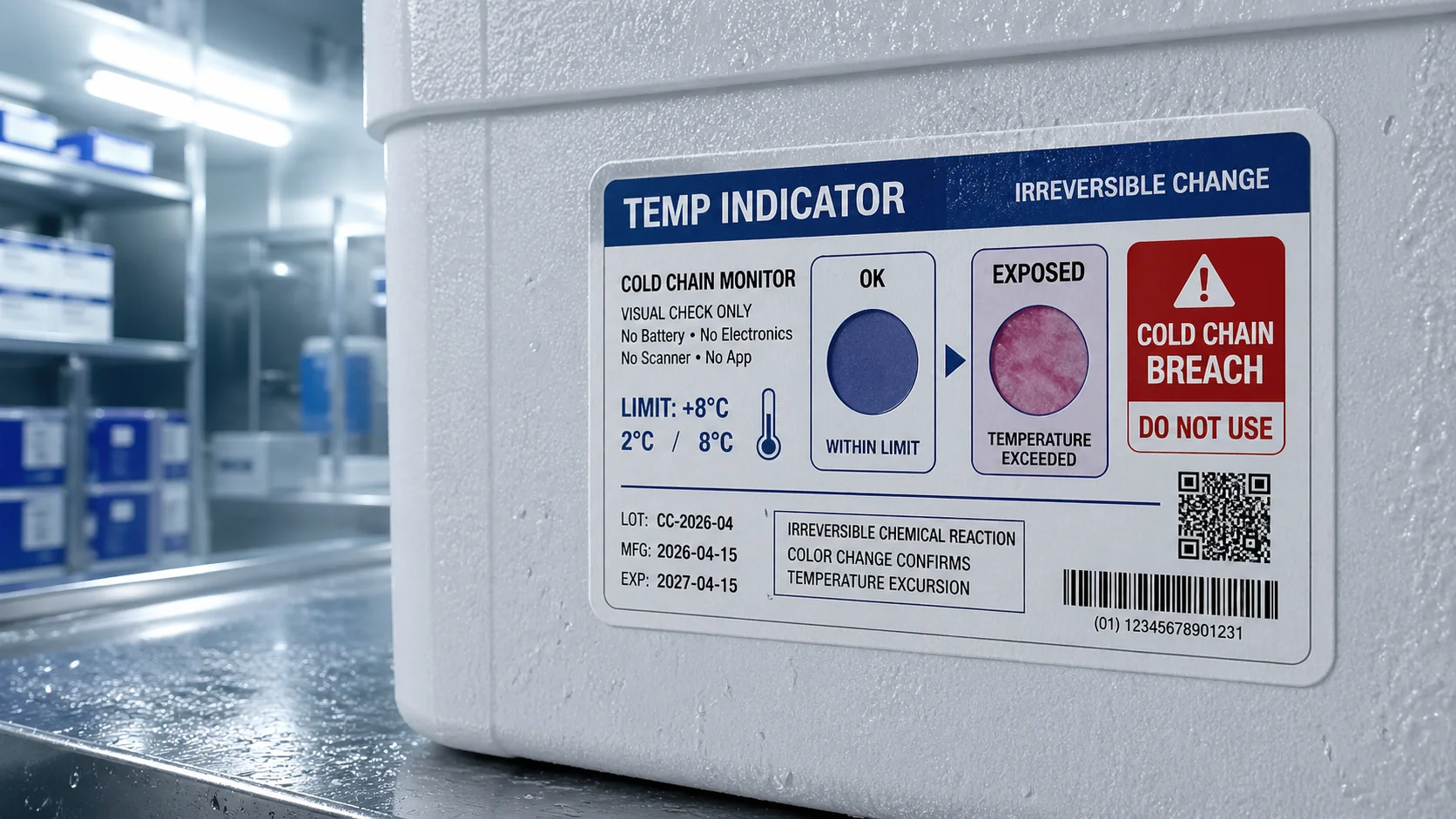
Imagine a label that shows "correct" right up until the moment the temperature crosses the critical threshold. At that instant it changes colour —or reveals text, or an irreversible stripe— and that state can't be undone. No batteries, no electronic sensor, no special reading system. Just a chemical reaction visible to the naked eye. That's a photochromic temperature label: the simplest, most reliable mechanism for knowing whether the cold chain has been broken.
The ink that changes colour: microcapsules and heat reaction
The operating principle is chemical, not electronic. The ink used to print the label's reactive zone contains microcapsules —extremely small spheres, invisible to the naked eye— that encapsulate a leuco dye together with a weak organic acid. Under normal conditions, the combination keeps the dye in its oxidised form: colourless or with a set colour (for example, clear or blue).
A note on terminology: the mechanism described —a leuco dye activated by temperature— technically corresponds to thermochromic inks. In the market, this type of indicator label is usually sold as "photochromic", and this guide uses that commercial name.
When the temperature crosses the design threshold —it could be 8 °C, 25 °C or whatever value the application requires— the capsule melts or opens, the chemical balance shifts and the dye switches to its reduced form: the alert colour appears. If the design is irreversible —as in most cold-chain control applications— that change is permanent even if the temperature drops again afterwards.
Irreversibility is the key: once the label shows that the temperature was exceeded, there's no way to hide that it happened. It doesn't matter if the product is cooled down again. The evidence remains.
The go/no-go logic: no electronics, no reading failures
The main advantage of a photochromic label over an electronic temperature data logger isn't the price —although that too— it's the absence of failure points. A data logger can run out of battery, can fail an NFC or Bluetooth reading, can be forgotten in the warehouse, or simply not be checked. A photochromic label has none of that. It's right there, in plain sight, and the outcome is binary: green or red, correct or alerted.
This go/no-go logic ("proceed" or "don't proceed") is especially valuable at entry points where a fast decision has to be made: goods-in at a cold store, checking a pharmaceutical delivery, a customs inspection of a food shipment. The operator doesn't need a terminal, an app, or special training. Just a look.
⚠ When it's not enough
If the application requires a continuous historical record of temperatures —full curve, timestamps, export to a quality system— the photochromic label isn't the right tool. In those cases, the data logger is still the solution. The photochromic label covers the most common use case: knowing whether the limit was crossed, with or without a detailed record.
Where they're used: pharma, food and cold logistics
The three sectors adopting this technology fastest share a common problem: high-value products that deteriorate —or become outright dangerous— if the temperature strays out of range during transport or storage.
Pharma and biology
Vaccines, biological medicines and laboratory reagents have very strict temperature ranges, usually between 2 °C and 8 °C. A cold-chain break can invalidate the product silently —with no visible sign— until the patient or the lab uses it. A photochromic label calibrated at 8 °C turns that invisible break into a signal impossible to ignore: the package arrives with the alert zone activated, or it doesn't.
Food and cold chain
The food industry uses these labels mainly on fresh and ultra-fresh products moving through several points of the supply chain: from plant to distributor, from distributor to supermarket. At each handover, the label offers instant verification with no need for thermometers or equipment. The threshold is calibrated by product type: a 5 °C threshold for dairy, 0 °C for fresh fish, or −18 °C for frozen goods.
E-commerce logistics for sensitive products
The growth of e-commerce for food, premium cosmetics and supplements has created a new use case: the end recipient needs to know whether the parcel they received kept the correct temperature. The photochromic label applied to the packaging answers that question before the box is opened. It's simpler and much cheaper than an electronic logger, although the logger remains superior when a temperature history is needed.
“The value of the photochromic label isn't measuring temperature: it's letting anyone, anywhere in the chain, know, with no equipment or training, whether the product has been kept correctly.”
How it fits into packaging and printing
A photochromic label is, physically, a standard self-adhesive label. At the customer's facilities it's printed in roll form with thermal transfer or colour inkjet printers, reserving the reactive zone for the photochromic ink. This allows a single label to combine: barcode or QR code, batch and expiry data, product information and the thermal indicator.
Integration into a packaging line is straightforward: the label is applied just like any other pressure-sensitive label. There's no extra process, no prior activator. It just needs to be kept in suitable conditions (usually cold) before application, to avoid premature activation.
| Parameter | Typical range | Note |
|---|---|---|
| Activation threshold | −25 °C to +60 °C | Configurable according to application |
| Response time | Seconds to minutes | Depends on the formulation and the temperature delta |
| Reversibility | Irreversible (standard) or reversible | Control applications usually require irreversible |
| Shelf life before activation | 12–36 months (stored cold) | Check the supplier's conditions |
| Print compatibility | TT, colour inkjet | Avoid excessive printhead heat over the reactive zone |
Do you work with temperature-sensitive products? We'll guide you on the labelling options for your cold chain.
Ask with no obligationSummary
Photochromic temperature labels are a simple, reliable and economical solution for the most common use case in cold-chain control: knowing whether the thermal threshold was crossed at any point along the route. They don't record a historical curve —that's what data loggers are for— but they offer something no data logger gives: a visual, immediate and irreversible response that anyone can read with no equipment.
The technology is mature, integration into a packaging line is straightforward, and the unit cost fits high-volume applications. Pharma, food and e-commerce logistics are the sectors adopting it fastest, but the applicability is much broader: any valuable product that travels with a thermal requirement can benefit.
Frequently asked questions
How does a temperature-indicating label work?
The principle is chemical, not electronic. The ink contains microcapsules holding a leuco dye together with a weak organic acid. When the temperature passes the design threshold, the capsule melts or opens, the chemical balance shifts and the alert colour appears. No battery, no electronic sensor and no special reader.
Can the colour change be undone?
In most cold-chain monitoring applications the design is irreversible: once the label shows that the temperature was exceeded, there is no way to hide that it happened, even if the product is chilled again.
Are they photochromic or thermochromic?
The mechanism described — a leuco dye activated by temperature — is technically thermochromic. In the market these indicator labels are usually sold as photochromic, and that is the commercial term used here.
What temperature threshold can be set?
Whatever the application requires: 8 °C, 25 °C or the value that matches the product and the process.