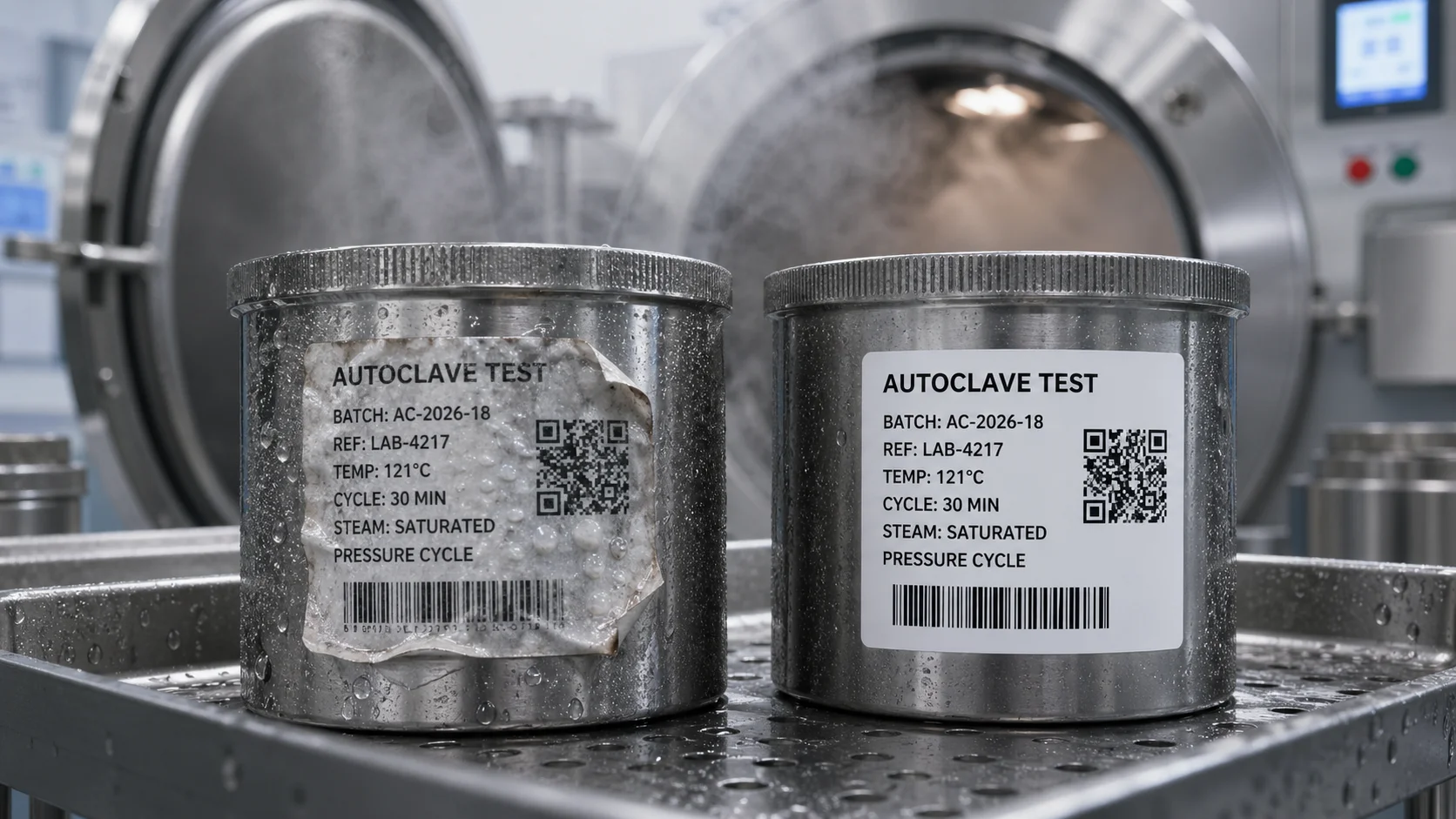
An autoclave isn't simply high heat. It's the combination of three simultaneous factors that no conventional material withstands without an explicit specification: sustained temperature of 121 °C in a standard cycle (134 °C in a rapid cycle), 100% saturated steam that penetrates any adhesive-substrate interface, and pressure of between 1 and 2 bar that compresses and then releases the structure of the label/substrate assembly. Each factor alone would already be demanding. Together they produce cascading failures.
What happens to a standard label in an autoclave cycle
The first factor at work is temperature. Most conventional acrylic adhesives have a softening point below 121 °C: as soon as the adhesive reaches that temperature, it flows, loses internal cohesion and stops holding the face material against the surface. Steam does the rest: it penetrates the weakened interface and breaks the contact irreversibly.
The second factor is saturated steam. Paper absorbs moisture instantly and is destroyed within seconds. Synthetic materials hold up better, but steam still penetrates the adhesive-surface interface and, if the adhesive isn't formulated for that temperature, the result is the same: lifting. In addition, wax or water-based inks dissolve or come away completely.
The third is pressure. During the cycle, pressure compresses the label/substrate assembly. At the end of the cycle, pressure drops rapidly: that decompression creates microbubbles at the adhesive-surface interface that end up wrinkling or lifting the label even if it survived the thermal phase.
All three factors act simultaneously throughout the cycle. A label that passes the temperature test in a lab at ambient pressure isn't a label validated for autoclave use.
The four most common failures and their real cause
Failure 1 — The label lifts during or after the cycle
Conventional acrylic-based adhesive has a softening point below 121 °C. On reaching that temperature, it flows, loses cohesion and stops holding the face material. Steam penetrates the weakened interface and breaks the contact irreversibly.
✓ Solution
High-temperature adhesive formulated specifically for autoclave use, with a certified working temperature equal to or above that of the cycle (121 °C or 134 °C depending on the process).
Failure 2 — The material shrinks, wrinkles or deforms
Paper absorbs steam instantly and is destroyed within seconds. Even synthetic materials without an autoclave specification can shrink: standard polypropylene has a heat deflection temperature (HDT) that can sit close to 121 °C. Polyester (PET) holds up better, but not all grades are equivalent.
✓ Solution
High-temperature polyester with a certified HDT above 135 °C. For standard cycles at 121 °C, some high-HDT polypropylenes are also valid, but they require explicit validation.
Failure 3 — The text or code disappears or becomes illegible
Inkjet inks and wax or wax-resin ribbons don't survive saturated steam: the ink dissolves or lifts off during the cycle. Even mid-quality resin ribbons can degrade if they aren't formulated for temperatures above 100 °C in a humid environment.
✓ Solution
High-temperature pure resin ribbon with explicit autoclave validation, or thermal transfer printing on polyester with certification for the process.
Failure 4 — The label survives but the information is compromised
This is the most dangerous failure because it isn't visible to the naked eye. The label stays adhered and the text looks legible, but the barcode has lost enough contrast for the scanner to fail intermittently. It happens when the ribbon or ink has partially degraded without it being obvious on visual inspection.
✓ Solution
Verify code readability to ISO/IEC 15416 or equivalent after the validation cycles. The acceptance threshold must be agreed before production, not after.
⚠ Multiple cycles
Many processes subject the same materials to several autoclave cycles. The specification must state how many cycles are required, not just whether it survives one. A material that passes 1 cycle can fail on the third if the adhesive accumulates progressive thermal degradation.
| Failure | Typical cause | Specification key |
|---|---|---|
| Lifting during cycle | Conventional adhesive below cycle temp. | Autoclave adhesive ≥ cycle temp. |
| Material deformation | Face material HDT below cycle temp. | High-temp. PET with HDT > 135 °C |
| Illegible text / ink lifting | Wax ribbon or inkjet ink | High-temp. resin ribbon + validation |
| Illegible code post-cycle | Partial contrast degradation | Post-cycle ISO verification, not just before |
How to specify correctly: five questions before choosing
Without answering these questions, any material recommendation is a guess. With them, the specification is straightforward and validation is fast.
- What's the temperature and type of cycle? 121 °C (standard type B or S cycle) or 134 °C (prion cycle, rapid cycle). Materials valid for 121 °C aren't always valid for 134 °C. It's the first figure to fix before any other consideration.
- How many cycles must the label withstand? Instruments sterilised once before use (single-cycle label) versus reusable instruments that accumulate 50, 100 or more cycles. The number of cycles changes the adhesive choice and, sometimes, the face material.
- What surface is it applied to? Stainless steel, high-temperature plastic, glass or technical textile. The substrate's surface energy shapes the adhesive choice. Low-energy surfaces (some plastics) need adhesives with specific formulas even if they're high-temperature.
- What information must survive and how is it read? If the label carries a barcode or datamatrix read by a scanner, post-cycle verification is mandatory. If it carries human-readable text, the requirement is looser, although visual contrast must be maintained.
- Are there additional traceability or regulatory requirements? For medical devices, UDI requires the label to remain legible throughout the device's service life, including all its sterilisation cycles. In food applications, the material may need to be food-contact safe even after sterilisation.
“Specifying an autoclave label starts with the number of cycles and the temperature, not the material. With those two figures on the table, the selection is technical. Without them, it's a gamble.”
Common combinations by process type
| Process | Face material | Adhesive | Printing |
|---|---|---|---|
| Medical instruments, 121 °C cycle, 1–5 cycles | High-temp. white PET | High-temp. acrylic > 130 °C | TT resin ribbon |
| Reusable instruments, > 50 cycles | Metallised PET | Epoxy or speciality adhesive | Laser engraving or UV printing |
| 134 °C cycle (prions) | High-temp. PET certified to 150 °C | Speciality adhesive > 140 °C | TT special resin ribbon |
| Laboratory, cycle < 121 °C, few cycles | High-HDT PP or standard PET | High-temp. acrylic > 130 °C | TT resin ribbon |
Need to specify labels for your sterilisation process? Tell us the cycle temperature, the number of cycles and the surface.
Ask with no obligationSummary
The autoclave destroys standard labels through the simultaneous combination of temperature, saturated steam and pressure. The four most common failures —lifting, deformation, ink loss and illegible codes— have known causes and available material solutions.
No material is universally valid: the correct specification depends on the cycle temperature, the number of cycles, the application surface and post-cycle legibility requirements. Validation under real conditions isn't optional in regulated environments. A label that passes one cycle in a lab at ambient pressure isn't a label validated for autoclave use.
Frequently asked questions
What makes an autoclave cycle so demanding?
That it is not just heat. Three factors act at once: sustained temperature of 121 °C in a standard cycle — 134 °C in a fast cycle —, 100 % saturated steam that penetrates any adhesive-substrate interface, and pressure of between 1 and 2 bar. Each one alone would already be demanding.
Why does a standard label come off?
Because most conventional acrylic adhesives soften below 121 °C: the adhesive flows, loses internal cohesion and stops holding the face material against the surface. The steam does the rest, penetrating the weakened interface.
Is a material that survives 121 °C in the laboratory enough?
Not on its own. A label that withstands the temperature at ambient pressure is not a label validated for autoclave: at the end of the cycle the pressure drops sharply, and that decompression creates microbubbles that wrinkle or lift the label even after it has survived the thermal phase.
What happens to the print?
Wax or water-based inks dissolve or come off completely. And paper absorbs moisture immediately and is destroyed in seconds.