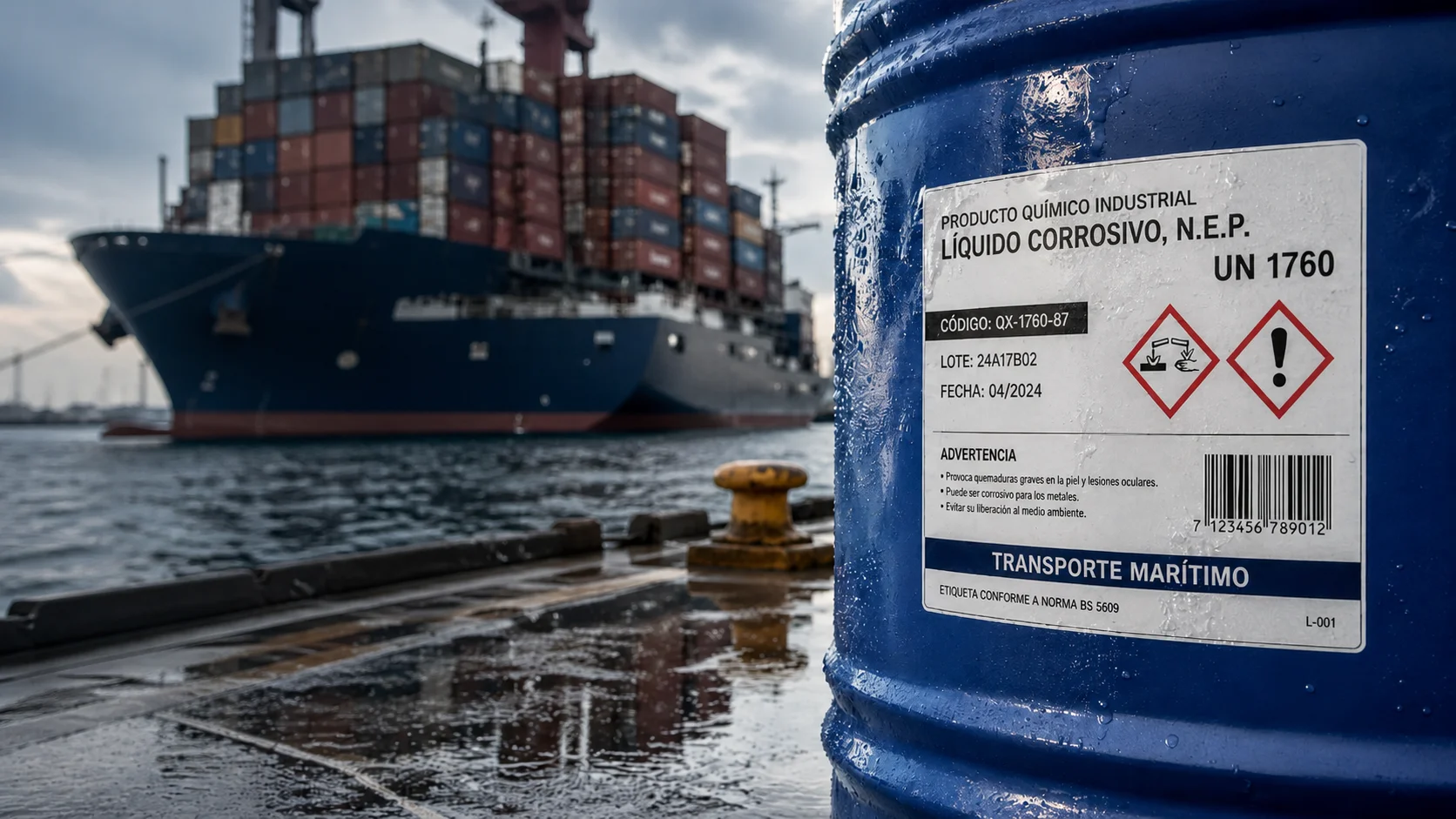
A GHS label on a drum of acid leaving Spain for Rotterdam seems like a minor detail. It isn't. If that label doesn't meet the BS 5609 standard, the shipment can be held at port, the consignee can reject the goods and, in the event of an accident, the exporting company can be found liable. All because of a label that didn't withstand the moisture of the sea.
What the BS 5609 standard is and why it exists
BS 5609 is a technical standard of British origin, adopted internationally for labelling dangerous goods in sea transit. Its purpose is very specific: the marine environment is one of the most aggressive for any material. Moisture, salt, temperature changes and prolonged UV exposure destroy in weeks labels that would last years under normal warehouse conditions.
The IMDG Code (International Maritime Dangerous Goods Code), which regulates the sea transport of dangerous goods worldwide, requires GHS labels on sea shipments to meet the requirements of BS 5609. It isn't optional: it's an obligation for any company that exports or imports classified chemical products by sea.
BS 5609 doesn't regulate what information the label must carry — that's covered by the CLP Regulation and the IMDG Code. What it regulates is the physical construction of the label: the material, the adhesive and the ink. The content can be correct and the label can still fail to meet the standard.
The three sections of the standard
The standard is structured in three parts with different requirements, although in practice all three must be met simultaneously:
- Section 1: general requirements and assessment procedures. Defines how the tests are carried out and which conditions must be controlled.
- Section 2: specification of the self-adhesive base material. This is where the demanding test lives: the face material and adhesive must keep the label adhered and legible after three months of immersion in artificial salt water.
- Section 3: specification of the printed label. The print must not fade, run or lift under UV exposure and moisture.
What materials and inks pass the standard
The three-month salt water test is demanding. It practically rules out paper, standard polypropylene and any rubber-based adhesive. Only one specific combination of materials reliably meets the standard's three requirements.
The face material: polyester (PET)
Polyester is the only face material that combines total impermeability, dimensional stability in water and enough UV resistance to pass Section 2. Paper absorbs water and falls apart. Polypropylene can tolerate moisture but doesn't keep the print under prolonged immersion. Polyester, on the other hand, doesn't swell, doesn't wrinkle and doesn't absorb the saline solution.
The adhesive: high-performance permanent acrylic
Rubber-based adhesives —the most common and economical— lose adhesion under sustained moisture. High-performance permanent acrylic adhesive, by contrast, keeps its bond strength during and after immersion. It's the only type that guarantees the label stays adhered to the HDPE drum after 90 days in salt water.
The ink: pure resin ribbon
Section 3 of the standard requires the print not to bleed or lift under UV exposure and moisture. A wax ribbon loses the print within days; a wax-resin ribbon can bleed. Only pure resin ribbon fuses the ink with the polyester face material, forming a bond that salt water neither breaks nor discolours. What's more, the resin doesn't lift with water swelling because, on PET, there's no swelling to manage.
| Component | What passes the standard | What doesn't pass it |
|---|---|---|
| Face material | White or clear polyester (PET) | Paper, standard PP, soft vinyl |
| Adhesive | High-performance permanent acrylic | Rubber-based, standard acrylic |
| Ink | Pure resin ribbon | Wax, wax-resin |
| Overprint varnish | No varnish, or BS 5609-compatible varnish | Standard, untested varnishes |
⚠ Certification is combination-specific
The BS 5609 certificate is issued for a specific combination of face material + adhesive + ink. Changing any of the three components —even for another “equivalent”— invalidates the certificate. If you need to label sea shipments of dangerous goods, always request documentation proving that the complete set has been tested.
How it affects the labelling process
Meeting BS 5609 doesn't change the printing process beyond material selection: you still use a standard thermal transfer printer, still print in roll form. What changes is the order specification.
What to order
- White polyester (PET) label with BS 5609-certified high-performance acrylic adhesive.
- Pure resin ribbon compatible with the selected PET face material.
- Supplier documentation certifying the set.
Sizes and formats
BS 5609 doesn't impose sizes or formats. GHS label size requirements are set by the CLP Regulation according to container capacity. For containers up to 3 L, the label can be 52 × 74 mm. For larger containers, the minimum size increases progressively. What the standard does require is that the label fully covers the hazard pictograms and regulatory text without cropping.
“The BS 5609 test is simple in concept and demanding in outcome: three months in salt water. Few material combinations pass it without specific preparation.”
What happens if the label doesn't meet the standard
Non-compliance with BS 5609 on a sea shipment of dangerous goods can have consequences on several fronts. Operationally, the goods can be held at the destination port by control authorities or rejected by the sea carrier, who is obliged to verify that packaging and labelling comply with the IMDG Code. Legally, in the event of an incident during transit, the deficient label can be considered an aggravating factor in the shipper's liability.
The cost of a held or returned shipment, or of a regulatory penalty, far exceeds the price difference between a standard label and a BS 5609-certified label. The problem isn't the cost of the material: it's not knowing the obligation exists.
Do you ship chemical products by sea and need BS 5609-certified labels? Tell us the type of container, the contents and the estimated volume.
Ask about certificationSummary
The BS 5609 standard requires a dangerous goods label for sea transport to withstand 90 days of immersion in salt water while keeping its adhesion and legibility. Only a combination of polyester face material, high-performance acrylic adhesive and pure resin ribbon reliably passes the standard's three tests. The certificate is mandatory for any company exporting or importing classified chemical products by sea under the IMDG Code.
If your company already uses GHS labels for road shipments and wants to extend to sea transport, the difference isn't in the label's content but in the material specification. A change of face material and adhesive, with the right ribbon, turns an existing label into one that's BS 5609-compliant.
Frequently asked questions
What is BS 5609 and who does it apply to?
It is a British technical standard, adopted internationally for labelling dangerous goods in marine transit. The IMDG code requires GHS labels on sea shipments to meet its requirements, so it is mandatory for any company exporting or importing classified chemical products by sea.
What exactly does the standard regulate?
The physical construction of the label: the material, the adhesive and the ink. It does not regulate what information must appear — that is done by the CLP regulation and the IMDG code — so the content can be correct and the label still fail to meet the standard.
What is the central test?
Immersion of the label for 90 days in artificial seawater at 23 °C. On removal it must still be adhered and legible, and the ink must not have bled.
How is the standard divided?
Into three sections. Section 1 sets general requirements and evaluation procedures. Section 2 specifies the self-adhesive base material, and is where the immersion test lives. Section 3 specifies the printed label. In practice all three must be met at once.