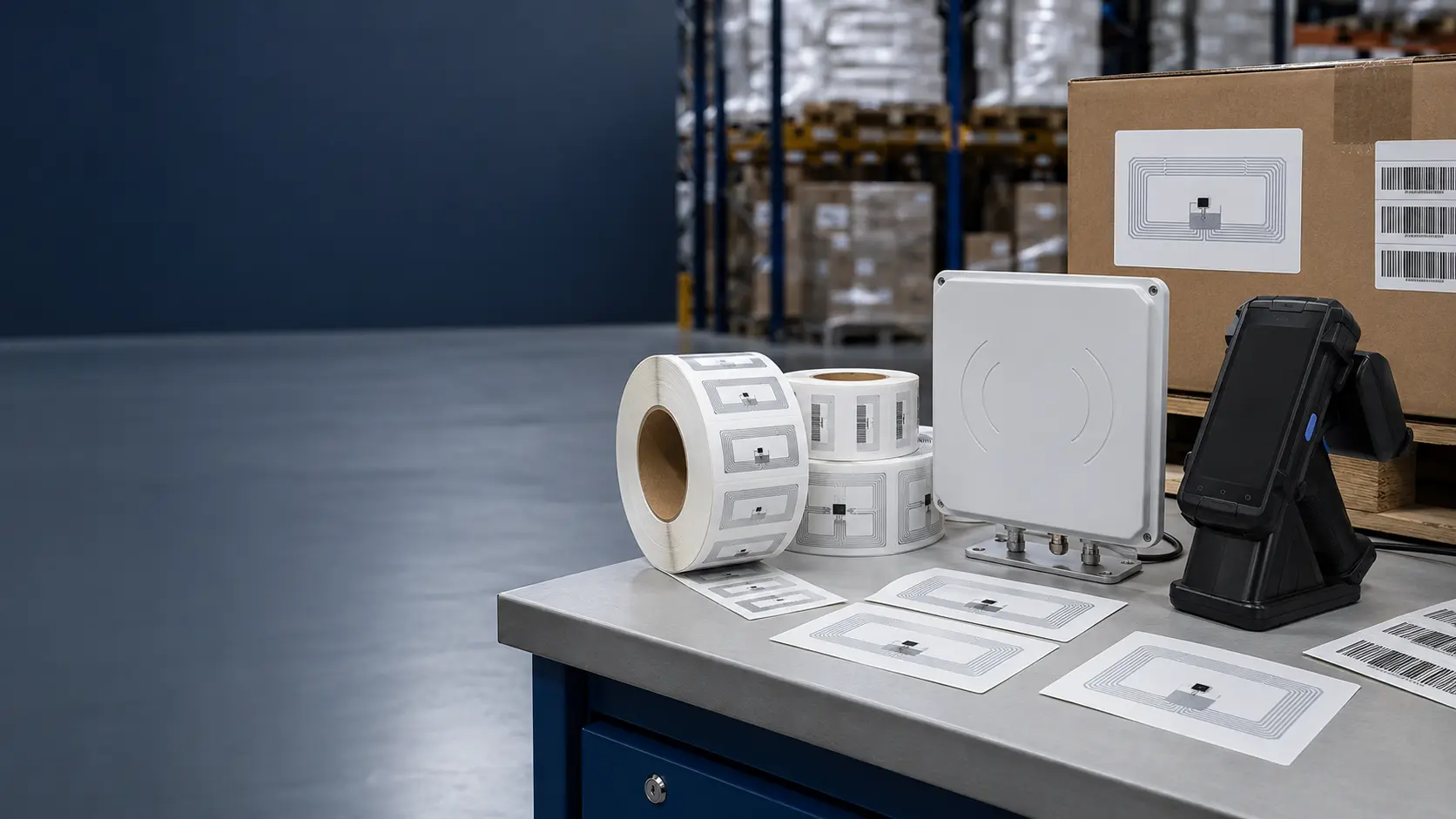
RFID stands for Radio Frequency Identification. The idea is simple: a small label containing a chip and an antenna transmits a unique identifier over radio waves when a reader activates it. It needs no battery to work, it needs no line of sight and, in many cases, it can be read from several metres away. That combination of properties is what has made it the natural replacement for the barcode in many industrial and logistics applications.
This guide is an introduction to the technology, not a catalogue of solutions. If what you need is a specific RFID label for an industrial application —traceability, inventory, dispatch control, on-metal identification— the product detail, specific frequencies and custom conversion are on the RFID labels page.
What is an RFID label
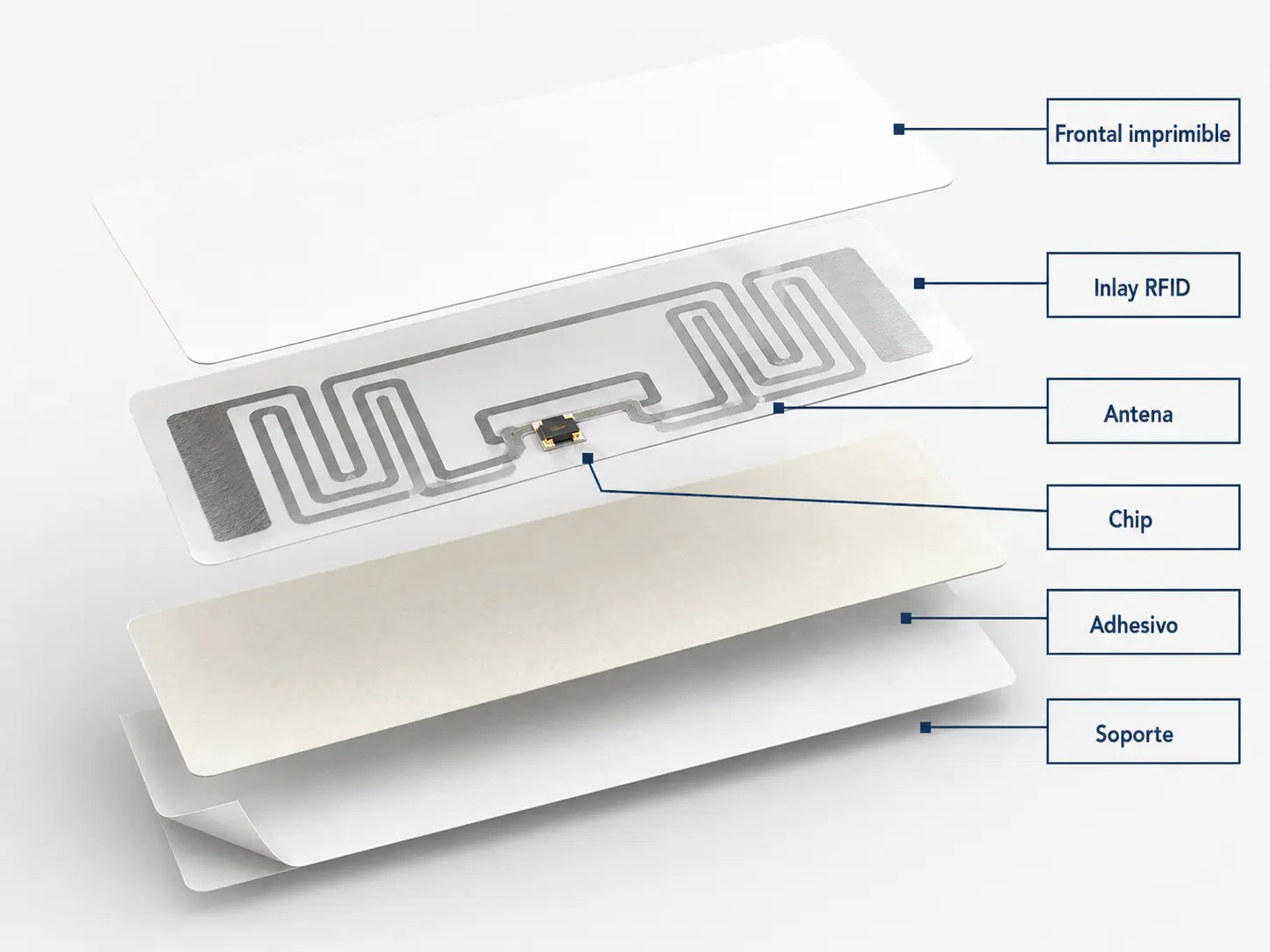
An RFID label, also called a tag or transponder, is a device made up of two essential elements and a physical carrier:
- An integrated chip: stores the unique identifier and, depending on the type, can also store additional rewritable data. It is very small —about the size of a grain of sand— and consumes very little energy.
- An antenna: receives the reader's signal and emits the chip's response. Its shape and size largely determine the read range. It is printed or etched onto a thin substrate, usually copper or aluminium.
- A substrate or encapsulation: protects the chip and antenna, and allows the assembly to be adhered or fixed to the object being identified. It can be a flexible self-adhesive label (industrial passive tag), a rigid plastic capsule (asset tag) or a liquid-resistant wrapper.
The chip+antenna assembly mounted on a substrate is called an inlay. When the inlay is integrated into a ready-to-use label, with a printable face and adhesive, we call it a Smart Label: a conventional label with an RFID chip inside.
Think of an RFID label as an invisible barcode that responds by radio when queried, instead of having to be seen and read optically.
How it works physically
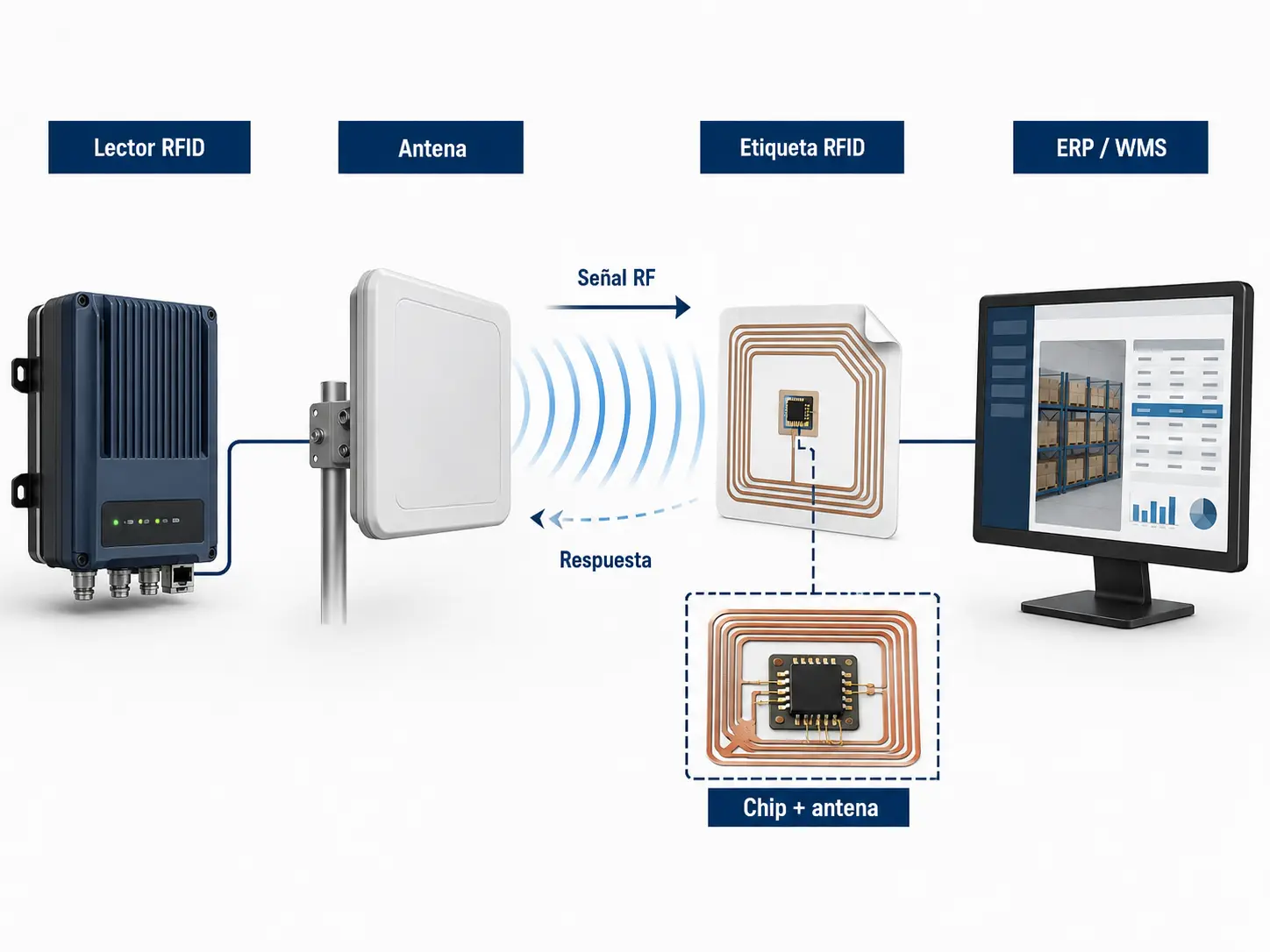
RFID operation relies on a relatively simple physical principle: electromagnetic induction and the propagation of radio waves. An RFID system works in three very fast phases that repeat every time a reader comes into contact with a label.
1. The reader emits an electromagnetic field
The RFID reader has its own antenna and continuously emits an electromagnetic field at a given frequency (LF, HF or UHF, depending on the technology). Any RFID label that enters that field is affected by it.
2. The label "harvests" energy and switches on
In the most common case —passive labels, without a battery— the label's antenna picks up part of the energy from the field emitted by the reader and diverts it to the chip. That small amount of energy is enough for the chip to activate and work for the brief instant the interaction lasts. It is the same physical principle an induction hob uses to heat a pan, but on a different scale.
3. The label responds by modulating the signal
Once activated, the chip sends its unique identifier to the reader. It does so using a technique called backscatter in UHF (modulating the reflection of the reader's field) or by inductive coupling in HF and LF. The reader receives the response, interprets it and sends it to the IT system, which already knows what to do with that identifier: update the inventory, log an entry, open a door, validate a warranty.
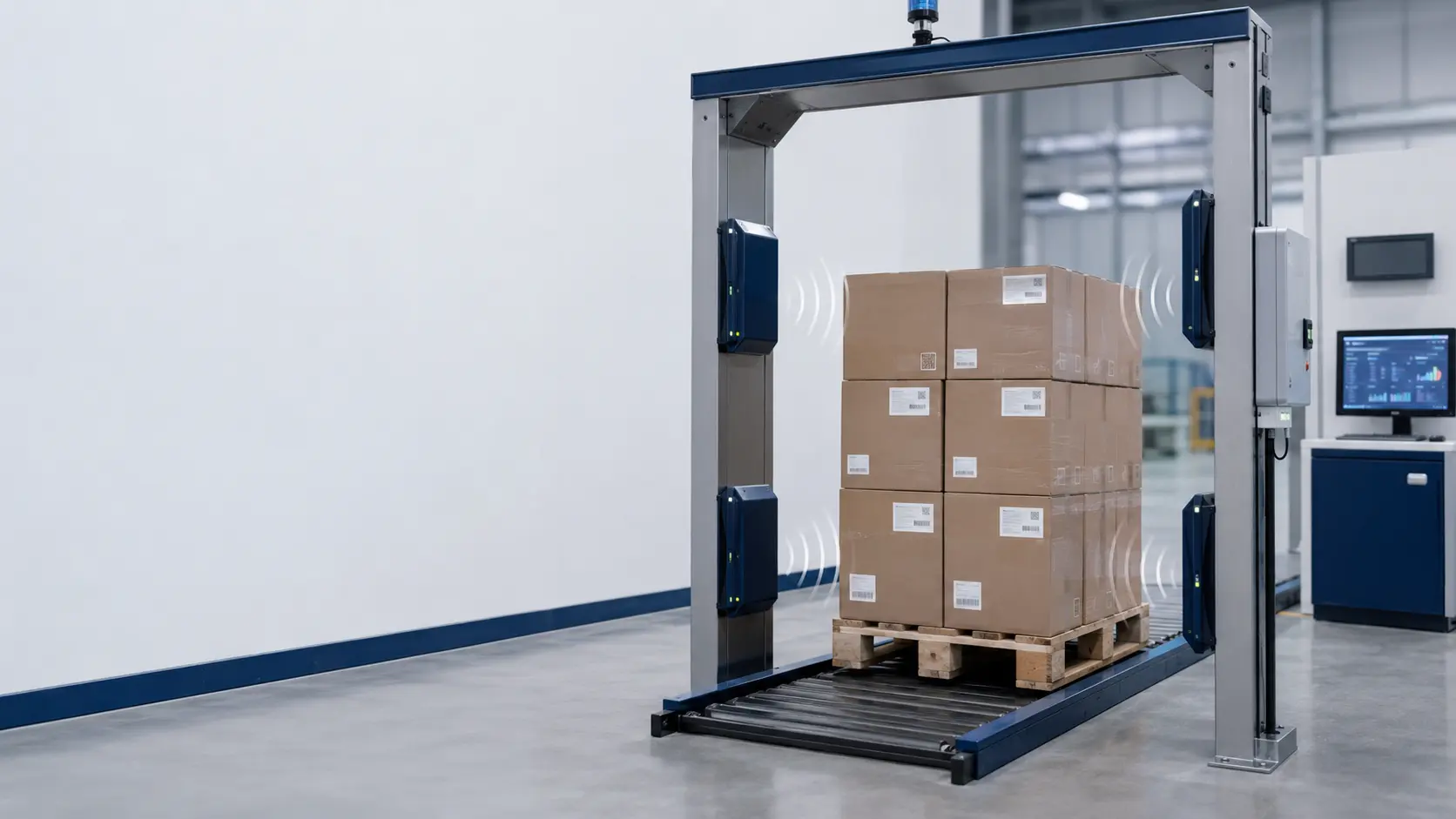
The whole process happens in thousandths of a second. A modern UHF RFID reader can read hundreds or thousands of labels per second within its coverage area, which explains why it is used in warehouse portals or production lines: there is no need to scan one at a time.
RFID frequencies: the full spectrum
RFID technology does not operate on a single frequency. There are four main bands with very different properties. The choice of frequency determines the read range, behaviour on liquids and metals, cost and regional regulation.
| Band | Frequency | Typical range | Key characteristic |
|---|---|---|---|
| LF | 125–134 kHz | Centimetres | Works well on metals and liquids. Slow and short range. |
| HF / NFC | 13.56 MHz | Up to 1 m | Universal standard for NFC and security or payment applications. |
| UHF | 860–960 MHz | Up to 12 m | Logistics standard. Struggles with liquids and direct metal. |
| Microwave | 2.45 / 5.8 GHz | Tens of metres with an active tag | Specialised use: tolls, vehicle access control. |
LF — low frequency (125-134 kHz)
The oldest and most robust frequency. It reads at short range —centimetres— but passes well through water, the human body and other materials that block higher frequencies. It is used in animal identification (subcutaneous microchip), in car immobilisers and in some access control systems. It is not the usual choice in modern industrial applications, where UHF and HF dominate.
HF — high frequency (13.56 MHz) and NFC
Probably the most widely used RFID frequency in the consumer world. It is the basis of NFC (Near Field Communication), the technology smartphones carry for contactless payments and public transport cards. It offers short read ranges (up to one metre) but with good security and good behaviour in the presence of liquids. In an industrial setting it is used for tool identification, laboratory samples, libraries and archives.
UHF — ultra-high frequency (860-960 MHz)
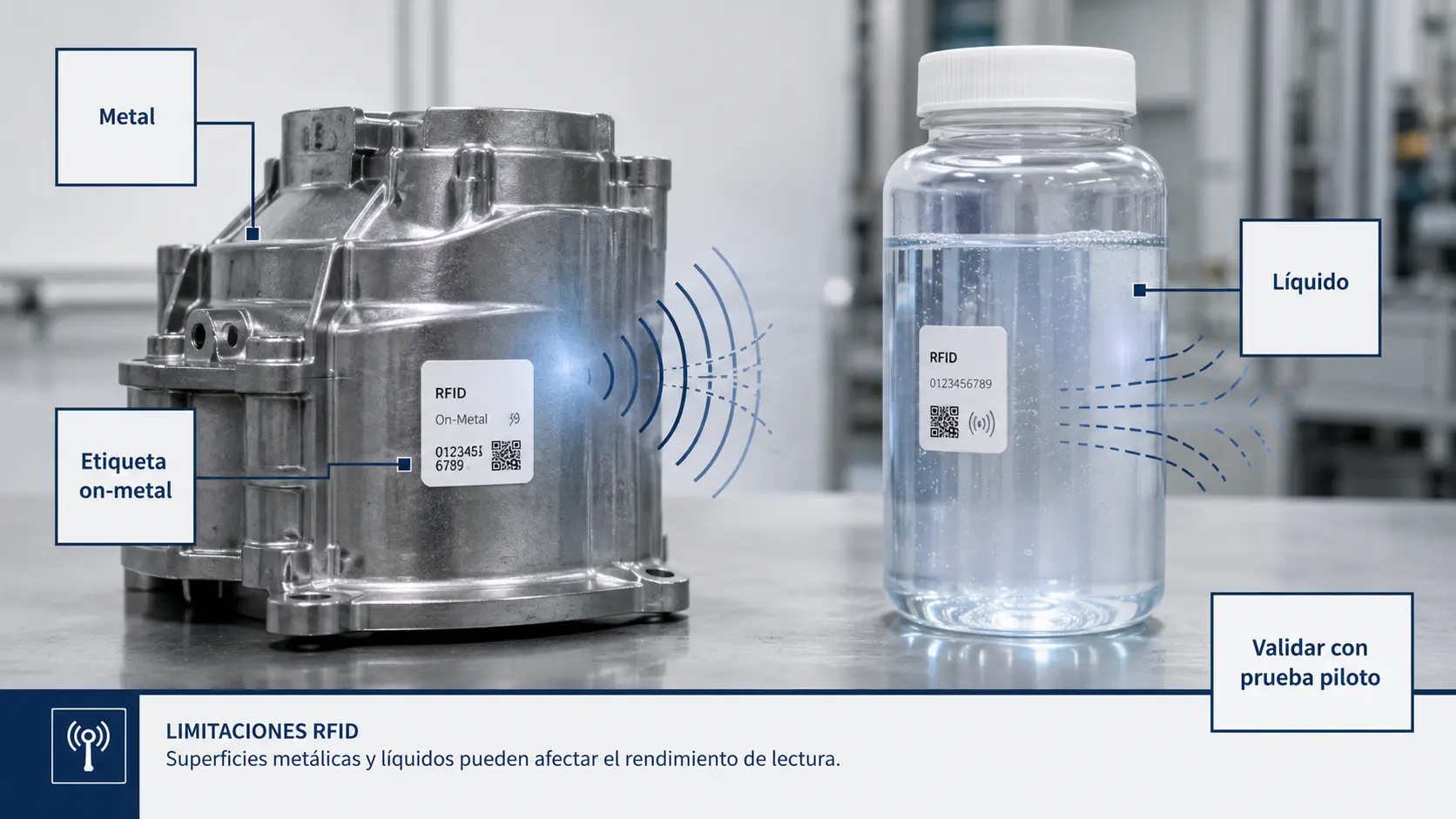
The frequency that has made RFID popular in logistics and industry. It allows labels to be read from several metres away and hundreds of tags to be read simultaneously. It is the basis of warehouse RFID portals, pallet traceability and automated inventory in retail. Its major limitation is that water absorbs the signal and metals reflect it, so applications on liquids or metal surfaces need specific labels (the so-called on-metal labels). The exact permitted range varies by region: 865–868 MHz in Europe, 902–928 MHz in North America.
Microwave (2.45 GHz)
A frequency reserved for very specific applications, almost always with active tags: motorway tolls, vehicle access control, real-time location of containers in large yards. It allows long ranges but requires more expensive infrastructure and a battery in the label.
A specific RFID project? We supply it
Tell us the frequency (UHF/HF), the application and the environment —on-metal, liquids, outdoor— and we will prepare a pilot test to validate before producing in series. Industrial specialist since 1994, response in under 24 hours.
Passive, active or semi-passive
Beyond frequency, RFID labels are classified into three families according to their power source. It is a fundamental technical distinction: it determines the label's cost, size, service life and read range.
Passive labels
They have no battery. All the energy they need to work is obtained from the reader's electromagnetic field. This makes them cheap, thin and with practically no limited service life (there is no battery to run down). In exchange, their read range is the shortest of the three categories, because they can only respond when inside the reader's field.
It is the most widely used family in industrial and logistics RFID: traceability, inventory, dispatch, access control, asset identification, Smart Labels for production. When "RFID labels" is mentioned on its own in an industrial context, in most cases it refers to passive labels.
Active labels
They carry an integrated battery. That lets them emit their signal continuously or whenever they decide, without depending on the reader. The immediate consequence is that they can be read at much greater distances —tens or hundreds of metres— and allow their own sensors (temperature, humidity, vibration) to be built in, recording data throughout the tag's life.
Their typical use: real-time location (RTLS) of vehicles, containers, wagons; cold-chain control with historical logging; fleet management of equipment on large construction sites. They are significantly more expensive and bulkier than passive labels, and the battery marks the end of their service life (typically between 3 and 7 years).
Semi-passive labels (BAP)
An intermediate category. They incorporate a small battery that powers the chip and sensors, but communication with the reader uses the passive method (modulating the reader's field). That gives them more read range than a pure passive label and lets them log sensor data, while keeping the simplicity of passive reading. They are used, for example, in cold-chain data loggers that record temperature at set intervals and are downloaded when passed by a reader.
Summary: in typical industrial applications (traceability, inventory, dispatch) labels are passive. Active and semi-passive labels are reserved for cases that need very long range or built-in sensors.
RFID versus barcode, QR and NFC
It is an inevitable question: if I already have a barcode, what does RFID give me? It does not always replace it. Each technology has ground where it is the obvious choice and ground where it is the worst option.
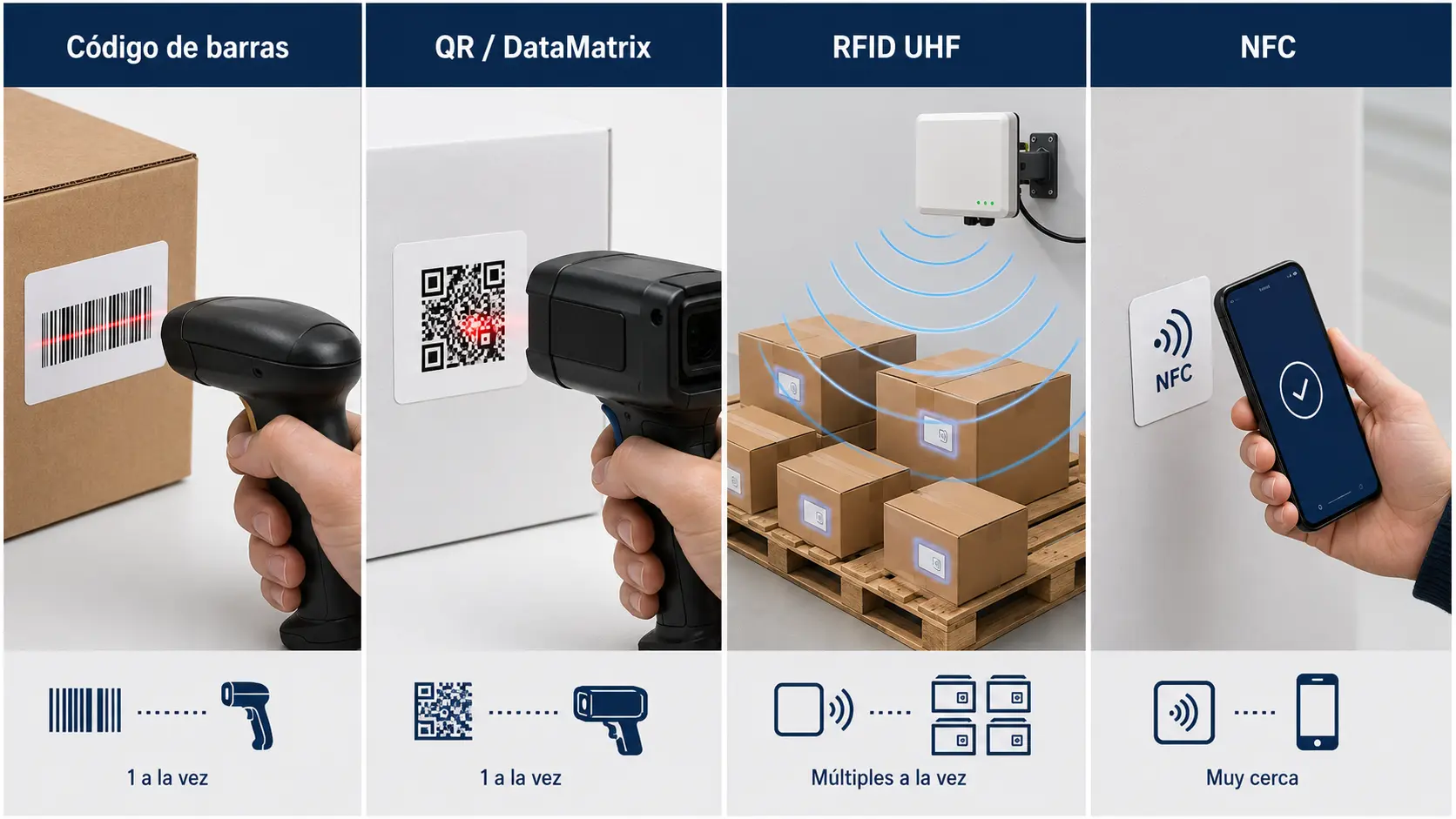
| Feature | Barcode | QR / DataMatrix | RFID UHF | NFC (HF) |
|---|---|---|---|---|
| Line of sight | Required | Required | Not required | Not required |
| Simultaneous reading | One at a time | One at a time | Hundreds at once | One at a time |
| Maximum distance | A few cm | A few cm | Up to 12 m | Up to 10 cm |
| Rewritable data | No | No | Yes | Yes |
| Cost per unit | Minimal | Minimal | Low–medium | Low–medium |
| Wear resistance | Limited | Limited | High | High |
| Reader required | Optical scanner | Optical scanner / mobile | UHF RFID reader | Smartphone |
The reality is that many rollouts combine both: a Smart Label carries a printed barcode on the visible face and an RFID chip inside. That way, the operator can scan manually when needed, and the fixed RFID readers do their job in parallel.
RFID and NFC: are they the same?
NFC is a subset of RFID. Specifically, it is a variant of the HF frequency (13.56 MHz) designed for very short distances and for a device —typically a smartphone— to act as both reader and tag at the same time. Every NFC label is an HF RFID label, but not every HF RFID label is NFC: NFC adds specific protocols for peer-to-peer communication between devices.
Components of a complete RFID system
An RFID label on its own does nothing. For a rollout to work, four elements are needed:
- The labels (tags): the element attached to the object. Passive or active, at the frequency and with the material suited to the environment of use.
- The RFID reader: emits the electromagnetic field and receives the response. It can be fixed (mounted on a wall, a portal or a production line) or portable (a handheld unit the operator carries).
- The reader's antenna: on fixed readers it is usually separate from the reader's body. Its location and orientation are critical: a poor antenna cancels out the performance of a good label.
- The middleware or software: receives the identifiers read, filters them (because the same tags are often read many times in a row) and sends them to the ERP, WMS, MES or corresponding information system. It is the piece that turns a list of identifiers into useful information.
There is an implicit fifth element: chip encoding. Every label leaves the factory with a unique identifier, but in most industrial applications an additional code is also programmed —internal reference, batch, date— which the chip stores in a rewritable way. That step, called encoding, happens during label conversion.
Advantages and limitations of RFID
Advantages over barcodes
- No line of sight: the tag can be inside the box, under the packaging or on the back of the product. It reads the same either way.
- Mass reading: an RFID portal can register the full contents of a pallet as it passes, without scanning package by package.
- Rewritable information: the chip can be updated at any point in the process. A barcode is static.
- Greater durability: the chip protected inside the inlay resists abrasion, dirt and moisture much better than ink on paper.
- Sensor integration: in active or semi-passive versions, the label can log temperature or vibration during transport.
Limitations worth knowing
- Cost per label: even though it is cheap, it is still several times the cost of a printed barcode. For very large volumes and low unit-value products, it may not pay off.
- Behaviour on metal and liquid: UHF is disrupted by both. The solution is on-metal labels with an insulating layer or dropping down to HF, but both options add complexity.
- Need for a pilot test: the real-world performance of an RFID system depends on environmental variables (product shape, packaging, nearby materials) that are hard to predict on paper. A pilot almost always needs validating before rolling out at scale.
- Investment in readers and infrastructure: the cost is not just the labels. Fixed readers, antennas, cabling and middleware add up.
- Privacy and regulation: in applications that affect the end consumer, the possibility of deactivating the tag after purchase and local identification regulations must be considered.
When it makes sense to implement RFID
As a rule of thumb, the technology pays off when at least one of these conditions applies:
- The operator loses time scanning products one at a time that could be read simultaneously.
- Labels get dirty, scratched or wet and barcodes stop scanning.
- Objects need to be identified without seeing them (inside boxes, inside cabinets, among other products).
- Assets need to be identified several metres away (pallets on a dock, vehicles at a toll, containers in a yard).
- The cost of an inventory or traceability error is far greater than the cost of the label.
Need a specific RFID solution for your industrial process?
See RFID solutionsSummary
An RFID label is a chip with an antenna identified by radio frequency, with no need for line of sight. It works because the reader emits an electromagnetic field from which the label extracts energy (in passive labels, without a battery) or which only serves as a response channel (in active labels, with a battery).
There are four frequency bands with distinct uses —LF for robust short range, HF/NFC for security and mobile devices, UHF for logistics and industry, microwave for specialised cases— and three tag types according to their power source: passive (dominant in industry), active (long range and sensors) and semi-passive (intermediate, with sensors).
Compared with the barcode, RFID wins on mass reading, distance, durability and rewritable information; it loses on cost per unit and behaviour on metal and liquid. Before implementing it, it pays to be clear on the frequency, the tag type and the environment —and always validate with a pilot test before producing in series.
Frequently asked questions
What is an RFID label?
A device made up of a chip, an antenna and a substrate. The chip stores the unique identifier and, depending on the type, rewritable data; the antenna receives the reader's signal and sends the response, and its shape and size largely determine the read range; the substrate or encapsulation protects the assembly and allows it to be attached to the object.
Does it need a battery?
No. The label is activated by the reader's signal, does not need to be in line of sight and in many cases can be read from several metres away.
How does it differ from a barcode?
It needs no line of sight and can be read at a distance. That combination of properties is what has made it the natural replacement for the barcode in many industrial and logistics applications.