A lockout padlock is not there to prevent theft. It is there to stop someone re-energising a machine while another person has their hands inside it. That difference in purpose changes what to look for when choosing one, and explains why an apparently minor detail —the key system— decides whether a LOTO programme works or turns into a nuisance that staff end up working around.
This guide walks through the four decisions to be made (the body material, the shackle, the locking type and the key system) and ends with the colour code. If you are looking for the complete lockout procedure, it is in the LOTO lockout and tagout guide.
What sets a LOTO padlock apart from a conventional one
Three things. The first is that each padlock belongs to one specific person and only that person holds its key: this is the guarantee that nobody else can re-energise the machine. The second is that it is identified with the operator's name, so that anyone approaching the panel knows who applied the lockout and who to ask. The third is electrical insulation: when working on panels and disconnectors, neither the body nor the shackle should conduct.
That is why the reinforced nylon body is the reference material of the range, and why a nylon-shackle variant exists for the points where metal must not be introduced. A hardware-store padlock meets none of the three conditions, however well it locks.
The body: nylon, ABS, aluminium or brass
The body material decides two things: the temperature the padlock can work at and whether or not it conducts.
Reinforced nylon withstands −20 °C to +120 °C and does not conduct, which makes it suitable for most isolation points, including electrical ones. It is the material of the standard-, automatic- and cable-shackle series.
Industrial ABS covers the same use at a lower cost, with a shorter temperature range: −20 °C to +90 °C. It is the sensible choice when many operators have to be equipped and conditions are those of a normal workshop.
Aluminium and solid brass change the approach: these are metal bodies, with a hardened steel shackle —triple chrome plating on the aluminium version— and therefore conductive. They are chosen for mechanical strength and, in the case of brass, for its behaviour against corrosion in damp or saline environments. They are not for electrical work.
The laminated padlock is a case apart: a hardened steel shackle with a PVC sleeve, built to resist cutting and sawing when the padlock is left exposed.
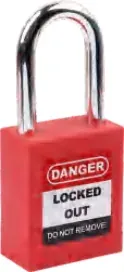 Reinforced nylon
 Aluminium
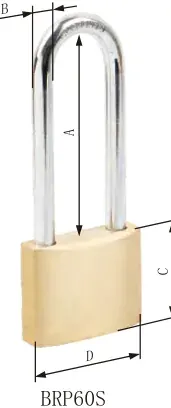 Solid brass
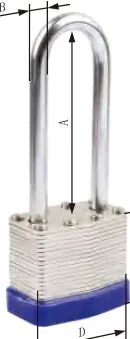 Laminated
The shackle: diameter, length and material
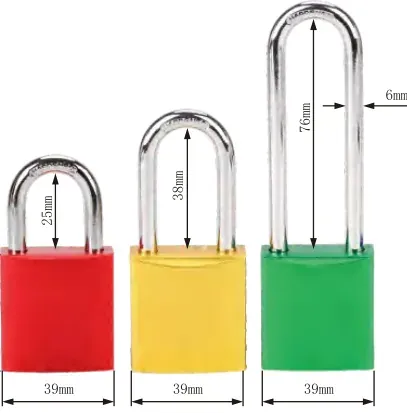
The shackle is chosen by three parameters. The diameter —4 or 6 mm— has to pass through the hole in the lockout device or the hasp; it is worth checking beforehand, because a 6 mm shackle will not fit through some eyes designed for 4 mm.
The usual length is 25, 38 or 76 mm. The 38 mm length covers most cases; 25 mm works where there is little clearance around the isolation point, and 76 mm where a thick element has to be encircled or a distant eye reached.
The shackle material is the decision most often overlooked. A chrome-plated steel shackle provides mechanical strength; a nylon shackle does not conduct, and it is the right choice when working on an electrical panel. Both versions exist on the same body, so there is no need to give up one thing for the other.
Standard, automatic or cable shackle
The standard shackle locks with the key. The automatic shackle locks by pushing it closed, without inserting the key: convenient when the same technician locks out several points in a row, and it reduces the risk of leaving the key in the lock.
The cable shackle solves impossible geometry. When the isolation point has no accessible eye, or a handle has to be looped around, a long stainless steel cable embraces what a rigid shackle cannot reach. Different cable diameters are available depending on how narrow the passage needs to be.
There is also a long-body variant, which gains gripping height without changing the shackle.
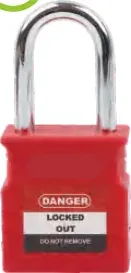 Standard shackle
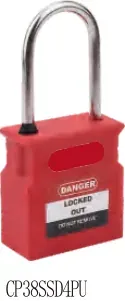 Automatic shackle
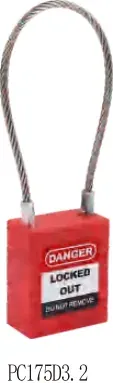 Cable shackle
The key systems: KA, KD, MK and GMK
This is the decision with the most consequences and the one least well understood. The four systems answer a single question: who can open what.
- KD (keyed different). Each padlock opens only with its own key, and no other key duplicates it. It is the system for each operator's personal padlock, because it is the only one that guarantees exclusive control.
- KA (keyed alike). A group of padlocks shares one key. Useful when the same person has to lock out several points on one machine and does not want to juggle six different keys. Never shared between different people.
- MK (master key). A higher-level key exists that opens an entire group. It is used for programme management: recovering a forgotten padlock or removing one whose owner cannot be located.
- GMK (grand master key). One more level of hierarchy above several MK groups, for plants with several areas.
It is worth being explicit about the risk: a master key breaks the principle of exclusive control if it is within anyone's reach. It makes sense for it to exist, because a forgotten padlock brings a line to a standstill, but its custody and the procedure for using it must be set down in writing, not left to habit. The practical rule is that the personal padlock is always KD, and that the master keys live under a control as formal as the lockout itself.
Quick selection table
| Situation | Body | Shackle | Key |
|---|---|---|---|
| Personal padlock, general use | Reinforced nylon | Steel, 38 mm | KD |
| Work on an electrical panel | Reinforced nylon | Non-conductive nylon | KD |
| Equipping many operators, standard workshop | Industrial ABS | Steel, 38 mm | KD |
| One technician, several points on one machine | Reinforced nylon | Automatic | KA |
| Isolation point with no accessible eye | Reinforced nylon | Cable | KD |
| Damp or saline environment | Solid brass | Hardened steel | KD |
| Padlock exposed to tampering | Laminated | Steel with PVC sleeve | KD |
| Programme management by area | — | — | MK / GMK |
Temperature ranges by body material: reinforced nylon from −20 °C to +120 °C; industrial ABS from −20 °C to +90 °C.
The colour code
No European or national standard assigns a meaning to each colour of padlock or tag. Each company decides it in its own lockout procedure. What does matter is having a code, putting it in writing and applying it the same way across the whole site, so that anyone can tell at a glance whose lock is whose.
The most common criteria are four: by trade or department, by shift, by company (own staff or contractors) and by person, when each worker has a colour of their own. It is best to apply a single criterion per site: if they are mixed, the colour stops telling you anything.
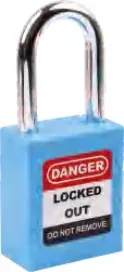
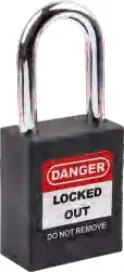
Plastic-body padlocks are supplied in eleven colours at no extra cost: red, yellow, blue, dark blue, green, orange, purple, brown, black, white and grey.
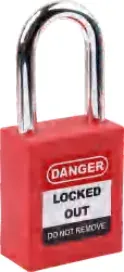 Red
Red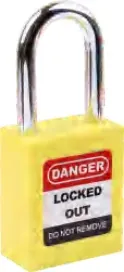 Yellow
 Blue
Blue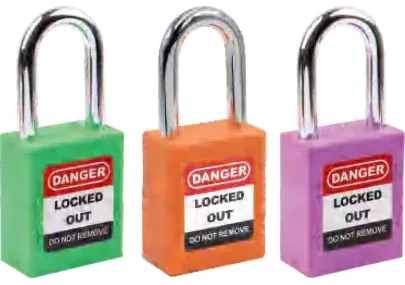 Green, orange and purple
 Black
Black| Colour | Example of allocation by trade |
|---|---|
| Red | Production and general use |
| Blue | Mechanical maintenance |
| Yellow | Electrical maintenance |
| Green | Contractors |
| Black | Supervision or person in charge of the lockout |
This is only an example: there is no mandatory allocation. Whatever code your site uses, it must be set out in the written procedure and in staff training.
Colour does not replace identification. It shows which group a lock belongs to; the worker's name on the padlock and on the tag says who it is. With both, anyone can find the person without having to ask. Laser marking of the name or a number, and logo engraving, are available on request.
Common mistakes when choosing a padlock
Buying every padlock with the same key. It is convenient to manage and it cancels out the protection: if one key opens the padlocks of three operators, none of the three has control over their own lockout.
Choosing the shackle out of habit rather than for the isolation point. A 6 mm shackle that does not fit through the eye forces improvisation, and what gets improvised in safety usually ends in a lockout that does not lock.
Using a metal body for electrical work. Aluminium and brass have their place, but not in front of a panel.
Leaving the padlock unidentified. A padlock with no name on it means tracking down the owner by asking around, and that friction is exactly what pushes people to skip the procedure.
Summary
The body decides temperature and insulation: reinforced nylon for almost everything, ABS when cost comes first, aluminium or brass for strength and corrosion, laminated if the padlock is left exposed.
The shackle decides whether the padlock fits where it has to fit. Check diameter and length against the actual isolation point, and reserve the nylon shackle for electrical work.
The key system decides whether the programme protects people. The personal padlock is always KD; master keys may exist, but with a written procedure behind them.
Colour brings order to the whole. No standard sets it for you: choose one criterion, write it into the procedure and apply it the same way across the site.
The full ranges, with shackle diameters, body materials and key systems, are in the safety padlock catalogue, inside the LOTO safety section.
Frequently asked questions
What makes a LOTO padlock different from a conventional one?
Three things: it belongs to one specific person and only that person holds the key, it is identified with the operator's name so it is clear who applied the lockout, and for work on panels neither the body nor the shackle may conduct. A hardware-store padlock meets none of the three, however well it closes.
What do KA, KD, MK and GMK mean?
They are the four key systems. KD, keyed different: each padlock opens only with its own key. KA, keyed alike: a group of padlocks shares one key. MK, master key: a higher-level key that opens a whole group. GMK, grand master key: one more level above several MK groups, for plants with multiple areas.
Which key system should a personal padlock use?
KD, always, because it is the only one that guarantees exclusive control. Buying every padlock keyed alike is convenient to manage and cancels the protection.
Which padlock is used for work on an electrical panel?
A reinforced nylon body with a non-conductive nylon shackle, keyed different. It is the combination for points where metal must not enter.
What temperature does the padlock body withstand?
Reinforced nylon works from −20 °C to +120 °C and industrial ABS from −20 °C to +90 °C. For humid or saline environments the option is solid brass with a hardened steel shackle.
Is there a mandatory colour code for LOTO padlocks?
No. No European or national standard assigns a meaning to colours: each company defines its code in its lockout procedure, by trade, shift, company or person. What matters is that it is written down and applied the same way across the whole site. Plastic-body padlocks are supplied in eleven colours at no extra cost.