LOTO guide: lockout/tagout of hazardous energies
What a LOTO procedure is, which energies must be isolated, how to choose the padlock and lockout device for each isolation point, and which regulations support it.
What a LOTO procedure is and when it applies
LOTO stands for Lockout/Tagout. It is the procedure by which, before working on a machine or installation (maintenance, cleaning, clearing a jam, adjustment, changeover), all its energy sources are isolated, the isolating devices are physically locked with a personal padlock and marked with a tag identifying who applied the lockout.
It applies whenever a worker has to expose any part of the body to a hazardous zone of the machine or has to defeat a guard in order to work. It does not replace the machine's safety interlocks: it complements them when these are not sufficient (long interventions, several people, residual energy, remote isolation points).
Energy sources that must be isolated
Electrical energy is the most obvious, but it is rarely the only one. Before locking out, all the sources of each piece of equipment should be inventoried:
- Electrical: disconnect switches, circuit breakers, sockets and plugs, variable speed drives, batteries and capacitors.
- Pneumatic: air supply points, quick-release fittings, ball and isolation valves; air accumulated in pipes and cylinders must be bled off.
- Hydraulic: shut-off valves, pressure accumulators.
- Mechanical: flywheel inertia, compressed springs, suspended loads, gravity.
- Thermal and chemical: steam, hot or corrosive fluids, gases; isolated with valves and blind flanges.
Each source requires an isolation point and a lockout device compatible with that point: this is why the catalogue is organised by type of device (valve, circuit breaker, plug, cable, etc.) and not by sector.
The eight steps of a correct lockout
- Preparation: identify the energy sources, the isolation points and the devices required (ideally in a written procedure for each machine).
- Notification: inform the workers and managers affected.
- Shutdown: stop the machine using the normal procedure.
- Isolation: operate disconnect switches, valves and circuit breakers.
- Lockout and tagout: fit the device at each isolation point, secure it with the personal padlock and attach the tag.
- Dissipation of residual energy: bleed off pressure, discharge capacitors, support loads, allow to cool.
- Verification: attempt to start and check with instruments that no energy is present.
- Removal: on completion, each worker removes their own padlock after checking that the area is clear; the last one re-energises the machine.
How to choose the safety padlock
The padlock is the personal element of the system. The usual criteria:
- Body: reinforced nylon (lightweight, insulating, resistant to chemicals and to temperatures from −20 °C to +120 °C) is the standard; aluminium, brass, laminated and long-body versions for writing the name are also available.
- Shackle: chrome-plated steel (general use), stainless steel (damp or corrosive environments), non-conductive nylon (electrical work: prevents current passing from the shackle to the key) or cable (lockout points with narrow or distant holes). Usual lengths: 25, 38 and 76 mm; diameters from 4 to 6.5 mm.
- Keying system: keyed different (KD) for personal padlocks; keyed alike (KA) for one worker with several points; master key (MK) for the person in charge; grand master key (GMK) for plants with several areas. It is advisable to record the combinations so that replacements can be supplied.
- Key retention: the key can only be removed with the shackle closed, so an open padlock is never left without its key.
- Colour and marking: one colour per department or type of energy and the worker's name or number laser-engraved make identification easier.
See the full range in safety padlocks.
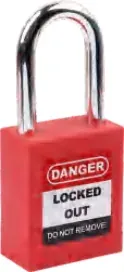 Safety padlock
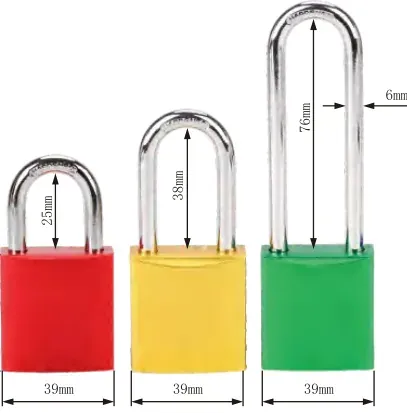 Aluminium safety padlock
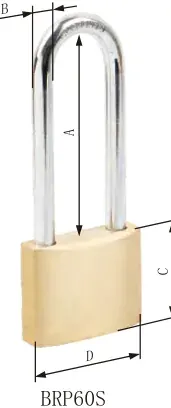 Brass padlock with steel shackle
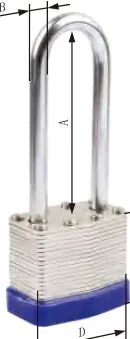 Laminated safety padlock
Which lockout device to use at each isolation point
| Isolation point | Device | Category |
|---|---|---|
| Ball valve (lever handle) | Standard or adjustable ball valve lockout, universal for non-standard handles | Valve lockouts |
| Gate valve (handwheel) | Lockout cover by handwheel diameter (25 to 635 mm) | Valve lockouts |
| Butterfly, diaphragm valve, flange | Butterfly valve, diaphragm valve, blind flange lockout | Valve lockouts |
| Miniature circuit breaker (MCB) | Pin-out / pin-in / tie-bar lockout depending on the toggle, or universal clamp type | Circuit breaker lockouts |
| Moulded case circuit breaker (MCCB) | Large or multi-function moulded case breaker lockout | Circuit breaker lockouts |
| Socket, industrial plug | Plug lockout or industrial plug lockout (box with padlock hole) | Pneumatic and electrical |
| Air supply point, quick-release fitting | Pneumatic fitting or air supply lockout | Pneumatic and electrical |
| Emergency stop button, push button, selector switch, wall switch | Transparent lockout cover | Pneumatic and electrical |
| Several remote or hard-to-reach points | Steel or plastic cable lockout | Cable lockouts |
| Several people at the same point | Lockout hasp (up to 24 padlocks) or group lock box | Hasps · Lock boxes and stations |
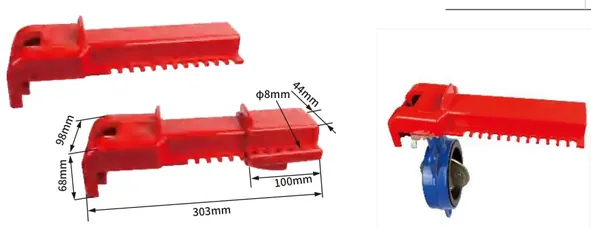 Butterfly valve lockout
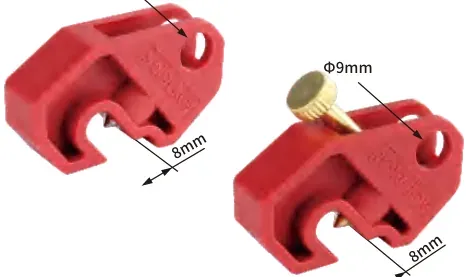 Circuit breaker lockout
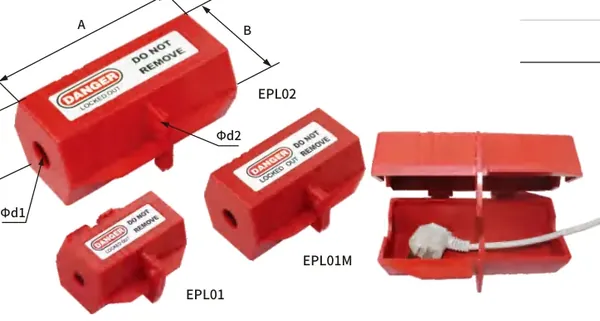 Plug lockout
Group lockout: hasps, lock boxes, stations and kits
When several people are involved, each of them must be able to apply their own padlock. The rule does not change with the size of the team: one padlock per person, and nobody removes anyone else's.
Lockout by several people
At a single isolation point, a lockout hasp is used: it closes over the point, takes several padlocks, and the point is not released until the last one is removed. If the point is electrical, a nylon hasp avoids bringing metal into the panel.
With many isolation points, a group lock box is used: the person in charge locks out every point with padlocks from the box, places the keys inside, and each worker locks the box with their personal padlock. Nobody can recover the keys while a padlock remains in place. At a shift change, the incoming worker fits their padlock before the outgoing one removes theirs, so the lockout is never interrupted.
When the work requires a written permit, the permit control station brings together, on the wall, the permit display case and the group lock box: the document stays in view next to the keys it protects.
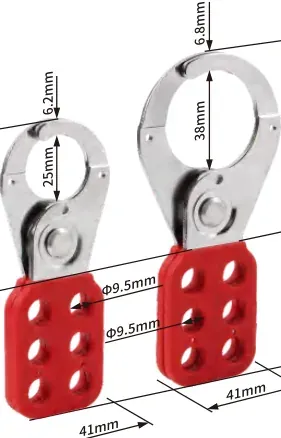 Steel hasp
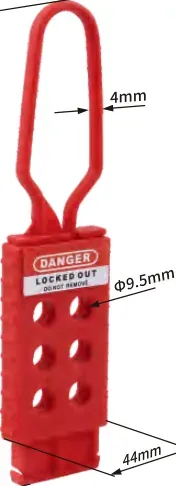 Nylon hasp
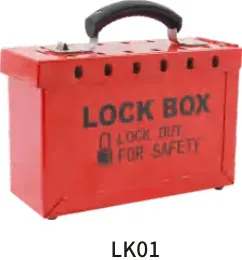 Portable box
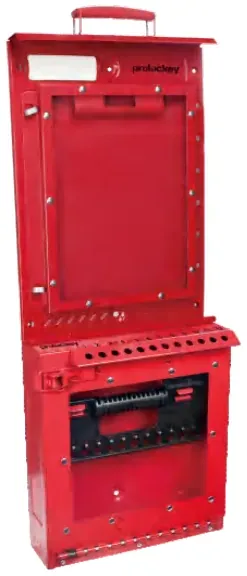 Permit station
| Need | Solution | References |
|---|---|---|
| Several people, one isolation point | Lockout hasp; nylon if the point is electrical | LO-2001 to LO-2026 |
| Several people, several points, equipment that moves around | Portable group lock box | LO-7001 to LO-7005, LO-7015, LO-7016 |
| Fixed position next to the machine | Plastic or wall-mounted group lock box | LO-7019, LO-7020, LO-7024, LO-7025, LO-7058 |
| Lockout with a work permit | Permit control station: display case and wall-mounted group lock box | LO-7059 |
| Spare keys and master keys | Key cabinet, with custody and controlled access | LO-7082 to LO-7089 |
Station or kit?
Lockout stations are fixed to the wall next to the machine or area and centralise padlocks, hasps and tags: the equipment is always to hand and complete, and you can see at a glance if anything is missing. Kits group a selection of devices in a bag, a waist bag, a toolbox or a ready-equipped station.
The practical rule is simple: if the lockout always takes place in the same spot, a station; if the equipment travels with the person, a kit.
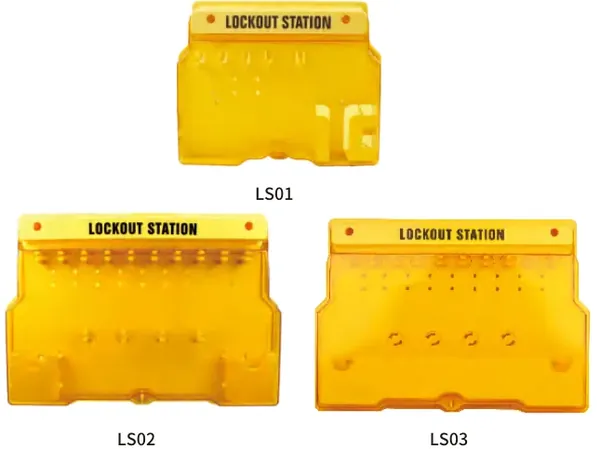 Lockout station
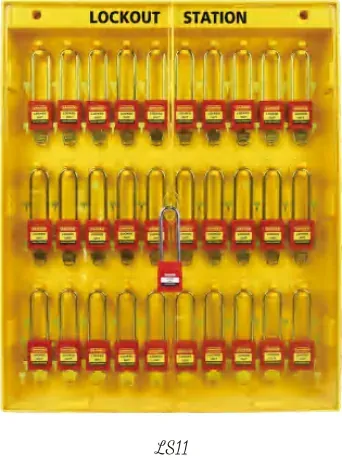 Combined station
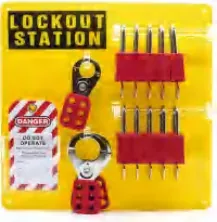 Kit with station
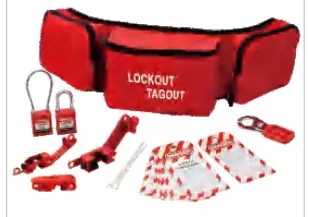 Waist-bag kit
| Situation | What to choose | References |
|---|---|---|
| Fixed equipment per machine or area | Wall-mounted lockout station, empty or equipped | LO-7026 to LO-7056, LO-7063 to LO-7068 |
| Equipment per department | Sheet-steel management station with adjustable dividers | LO-7006 to LO-7011 |
| Padlocks centralised in one place | Metal padlock station | LO-7012 to LO-7014, LO-7021 to LO-7023, LO-7069 to LO-7072 |
| Ready-to-use station | Kit with a ready-equipped station | LO-9001, LO-9002, LO-9008 to LO-9015 |
| Technician moving around the site | Kit in a bag, waist bag or toolbox | LO-9003, LO-9004, LO-9006, LO-9007, LO-9016 to LO-9019 |
| Padlocks for a work team | Portable padlock holder with 12 padlocks | LO-9005 |
Steel lockout hasp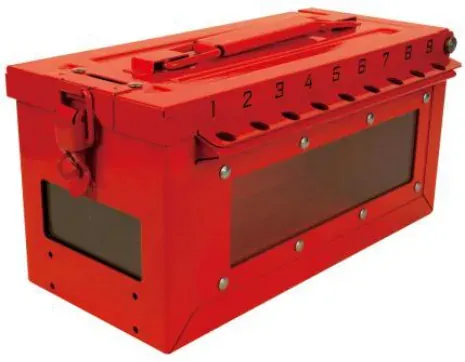 Group lock boxLockout station
Tagout: who, when and why
The tag always accompanies the padlock. It must be legible, resistant to the environment (PVC or similar) and state the worker's name, department, date and reason for the lockout. Write-on tags are used with an erasable marker; custom identification tags carry the worker's photo or details. A tag without a padlock (tagout only) is acceptable only when the isolation point does not allow physical lockout, and with compensatory measures.
Regulatory framework
- Framework Directive 89/391/EEC on safety and health at work and Directive 2009/104/EC on the use of work equipment: risks must be assessed, equipment must have clearly identifiable means of isolation from each energy source, and maintenance must be possible with the equipment shut down. Each Member State transposes them into national law.
- EN ISO 12100 (general principles for the design of machinery) and EN ISO 14118 (prevention of unexpected start-up), which describe the means of isolating and dissipating energy and locking them.
- Regulation (EU) 2023/1230 on machinery, which replaces Directive 2006/42/EC and applies from 20 January 2027: machinery must have lockable means of isolation from all its energy sources.
- EN 50110-1 (operation of electrical installations): the five rules for working dead include securing the switching devices against reconnection and marking them.
- International references: OSHA 29 CFR 1910.147 (USA) and ANSI/ASSP Z244.1, widely used by multinationals for their internal procedures.
This guide is for guidance only: the risk assessment and the isolation procedure for each installation must be drawn up with the company's health and safety service.
LOTO supply
Reply within 24 h
Quote with references, lead time and keying configuration.
Custom keying systems
Keyed different (KD), keyed alike (KA), master key (MK) and grand master key (GMK); key combinations kept on record for replacements.
Customisation
Laser marking of your logo, numbering of keys and padlock bodies, tags in your language.
Shipping throughout Europe
We supply the whole European Union from Sabadell (Barcelona).
Would you like help defining your LOTO programme?
Please tell us the type of installation, the isolation points and how many people are involved. We will propose devices and a keying system and send you a quote.
Reply within 24 hours.
- Advice on the keying system and the appropriate configuration.
- Quote by reference and quantity, with no obligation.
- Full catalogue available for download as PDF.