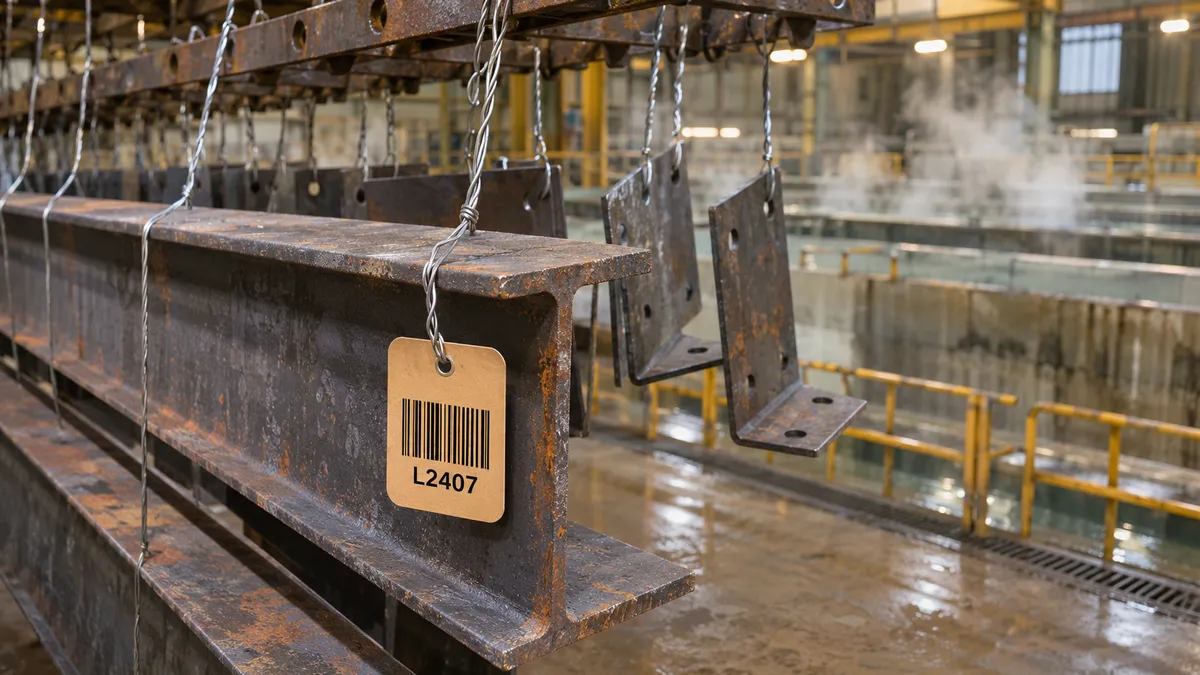
For the identification of the part, a hot-dip galvanising line is one of the hardest routes in industry: an alkaline bath, another of hydrochloric acid, another of flux salts, a drying oven and, at the end, molten zinc at over 440 °C. At a contract galvaniser, moreover, parts from dozens of different customers and orders come in on the same shift. If the identification does not leave the line with the part, what is lost is not a label: it is knowing whose each part is, which order it belongs to and which certificate it corresponds to.
The identification goes through the whole galvanising line
In hot-dip galvanising there is no “easy” stage. Each bath attacks something: degreasing, the grease and with it any adhesive; pickling, the rust and mill scale, and with them most label materials; the zinc bath, any film that is not very high temperature. That is why the approach that works on other finishing lines, an adhesive label on the clean part, does not work here: at the moment of labelling the part is not yet clean, and cleaning it is exactly what the line is going to do.
The question that decides the material is not “what temperature does it withstand?” but “up to which stage does the identification travel with the part?”. On some lines the tag travels tied to the part from goods-in to dispatch, and on others the identification goes on the rack or on the batch routing sheet and the part carries the tag only as far as the zinc bath. Both ways are correct; they call for different materials.
The first question is not “what temperature does the tag withstand?” but “does the tag go into the zinc bath with the part or stay out?”. The answer changes the material.
Stage by stage: what happens to the identification
The values in the table are the usual ones on hot-dip galvanising lines for steel parts by immersion. They help place each stage in order of magnitude; each plant works with its own, and it is the values of your line that count in the choice and in the trial.
| Stage | Typical conditions | What happens to the identification |
|---|---|---|
| Degreasing | Hot alkaline bath, usually between 40 and 80 °C, with a rinse afterwards | Dissolves oils and grease: the adhesive of a conventional label softens and loses adhesion |
| Pickling | Dilute hydrochloric acid, around 10–16 %, at room temperature; from half an hour to several hours depending on the rust and mill scale on the part | Attacks paper and conventional films and most inks; the adhesive label comes off with the layer of rust it was stuck to |
| Fluxing | Zinc chloride and ammonium chloride solution, around 40–70 °C | Another immersion in salts; leaves a layer of flux on everything that goes into the bath, tag included |
| Drying oven and preheating | Oven at around 100–150 °C, a few minutes | Dry heat that fixes the flux; within the range of the KPK laminate |
| Zinc bath | Molten zinc, usually at 440–460 °C; immersion of a few minutes depending on the thickness of the part | Beyond the range of any film except polyimide; what happens to the tag on entering and leaving the zinc can only be seen on the line |
| Cooling and passivation | Cooling in water or air; optional passivation | Thermal shock and, if there is a bath, another immersion; the part comes out coated in zinc |
The two stages that rule out materials are pickling and the zinc bath. The rest is within what a well-chosen tag with no adhesive can withstand.
Small parts (bolts and screws, fittings, castings) are galvanised in baskets and spun in a centrifuge on leaving the zinc. There the identification belongs to the batch, not to each part: the tag goes with the basket as far as the line allows and the rest of the route is covered by the batch routing sheet.
Why an adhesive label is not the answer
On most finishing lines a well-chosen adhesive label solves the problem; we explain it for powder coating and cataphoresis. In hot-dip galvanising it does not, and it is worth understanding why before asking for “a stronger adhesive”.
- The surface is the one the line is going to remove. An adhesive label sticks to the layer of rust, mill scale or oil that covers the raw part. Pickling dissolves that layer, and the label goes with it. It is not an adhesive problem: there is nothing underneath to stick to.
- The acid attacks the whole label. Even if the adhesive held, hydrochloric acid attacks paper and conventional films, and any inks that are not resin-based. The label comes out of the bath blank or falling apart.
- Molten zinc is out of range. A polyester film stops being viable above 200–250 °C, and the adhesive long before that. At over 440 °C there is no adhesive label left to evaluate.
- And even if it got there, it would be in the way. Zinc coats every steel surface it touches. A label stuck to the part in the bath would leave an uncoated area underneath.
That is why identification on a galvanising line is solved with a tag with no adhesive, that is, a hang tag made of a material that withstands the route, fixed mechanically to the part. The adhesive label makes sense again afterwards: on the already galvanised part, for dispatch and on-site marking, with an adhesive suited to galvanised steel, such as those described in labels for metals and steel.
The tag with no adhesive: how far it travels with the part
A tag with no adhesive does not depend on the surface: it is tied to the part and it withstands the route, or it does not, on its own. In our range there are two materials for this route, and the choice between them is decided by the earlier question: whether the tag goes into the zinc with the part or stays out.
If the tag stays out of the zinc bath
This is the case on lines where the tag is removed before immersion and rehung on the way out, or where the identification moves to the rack or the batch routing sheet. The tag has to withstand degreasing, pickling, fluxing and the drying oven. For this route we work with the Kraft/PET/Kraft laminate ARGIPRINT° KPK: a polyester film core between two layers of Kraft paper, with no adhesive, with resistance to hydrochloric acid at 25–30 % according to its data sheet, above the usual concentration of pickling baths. It comes in three models according to maximum temperature: Ref. 842 up to 200 °C, Ref. 800 up to 320 °C and Ref. 874 up to 350 °C, for exposures of up to 10 minutes. For the drying oven of a galvanising line, the 842 has ample margin; the 800 and 874 are intended for lines that combine pickling with more demanding heat treatments.
What the data sheet does not say is how many hours of pickling it withstands: the figure is one of acid resistance, not of immersion time. If your pickling is long, that is the first point looked at in the sample.
If the tag goes into the zinc with the part
Here the temperature range is different. Molten zinc is at around 440–460 °C, and the only material in our range with that margin is the polyimide film ARGIPRINT° HOT 150/151: up to 450 °C for Type 150 and up to 500 °C for Type 151, for short exposures, with no adhesive and printable by thermal transfer; the 151, on both sides. The HOT data sheet figure is the thermal one; its behaviour in the pickling and in the bath on your line is checked on the same sample.
⚠ The zinc bath is not taken for granted
A material withstanding the temperature of the bath does not mean the tag comes out of the zinc legible. On entering, the tag passes through the layer of ash on the surface and comes out wetted with zinc; whether it ends up coated, how much can be read and how the tie point behaves are things that can only be seen on your line. That is why, when the tag has to go into the zinc, we do not consider the material valid on paper: we send you a sample, the part goes through the full cycle and the reading is checked at the exit.
If the sample does not come out legible, the solution is the first case: remove the tag before the bath and rehang it on the way out, or carry the identification on the rack while the part is in the zinc. It is not giving up: the part comes out of the zinc coated, with the same geometry, and is identified again in seconds.
How to fix the tag to the part
On a galvanising line the part hangs from a rack or crossbar on steel wire, and the tag is fixed in the same way: wire passed through the hole in the tag and through a hole, slot or edge of the part. It is the usual fixing because it is the one the line already uses, and because the steel wire goes through the same baths as the part.
- Tie wire. The reference option in galvanising. It is tied loosely, so that the tag does not get trapped between two parts and the baths can drain, and without covering the venting and drainage holes of the part.
- Steel hooks and clips. For tags that are put on and taken off many times: at goods-in, at dispatch or when the identification goes on the rack. The types of hook and their sizes are in their own guide; we also supply them.
- Weld stud. When the part must carry a permanent anchor point for the identification. The stud is welded before galvanising and is coated along with the part.
- Where to tie it. Where the operator can read it without unhooking the part, away from the support points and from the areas that are machined or welded afterwards.
The plastic cable tie, usual on general-purpose hang tags, has no place on this route: the heat of the zinc rules it out and in a long pickling it is not reliable. If the identification goes only as far as goods-in or only from dispatch, then yes; but that is no longer a galvanising label, but a general-purpose hang tag.
How to print the tag
The tag is printed before entering the line, with the customer, order, heat number or batch and the barcode or DataMatrix to be read at the exit. Both materials are printed by thermal transfer, with some differences:
- KPK laminate. Thermal transfer with wax-resin or resin ribbon, and also laser printing on sheets. When the tag goes through the acid bath, the resin ribbon is the starting point, and the reading of the code is checked at the exit of the pickling, not by eye.
- HOT polyimide film. Thermal transfer with wax-resin or resin ribbon, at medium-low print speed. Type 151 is printed on both sides, useful when the tag hangs free and turns with the movement of the rack.
- Formats. KPK is supplied on rolls up to 1,000 mm wide, or as custom labels, fanfolded or individual; HOT on rolls up to 500 mm or to size. Tell us the size, the hole position and the equipment you print with.
- Ribbon. If you need a ribbon compatible with your printer and the material, we supply that too.
How to specify: six questions before choosing
With these answers the choice is technical and the sample is prepared right the first time. Without them, any recommendation is an assumption.
- Up to which stage does the tag travel with the part? Whether it goes into the zinc or is removed beforehand, and whether the identification moves to the rack or the batch routing sheet at some point.
- What is the pickling like? Acid concentration, temperature and, above all, how long the part is in it.
- At what temperature and for how long? The drying oven and, if the tag goes in, the zinc bath. Both figures, temperature and time.
- How is it fixed? Wire, hook or stud; hole, slot or edge; loose parts or baskets.
- What is printed and with what? Thermal transfer or laser printer, variable data, barcode or DataMatrix.
- Where and how is it read at the exit? Operator or scanner, before or after cooling and passivation.
“With the line sequence and the pickling time on the table, choosing the tag is a technical matter. Without that data, it is a bet.”
Which tag for each case
| Situation | Solution | Reference |
|---|---|---|
| The tag is removed before the zinc: degreasing, pickling, fluxing and drying oven | Kraft/PET/Kraft laminate with no adhesive, up to 200 °C for 10 min | KPK 842 |
| Hydrochloric acid pickling plus heat treatment of up to 320–350 °C | Kraft/PET/Kraft laminate with no adhesive, models with a higher temperature range | KPK 800 or 874 |
| The tag goes into the zinc bath with the part | Polyimide film with no adhesive, up to 450 / 500 °C for short exposures; legibility to be validated on your line | HOT 150 / 151, to be validated |
| The tag hangs free and has to be read on both sides | Polyimide film with both sides printable | HOT 151 |
| Identification on the already galvanised part, for dispatch | Adhesive label with an adhesive suited to galvanised steel | See sector |
The temperatures in the table are those of the technical data sheets, for short exposures, not continuous service. Final validation is always done with a sample on the real line.
Do your parts go through galvanising or pickling? Tell us up to which stage the tag travels with the part and what your pickling is like.
Ask with no obligationSummary
On a hot-dip galvanising line the identification goes through degreasing, hydrochloric acid pickling, fluxing, the drying oven and, if it is not removed beforehand, the zinc bath. An adhesive label does not solve this route: it sticks to the layer of rust that pickling removes, the acid attacks the material and the ink, and molten zinc is beyond the range of any adhesive.
The solution is a tag with no adhesive, tied to the part with wire. If the tag is removed before the zinc, the Kraft/PET/Kraft KPK laminate covers the pickling and the drying oven. If it goes into the zinc with the part, the only material with that temperature range is the HOT 150/151 polyimide film, and that it comes out of the bath legible is not taken for granted: it is checked with a sample on your line. If it does not, the identification is removed before the bath or travels on the rack.
In every case the test that counts is a run through the real line, reading the codes at the exit.
Frequently asked questions
Which label withstands hydrochloric acid pickling?
A tag with no adhesive made of Kraft/PET/Kraft laminate, such as ARGIPRINT° KPK: its data sheet states resistance to hydrochloric acid at 25–30 %, above the usual concentration of pickling baths, and the tag stays legible after the bath. The data sheet does not set an immersion time, so the pickling duration of your line is checked with a sample. An adhesive label is not an option: it sticks to the layer of rust that pickling removes.
Can an adhesive label go through a hot-dip galvanising line?
No. Degreasing softens the adhesive, pickling dissolves the layer of rust it was stuck to, and the acid attacks paper and conventional films and most inks; and molten zinc, at over 440 °C, is beyond the range of any adhesive label. Also, a label that reached the bath on the part would leave an uncoated area underneath. The adhesive label makes sense again after galvanising, for dispatch, with an adhesive suited to galvanised steel.
Does the tag go into the zinc bath with the part?
It depends on your line, and it is the piece of information that decides the material. If the tag is removed before immersion or the identification moves to the rack, the KPK laminate covers degreasing, pickling, fluxing and the drying oven. If the tag goes into the zinc with the part, the only material in our range with that temperature range is the HOT 150/151 polyimide film, up to 450 and 500 °C for short exposures. A material withstanding the temperature does not guarantee that the tag comes out of the zinc legible: it is validated with a sample on your line before production.
How is the tag fixed to the part on a galvanising line?
With steel tie wire passed through the hole in the tag and through a hole, slot or edge of the part, the same system by which the part hangs from the rack. It is tied loosely, without covering the venting and drainage holes and where the operator can read it without unhooking the part. Steel hooks and clips suit tags that are put on and taken off often; the plastic cable tie of general-purpose hang tags is not intended for this route.
How is a tag for galvanising and pickling printed?
Before entering the line, by thermal transfer. The KPK laminate accepts wax-resin or resin ribbon and also laser printing on sheets; the HOT polyimide film is printed by thermal transfer with wax-resin or resin ribbon, and Type 151 on both sides. When the tag goes through the acid bath, resin printing is the starting point and the reading of the code is checked at the exit of the pickling. We also supply the ribbon.
How is the tag validated before production?
With a sample on your line. Printed tags are tied to real parts, go through the full route as far as the stage the tag travels with the part, and at the exit the condition of the tag, the tie point and the reading of the code are checked, with a scanner and not by eye. We send you the sample at no cost.