Almost every incomplete lockout looks the same: someone isolated the power and declared the machine safe. Electrical energy is the one you can see, but it is rarely the only one. A cylinder with air still inside, a hydraulic accumulator or a raised load remain capable of moving the machine with the electrical panel open.
This guide covers the five energy families, which isolation point each one has and which device locks it. The full procedure is in the eight-step guide, and the overall equipment in the LOTO guide.
Start with the inventory, not the catalogue
The correct order is machine → sources → isolation points → devices. First list which energies enter the equipment, then where each one is cut off, and only then look for the device that fits that specific point.
Doing it the other way round —buying an assortment of devices and seeing which ones fit— ends in a cupboard full of equipment that does not fit where it is needed, and in lockouts improvised with whatever was to hand.
Electrical energy
It is the most common, and the one with the widest variety of isolation points, because the element to be immobilised changes completely from one panel to another.
On a circuit breaker, what gets locked is the toggle. There are different devices depending on the format: for miniature circuit breakers with a pin —the pin either protrudes or sits recessed, and that changes the part—, for moulded-case circuit breakers, and clamp-style devices that grip the toggle. Checking the format before ordering avoids half of all returns.
On a plug or industrial connector, the connector is enclosed so that it cannot be plugged back in. On a wall switch, a plate covers it in the off position. And on a handle-operated disconnector, an electrical handle lockout immobilises it in the open position.
Remember that the material matters here: for electrical work, the padlock must have a non-conductive body and shackle, as detailed in the padlock selection guide.
Pneumatic energy
The isolation point is usually an isolation valve, a quick-release coupling or the air supply point itself. They are locked with the device matching that element: air supply lockouts for quick couplings and valve lockouts for shut-off valves.
The failure specific to pneumatics is not in the lockout but in the next step: cutting off the air does not empty what is already in the pipes and cylinders. Bleed before working, and confirm it with a pressure gauge.
Hydraulic energy
Same approach as pneumatics —shut-off valves, valve lockouts— with one aggravating factor: pressure accumulators can keep force in the circuit long after the supply is closed, and that pressure moves large masses.
In hydraulics, discharging the accumulator is not an optional step at the end; it is part of the isolation.
Mechanical energy and gravity
This is the one with no panel to open, which is why it gets forgotten: a flywheel still spinning by inertia, a compressed spring, a suspended load, a platform that lowers by itself as soon as it loses pressure.
Here there is not always an “isolation point” in the usual sense. The energy is neutralised physically: chocking, resting the load on a support, lowering it to the ground or immobilising the moving element. Where there is a pin or an immobilising lever, a cable lockout allows it to be tied in the safe position.
Thermal and chemical energy
Steam, hot fluids, gases and corrosive products are isolated by closing valves and, when the tightness of the valve is not a sufficient guarantee, by inserting a blind flange. A specific blind flange lockout exists precisely because in these circuits the isolation has to be visible and unambiguous.
Add the cooling time: an isolated line can remain at burn temperature for quite a while.
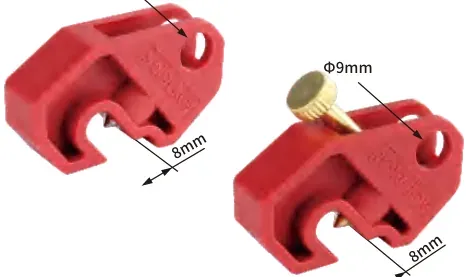 Circuit breaker
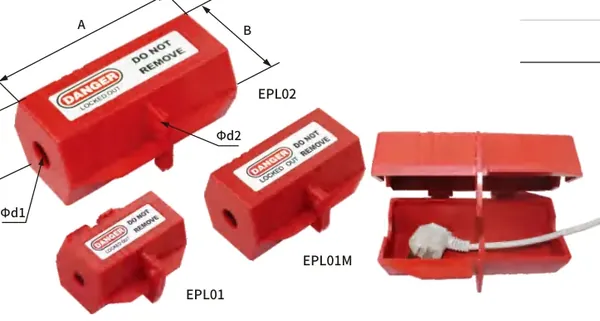 Plug
Plug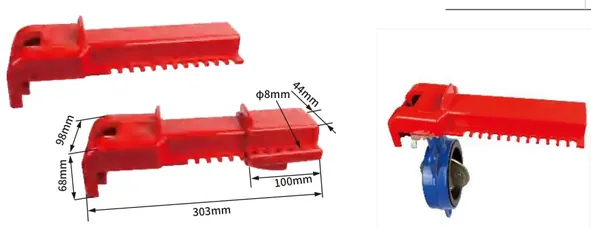 Valve
ValveFrom energy to device
| Energy | Typical isolation point | Device | Before working |
|---|---|---|---|
| Electrical | Circuit breaker | Circuit breaker lockout to match the format | Verify absence of voltage |
| Electrical | Plug or connector | Plug or industrial connector lockout | Verify absence of voltage |
| Electrical | Switch or handle | Switch or handle lockout | Discharge the capacitors |
| Pneumatic | Valve or quick coupling | Valve or air supply lockout | Bleed lines and cylinders |
| Hydraulic | Shut-off valve | Valve lockout | Discharge the accumulator |
| Mechanical | No isolation point | Chock, support or cable lockout | Support or lower the load |
| Thermal or chemical | Valve or flange | Valve or blind flange lockout | Bleed and let cool |
The fourth column is what turns isolation into safety: locking the point does not empty what is already inside the circuit.
When the isolation point takes no device at all
It happens with odd geometries, handles without a hole or valves in unusual formats. Before improvising with cable ties or wire, there are two reasonable ways out.
The first is the cable lockout: a steel cable wraps around the element and is tensioned until movement is impossible, with no need for a dedicated housing. It solves most difficult cases.
The second is the lockout hasp, which besides taking several padlocks on one point serves as an adapter where the available hole will not accept the shackle directly.
What is not a way out is leaving that point unlocked and trusting that no one will touch it. If there is no way to lock it, the isolation point is badly chosen and another one must be found upstream.
Summary
Inventory the energies first, not the devices. Electrical energy almost never travels alone, and the ones that come with it —pneumatic, hydraulic, gravity— are the ones left off the list.
Each isolation point has its device, and the specific format matters: a circuit breaker lockout that does not fit that toggle locks nothing.
Locking is not emptying. Bleeding the air, discharging the accumulator, supporting the load and letting things cool are part of the isolation, not of the paperwork afterwards.
Each family has its own catalogue: circuit-breaker lockouts, valve lockouts, electrical and pneumatic lockouts, cable lockouts and multiple hasps, all in the LOTO safety section.
Frequently asked questions
Do you start from the energy or from the device?
From the inventory of energies. Electrical energy almost never travels alone, and the ones that come with it — pneumatic, hydraulic, gravity — are precisely the ones left off the list.
Which lockout device matches each energy?
For electrical, a circuit-breaker, plug or handle lockout depending on the format of the cut-off point. For pneumatic, a valve or air-line lockout. For hydraulic, a valve lockout. For mechanical and gravity, a chock, support or cable lockout. For thermal or chemical, a valve or blind-flange lockout.
Is locking the cut-off point enough?
No. Locking is not emptying: you have to purge lines and cylinders in pneumatics, discharge the accumulator in hydraulics, discharge capacitors in electrical systems, support or lower the load in mechanical ones and let thermal systems cool.
What do I do if the cut-off point takes no device at all?
There are two reasonable ways out. A cable lockout, which wraps around the element and tightens without needing a specific housing, and a multiple hasp, which acts as an adapter where the hole will not take the shackle. What is not a way out is leaving that point unlocked: if there is no way to do it, the cut-off point is the wrong one and another must be found upstream.